Showing posts with label Military Policy. Show all posts

Thursday, 5 October 2017

The US and Guns

Yet, again the US is subject to another catastrophe, as one of its citizens unleashes the power of the gun to kill dozens of people, and injure hundreds more, apparently with no reason. Yet, again the media frame the discussion in terms of a dichotomy between the liberal hostility to the right to bear arms, and the conservative demand for each individual to own and carry a gun. It is a false dichotomy.

The liberals are quite right to point out that none of the arguments of the conservatives, epitomised by the NRA, suggesting that the individual possession of guns saves lives, stand up. None of those killed in Las Vegas could have saved their lives by having a gun to defend themselves, because their assassin was too far away, hidden, and already unleashing huge firepower against them, with an automatic weapon. It was rather the right of their assassin to own such a weapon that was the direct and immediate cause of them being killed.

But, the conservatives are also right to point out that it isn't guns that kill people, but people that kill people. Numerous recent events show that its not necessary to own a gun to be a mass murderer. The simple use of a car or van to mow down innocent pedestrians is an easy way to kill large numbers of people; the use of explosives can kill and maim large numbers; indeed, we have seen mentally disturbed people who are surgeons kill and mutilate patients, and so on. The argument of the liberals is that instead of individuals having guns, to protect themselves, they should instead rely on the state to provide them with such protection.

But, if you are a young black man, particularly in the US, such a suggestion must ring rather hollow, given the number who have been shot by the police. Indeed, the reason that the US introduced the Second Amendment to its constitution, was precisely because of the recognition of the dangers of an all powerful state, with a monopoly of armed force that could be used against its own citizens. Rather like the citizens of Catalunya, in recent days, the Americans had seen the consequence of their colonial master, the British state, having such a monopoly of force, and so arranged their affairs to try to prevent such a situation arising in their own Republic.

Of course, however, the conservatives only ever quote one bit of the Second Amendment. It does not at all talk about individuals owning guns. It says,

“A well regulated Militia, being necessary to the security of a free State, the right of the people to keep and bear Arms, shall not be infringed.”

In other words, the clear intention is that rather than the state having a monopoly of violence, via a standing army, the citizens themselves should be organised in a citizens militia, as indeed they were organised to fight the British state. Moreover, it is not to be any old rag-tag militia, but a “well regulated militia”, which necessarily means that it be based upon some form of democratic collective organisation, that prevents individuals from holding weapons and acting as mavericks outside the regulation of that militia.

A well regulated militia that is the product of, and under the democratic control of, citizens in each area, and which thereby controls who is a part of it, who has access to weapons, and under what conditions, is clearly a completely different thing, to individuals simply owning guns, and using them outside of any kind of militia, and any kind of regulation. Indeed, such militia exist in Switzerland, for example, where the whole populace are trained in such weapons, and take part in the militia without any of the problems that the US suffers. Engels also recommended a similar approach, as being absolutely necessary, as a corollary to universal suffrage.

“The more workers who are trained in the use of weapons the better. Universal conscription is the necessary and natural corollary of universal suffrage; it puts the voters in the position of being able to enforce their decisions gun in hand against any attempt at a coup d'état.”


Indeed, if we are to protect ourselves, as workers and citizens, not only against the potential for such a coup d'etat by the ruling class, but also against the increasingly random threats of terrorists, the need for such a militia is increasingly obvious. The state can never have the resources based upon a standing army or a standing police force to be able to provide the kind of constant vigilance and protection against terrorist attacks. In fact, the standing army almost by definition tends to be more concerned with acting offensively rather than defensively. The military is based upon weapons useful only to attack other countries, or people in other countries, and that military is most frequently stationed abroad, or on naval vessels patrolling the world's oceans, rather than protecting UK citizens. Separated from the citizenry, in general, the only way that the state can organise surveillance of potential threats is via the use of secret police and security services, which by definition of being secret are largely outside any kind of democratic control and regulation, which makes them immediately a potential danger for civil society.

The US Second Amendment, in calling for such a well regulated militia, does indeed set out the basis upon which both the danger that the state itself represents to civil society, and the danger of external threats can be dealt with via democratic means. Of course, that does not mean that it can prevent every attack. It would not prevent, of itself, the kind of attack seen in Las Vegas. But, if the provision of weapons was limited to only those who were a part of such a well regulated militia, it would drastically reduce the quantity of such weapons circulating in society.

Again, it would not stop someone using a car or van to mow down pedestrians, but the answer to that, in any case, even in relation to road accidents, is that pedestrians and cyclists should be physically separated from the road and vehicles. Moreover, the development of self-driving vehicles will itself remove that problem in the next few years, as vehicles will be prevented from collisions, by their own software. It would not stop people with mental health problems from committing various attacks, but that illustrates the extent to which society needs to devote resources to treating people with mental health problems, rather than as often happens now, leaving such people to fend for themselves. 

The answer to the kind of attack seen in Las Vegas is not to place even greater reliance upon the state, and thereby to strengthen its position as against civil society, but to further strengthen the position of civil society, by creating a democratic and well-regulated citizen's militia. Of course, it will be argued that in some places, that militia may be comprised of unsavoury elements, and fascists. That is the challenge of democracy. It means that we have to win the battle of democracy, it means that everywhere, we have to work to undermine the power of such unsavoury elements, who, in any case, will seek to exert their own power and influence. With over 600,000 members, with millions more within the trades unions and co-operative movement, we have every opportunity to turn outwards to the workers communities, and workplaces so as to win that battle of democracy in every corner of society.

Tuesday, 10 November 2015

A Deterrent Against What?

The media over the weekend used the Remembrance Day commemorations to raise what they consider to be awkward questions for Jeremy Corbyn over the issue of the replacement of Trident, and use of nuclear weapons. However, all it has really highlighted in current circumstances is the question of what Trident is supposed to be a deterrent against.

Has the existence of Trident prevented the attacks of jihadists on Britain, for example? Similarly, did the possession of nuclear weapons by Russia, stop jihadists from blowing up one of its passenger airliners? Did it stop them attacking Russia in Chechnya, and so on? The answer is quite clearly no, and its impossible to see how the possession of nuclear weapons would prevent such terrorist attacks.

Of course, its possible to argue that at some point those terrorists might themselves obtain nuclear weapons. But, what would then change? Who would a nuclear state retaliate against, in the event of a terrorist group using such a weapon? Moreover, the existence of nuclear weapons, in general, makes it more likely that some such terrorist group will eventually get its hands on such a weapon, precisely because of the existence of the technology, the know-how, and the nuclear material required for constructing such weapons.

And, if this was framed in terms of some state falling into the hands of such terrorists and fanatics, its difficult to see how having nuclear weapons of your own, acts as a deterrence. If ISIS had nuclear weapons at the moment, does anyone seriously believe that Trident would act as a deterrent against them using those weapons? These are after all irrational, religious fanatics, who are deluded into a belief that if they die they will go to some mystical heaven, to be feted upon by dozens of virgins. With such nutters prepared to blow themselves up, how can nuclear weapons act as a deterrent?

What is more, a look at history since the existence of nuclear weapons, shows that they have not acted as a deterrent against wars. Since the end of WWII, there has been virtually no year when there has not been a war going on somewhere in the world. Many of those wars have involved in some way, states that have nuclear weapons. The US lost the war in Vietnam, despite its possession of a vast nuclear arsenal. That arsenal acted neither as a deterrent to the North Vietnamese, nor as an effective tactical or strategic resource within that war. The US did consider the use of nuclear weapons, but decided against it, because it realised that it would make them an even greater pariah than it already was, at that time, as well as probably provoking widespread social unrest within the US itself. The US, after all still bears the mark of Cain, for being the only state to have murdered tens of thousands of innocent civilians, as a result of its use of nuclear weapons in Hiroshima and Nagasaki.

The same was true of the Korean War. Similarly, Britain's possession of nuclear weapons did not prevent a non-nuclear Argentina from invading the Falklands. In fact, the money spent on Trident, that could have been used for conventional armed forces, is one reason that today, Britain almost certainly could not have won the Falklands War. On a smaller scale, in the 1970's, Britain's nuclear 'deterrent' acted as no deterrent at all even against tiny Iceland, during the “Cod Wars”.

The fact is that nuclear weapons act as no deterrent for any such military actions. They are an expensive piece of state conspicuous consumption, much like were the pyramids of the Pharaohs. As far as Trident is concerned, no one is surely deluded enough to believe that it is in any sense an “Independent” deterrent, because there are no conditions in which it would be used without the prior approval, and probably even request, by the US and the rest of NATO. Similarly, there is no reason to believe that a UK inside, or out of NATO, could be attacked by nuclear weapons, without the United States and NATO responding, because if things were at that stage, a nuclear attack on Britain would represent just one part of a global conflict, in which the strategic interests across the globe of the United States were being seriously threatened.

Jeremy Corbyn has been criticised for saying that he would not use Trident, even if it existed. The basis of the criticism is that its deterrent effect comes from the fact that a foreign power does not know whether it would be used against them. However, as indicated above, in all of the actual current situations, where Britain not only could be, but is under attack, and has been under attack, the possession of nuclear weapons has provided no such deterrence, because the presumption, quite correctly of the combatants has been that those weapons would not be used, rather than that they would be used.

In purely military strategic terms, and this is a point that many in the army itself put forward, the money spent on a nuclear deterrent that is never likely to be used, would have been far better spent on conventional defence forces, to deal with the actual threats posed by jihadism and other terrorist organisations. For a consistent democrat, those resources would be better used, as, for example, in Switzerland in the development of a Citizen's Militia, and real defence. In fact, as Engels long ago pointed out, a consistent democracy is impossible without such a militia and universal military conscription.

“The more workers who are trained in the use of weapons the better. Universal conscription is the necessary and natural corollary of universal suffrage; it puts the voters in the position of being able to enforce their decisions gun in hand against any attempt at a coup d'état.”

( The Prussian Military Question and the German Workers' Party)


And from a social-democratic standpoint, the money spent on nuclear weapons is a complete waste, a drain of vital resources out of surplus value that could be used for the expansion of productive-capital. The sectional trades union interests being expressed against scrapping a renewal of Trident, are understandable, in the very short term, because they imply a loss of jobs in shipbuilding and so on. But, in the longer-term, even in those narrow sectional terms, the money wasted on Trident makes no sense. The expense of Trident is financed out of taxes, which is revenue deducted from surplus value, but it goes to no accumulation of capital, and so no longer-term increase in employment or wealth.

Put simply, if £30 billion goes into the construction of additional factories, machines, and employment of workers to produce, cars, kidney machines, or other commodities, then that capital produces profit, as a result of the workers employed creating surplus value. In turn that means that additional factories, machines and workers are put to work and so on. But spending £30 billion on a Trident submarine does none of that. The submarine simply slinks around the oceans, soaking up even more potential productive-capital, as a result of its running costs.

Moreover, as the Lucas Plan showed, the alternative is not just to produce weapons of war or nothing. Here and now, workers can follow the example of the Lucas workers from nearly 40 years ago, and create their own alternative plan for the conversion of useless arms production, into useful production to meet society's needs.

Corbyn and the Labour leadership, need to ensure that the Labour Party is turned outwards and away from esoteric internal debates and manoeuvring, towards campaigns for such alternatives that can bring in groups of workers, trades unions and others across a wide spectrum to debate such alternatives, which would create the basis for winning over the respective trades unions and their members to a policy of replacing the money spent on Trident with a programme of useful social investment.

Tuesday, 7 December 2010

CPGB Cuts Strategy Falls Between Scylla And Charybdis - Part 3

Mike says,

“We need broad mass unity to fight them. But if this broad mass unity is to require the far left, which in theory does advocate the overthrow of the existing capitalist system, shutting up about this for the sake of unity, and serving as bag carriers for those who advocate national solutions, it is actually a waste of time. It is true that people may be mobilised and so forth. But at the end of the day it will not prevent the cuts or result in the political defeat of the cuts project. It will be mere protest, ultimately ineffective: what columnists in The Times and The Daily Telegraph are calling 'nostalgia for the 1970s'.”

As an attack on those who simply want to build a broad movement, for the sake of it being broad, I'd agree. If the only purpose is like say the Stop The War Coalition, to hold bigger demonstrations, and shout political slogans, and recruit the odd person to one of the sects then again I'd agree. But, actually the problem with STW was not that it didn't have a program that dared to call for the overthrow of Capitalism as the only means by which to stop imperialist wars, but that it didn't have any program to offer people short of that other than yet another demonstration. What it really needed was a program like that I set out in Proletarian Military Policy, and people committed to building such things as neighbourhood policing from which could be developed the idea of defence squads and a militia in place of a national army stationed in other people's countries. What it needed was work to be done that could be linked into developing Workers Co-ops with alternative production to replace armaments. What it lacked was a campaign to win democratic rights for the armed forces, for a programme of democratic demands to elect the military top brass, for open diplomacy and so on – which we should advance now by building a campaign of mass support for Wikileaks. Just how much even a committed individual can achieve under the right conditions in that respect was shown by Tom Wintringham, as I set out in "Proletarian Military Policy".

It is not at all clear to me that, whilst I would not favour Popular Frontist politics, to limit the calls for the overthrow of Capitalism, how such calls have any immediate relevance to the need to fight the Cuts here and now. And, if not, why focus on that rather than attempting to build a broad movement that actually fights the Cuts in practice, by mobilising around individual struggles with a programme of limited reforms that ARE capable of being won. That was Marx's approach in the development of the Programme of the First International, and of the French Socialists, for example. Of course, Mike, can't do that, because he does not believe that any such reforms can be granted by Capital, because his catastrophist view insists that there is no way out for Capital from its global crisis other than to force these Cuts on to workers. In essence his message has to be revolution or nothing.

So for example, he writes,

“Looking forwards from where we are now, our aim is a mass campaign. It is not about small campaigns or about 'thinking global and acting local', and it is not about focusing on one particular campaign for a particular hospital or school which is being closed down and so on. In this cuts process, partial victories on single services which do not break the framework of the budget cuts would be like workers in a car factory winning no redundancies in the paint shop - on the basis that the same number of people would be made redundant on the assembly line.”

But, this is a false dichotomy. Marxists would not put forward a proposal to save jobs in the paint shop at the expense of jobs elsewhere, but if paint shop workers took action they would support them. As I have argued in relation to the Lessons Of UCS, the workers victory was limited, and was won at the cost of jobs in other shipyards. But, that would be no reason to not support such a struggle. The job of a Marxist would be to intervene in it to try to provide a basis for overcoming those limitations. As I suggested, it was a mistake for the workers to have seen their salvation in a State takeover, having already gained possession of the means of production themselves. Had workers established a Co-operative, and demanded the same level of support that private firms were receiving from the State, then they could have overcome that particular limitation. Of course, Mike McNair is right that no real solution on an individual basis is possible, but even a thousand mile march begins with a single step! Having taken over UCS, the workers there would have needed to link up with workers in other Co-ops, and private firms. They would have had to propagandise and physically assist workers in other shipyards to follow their example, not just in Britain, but at least throughout Europe where similar problems were being faced. Would this mean that no workers jobs would be lost? Probably not, but that is merely a reflection that we cannot achieve everything all at once, and that so long as Capitalism exists the conditions that lead to uncertainty and periodic crisis will remain. It is the growing consciousness of that reality, which forms the basis of driving workers forward to a more general solution, and the need to secure for themselves political power.

The same is true now in relation to the Cuts. If a School, or Library or Sports Centre is threatened with closure, it is no point saying to the workers employed there, or the workers who use it that their problem can only be solved on a macro level, by resigning themselves to being part of a mass movement, which is committed to attacking the underlying causes of the Cuts. That is to ask them to wait for the revolution, when what they really need is an immediate partial solution. We do have to recommend that here and now the solution is to occupy that school, library or sports centre, to establish workers control over its continued operation, and to establish a support committee for it from within the local community and users to defend it. From that point forward we can begin to outline the implications of that, what would be necessary to successfully defend it, by linking that struggle into the struggle to defend wider services etc. And starting from the lessons that Marxists can provide from previous struggles in that process, we also know that workers themselves will develop new tactics, new methods of struggle, new solutions, that Marxists themselves will learn from. That is praxis. Indeed, the method by which the necessary programme and tactics will develop, will be precisely from the generalisation of lessons learned in these individual struggles, the basis of the mass movement, its real strength and democracy can only flow from the ground upwards by building these individual local struggles, and linking them together. Moreover, we know from experience that any attempt to build from the top down could only be on the basis of action by the existing sects, and all we know demonstrates that such an approach is already doomed, because even now these sects main concern in such activity is to push forward their own interests, their own desire for “party building” over and above the needs of ordinary workers. The demand for creating mass united national campaigns is just a continuation of the sectarian Left's obsession with political debate and point scoring, with manoeuvre and party building, rather than getting their hands dirty with the day to day practical activity of working alongside ordinary workers – many of whom hold ideas that are anathema to that Left, and make it shy away – to provide immediate practical solutions to their problems. A mass united national campaign would be great if it is the product of ordinary workers themselves. It cannot come from the sects, which are a part of the problem, not part of the solution. It is not that within the sects there are not many genuine, committed revolutionaries, but that the sects turn them into automatons, unable to think independently, and like Sisyphus, emroiled in an endless and pointless round of activity, of paper selling, attending meetings, and parroting the party line at every opportunity. In the 19th Century when workers were beginning to recognise the need for their own Party in England, Engels told the Marxists to avoid these sects such as the ILP, and the SDF, and instead to go straight to the ordinary workers. That is what Eleanor Marx did. They went straight to where the ordinary workers were in the Liberal Clubs, and it was via this activity, and building support for a Labour Party in the Trades Unions that the LP was created. We have a similar situation today. It is necessary to give the sects a wide berth, and go straight to the workers in their communities, in the Labour Clubs and Workingmen's Clubs, on the shop floor, in the Branch Labour Parties, and in the individual struggles of those workers.

But, when Mike says,

“It is not that the alternative to this is a 'hard left' campaign. What we want to see is a democratic campaign, which means that the national organisation and leadership has to be based on delegates from the united campaigns in the localities and be answerable to them. To put it in a rather crude way, imagine that the local cuts campaigns are soviets and the central campaign is a congress of soviets”,

this does not fill me with confidence either. Just read Trotsky's account of the Soviets to see how undemocratic they were.

“There were over 150,000 soldiers in Petrograd. There were at least four times as many working men and women of all categories. Nevertheless for every two worker-delegates in the Soviet there were five soldiers. The rules of representation were extremely elastic (I’ll say AB), and they were always stretched to the advantage of the soldiers. Whereas the workers elected only one delegate for every thousand, the most petty military unit would frequently send two. The grey army cloth became the general ground-tone of the Soviet.

“But by no means all even of the civilians were selected by workers. No small number of people got into the Soviet by individual invitation, through pull, or simply thanks to their own penetrative ability. Radical lawyers, physicians, students, journalists, representing various problematical groups – or most often representing their own ambition. This obviously distorted character of the Soviet was even welcomed by the leaders, who were not a bit sorry to dilute the too concentrated essence of factory and barrack with the lukewarm water of cultivated Philistia. Many of these accidental crashers-in, seekers of adventure, self-appointed Messiahs, and professional bunk shooters, for a long time crowded out with their authoritative elbows the silent workers and irresolute soldiers.

“And if this was so in Petrograd, it is not hard to imagine how it looked in the provinces, where the victory came wholly without struggle.” (Trotsky – History of the Russian revolution pp234-5)


Anyone who has been involved in such organisations will recognise this picture. Under the cover of building “Rank and File” organisations in the Trades Unions, for example, the mainstay of activity of the Left Sects has been a form of electoralism to get themselves elected to leading positions, or to get various motions passed at Conferences way out of proportion to their actual support amongst rank and file memberships, whilst the real job of building rank and file movements at the shop floor level, capable of responding immediately to managements, has largely gone by the board. The same kind of electoralist activity is what characterised the role of the sects within the LP, and it was the removal of the possibility to continue that activity, and need to actually build something meaningful at the base within working-class communities, which caused them to leave in search of a cosier environment in which to debate.

Back To Part 2

Forward To Part 4

Friday, 23 July 2010

The Politics And Programme Of The First International - Part 8

10.
Armies


[French and German subtitle reads: "Standing armies; their relation to production."]

(a) The deleterious influence of large standing armies upon production, has been sufficiently exposed at middle-class congresses of all denominations, at peace congresses, economical congresses, statistical congresses, philanthropical congresses, sociological congresses. We think it, therefore, quite superfluous to expatiate upon this point.

(b) We propose the general armament of the people and their general instruction in the use of arms.

(c) We accept as a transitory necessity small standing armies to form schools for the officers of the militia; every male citizen to serve for a very limited time in those armies.


I have already covered much of this topic in my blog Proletarian Military Policy. I will, therefore, restrict my comments to a basic summary of the background to the position set out here.
The idea that Marxists should not be interested in questions of how their own bourgeois state organises in this manner can be countered simply by referring to Engels excellent pamphlet The Prussian Military Question and the German Workers' Party where he makes this statement that would be anathema to today’s pacifists of the Left,

“Universal conscription — incidentally the sole democratic institution existing in Prussia, albeit only on paper — marks such an enormous advance on all previous forms of military organisation that, having once existed, even if its implementation left much to be desired, it cannot again be permanently reversed. An army today must be based on one of the two clearly defined systems: either the recruitment of volunteers — which is antiquated and only possible in exceptional cases such as England — or universal conscription. All conscriptive systems and ballots 33 are after all no more than very imperfect forms of the latter. The basic idea behind the Prussian law of 1814 is that every citizen who is physically capable of bearing arms thereby has the obligation to do so personally in defence of his country, during his years of military fitness; this basic idea is far superior to the principle of purchasing substitutes which we find in every other country having a conscriptive system, and having existed for fifty years it will undoubtedly not succumb to the bourgeoisie's burning desire for the introduction of the "trade in human flesh", as the French call it.

However once we accept that the Prussian military system is founded on universal, compulsory service without substitution, the only way it can be further improved without its own spirit being breached is for its basic principle to be put increasingly into practice. Let us consider how things stand in that respect.”


Engels goes on to take the opportunity of pointing out how the workings of Capitalism meant that large numbers were unfit for service, but also says in relation to draft dodging,

“All that is needed is to insist strictly and without mercy that men who have avoided recruitment should make up the time afterwards, and then the whole rigmarole of harassment and paperwork would be unnecessary and there would be more recruits than previously.”


Again pointing to the inefficient means by which the Capitalist state dealt with this issue.

He makes clear why for a socialist this is important.

“Whether reorganisation means some slight increase to the military burden or not, will make little difference to the working class as a class. On the other hand it certainly cannot remain indifferent to the question of whether or not universal conscription is fully implemented. The more workers who are trained in the use of weapons the better. Universal conscription is the necessary and natural corollary of universal suffrage; it puts the voters in the position of being able to enforce their decisions gun in hand against any attempt at a coup d'état
The only aspect of army reorganisation in Prussia which is of interest to the German working class is the increasingly thorough Implementation of universal conscription.”


Once again demonstrating how far Marx and Engels were from today’s Statists who masquerade as Marxists, Engels adds,

“It seems that the most advanced workers in Germany are demanding the emancipation of the workers from the capitalists by the transfer of state capital to associations of workers, so that production can be organised, without capitalists, for general account; and as a means to the achievement of this end: the conquest of political power by universal direct suffrage.”

This is another example of the attitude adopted earlier by Marx in relation to Education. We are not where we want to be, so we have to start from where we are. In the same way that Capitalism provided workers with the training and discipline, as well as the economic forms, Co-operative production and credit, which were the basic requirements for creating Socialism, so by providing universal training in the use of weapons it provided workers with the very simple method of enforcing their decisions made via Universal Suffrage, in the face of attempts to frustrate those decisions by the bourgeoisie. If only the Chilean workers under Allende all had weapons, all had had military training!

No wonder the bourgeoisie has adopted the method of creating for itself small, professional standing armies, only resorting to general conscription at times of extreme external threat. As Marx points out above, developing a Militia, is not something that can be developed overnight. The general arming and military training of the population, facilitates such a development, and means that a corps of workers can be developed with the necessary skills to be able to act as trainers for workers in such a militia, and to form its “officer corps”. In the US, the Constitution specifies the right of every citizen to bear arms, as part of a well-regulated militia, and many other countries have militia. In fact, the organisation of workers in their workplaces, and communities, facilitates the development of not just a militia, but of neighbourhood policing groups, defence squads etc. which can make the task of policing neighbourhoods, effectively combating crime and anti-social behaviour, a normal social function for all citizens.

Sunday, 11 July 2010

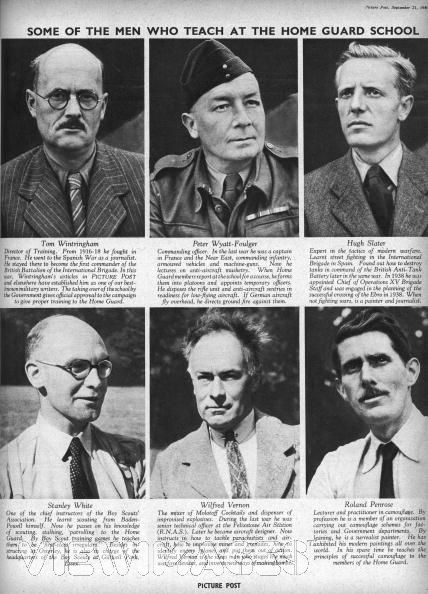
The Home Guard 70 Years On


This year marks the 70th Anniversary of the establishment of the Home Guard. The BBC has reported that it is being marked by a number of events such as archaeological work at Osterley Park, where the Home Guard trained its members. Part of the Transitional Programme echoes the US Constitution, which guarantees the right to bear arms as part of a well-regulated militia, and calls for the establishment of a Workers' Militia. Engels also favoured Universal Conscription, which he said was the necessary concomitant of Universal Suffrage. The history of the establishment of the Home Guard is important for socialists in all these respects, and more. It owed its establishment ot the work of one Communist – Tom Wintringham.


During the 1930’s repeated demands had been raised, by Tom Wintringham, for Britain to introduce adequate Air Raid Protection (ARP) measures. Wintringham had been a founding member of the British Communist Party. On the outbreak of the First World War he had given up his studies at Oxford University and signed up for the Royal Flying Corps. His politics are somewhat eclectic. Long before the policy was adopted by the Comintern he argued for cross class Popular Fronts. But, Wintringham also seems to have developed, fairly early on, some unease at the polciies being adopted by Stalin, and his Popular Frontism seems also to have been driven by a concern that change should be driven from the bottom up, rather than from the State down, as his later political activity demonstrated.

In the 1930’s he went to fight on the Republican side in the Spanish Civil War, and became the Commander of the English Battalion of the International Brigade.

See: Wintringham .

There he learned guerilla tactics, and as WWII loomed he argued not only the need for ARP measures, but also that the British people should be trained in such tactics to fight against any invaders. He argued strongly in favour of the Local Defence Volunteers (LDV), which was to become the Home Guard. But, when the LDV was first established it was a haphazard affair, much like the portrayal in “Dad’s Army”. Wintringham was brought in to organise proper training at Osterley Park.

See: Wintringham and the Home Guard .

Wintringham worked for the Picture Post, and when the film “The Life and Times of Colonel Blimp” was made it was Wintringham whose role was portrayed. Osterely Park was established not as a Government facility, but a private facility by the Picture Post.

See: Picture Post

Ironically, although a large part of the initial organisation and training for the Home Guard is attributable to Wintringham, he was not allowed to join it himself, because he was a member of the Communist Party!!!!

In Spain, Wintringham had an affair with an American Trotskyist, Kitty Bowler, who became his wife. His refusal to leave her led to his expulsion from the Communist Party. Wintringham’s political trajectory then led him to advance positions close to what would today be called Libertarian Socialism. His Popular Frontism led him into an alliance with Liberals, and together with J.B. Priestley he set up the Commonwealth Party, which sought to advocate politics based upon Co-operation. Having said that, at a time when the LP itself was in a Popular Front, National Government with the Tories, and the Communist Party was banned, the Commonwealth Party, did stand candidates in elections against the National Government candidates, in order to provide a socialist choice for workers, and did achieve some degree of success.

See: Commonwealth party

For more information on Wintringham and his writings see:
Wintringham Index

and

Tom Wintringham .

See Also:proletarian Military Policy

Friday, 18 June 2010

Clegg "Blooded"

We expect bourgeois politicians to be unprincipled, but, as professionals, the one thing they shouldn't be is inept. New Labour showed a significant degree of ineptness - accepting money from bernie Ecclestone, then exempting F1 from the ban on cigareete advertising; the 75p rise in Pensions; the abolition of the 10p tax rate. All are examples of actions, which unnecessarily drew criticism, and a subsequent loss of support. The announcements yesterday by the Liberal-Tory Government of a series of measures cutting programmes previously agreed by Labour are of the same order.

Some of the decisions seem just petulant. A number of hospital building programmes were agreed, but one for Hartlepool in deep Labour territory was scrapped, despite promises by the Tories and liberals prior to the election. None of the measures cut amount to a hill of beans in terms of the total amounts the Government proposes to cut, and so why these particular programmes is at first hard to fathom. Its one thing to simply reduce future spending that no one had been expecting, but to cut programmes that people had already thought had been agreed is to invite opposition.

The highest profile was the decision to scrap the £80 million loan to Sheffield Forgemasters, a decision which has already provoked the understandable reaction of workers within the City. The decision seems perverse. On Newsnight, last night, the Government did not even put up a Government Minister to defend the decision, but instead put up an old Thatcherite MP, Michael Fallon. His argument was ridiculous on a number of counts. Firstly, the Government line has been that these cuts were necessary because the books were worse than even they had thought they were. That is an obvious statement that any new Government is going to make to blame the previous Government. The trouble is that over the last few months the official data has been showing that actually things were BETTER than had previously been expected. To make that worse for the Government, the new Office of Budget Responsibility that they have set up as an independent assessor of how the Public Finances stand, has confirmed that view. The Government said it needed this £2bn of cuts, because they had found a further black hole, but the OBR had already said that actually the finances were £30 billion better than Alistair Darling had assumed in his calculations!

Worse, he repeatedly spoke about this not being sustainable because it amount to being a cost of half a million pounds per job. But, there was no such cost. It was n't a grant to the company, but a loan at a 3% rate of interest. Rather than it costing the Government money, they would have been receiving money from it! Rathger than there being a cost per job, there would have been income per job. That is before you consider the income that would be received in Tax from wages and profits, and so on. If this is the mathematical skills of the new Government let alone its grasp of Economics it does not speak very well for the prospects for the future! The decision seems perverse for another reason. The Government like Labour has spoken about the need to rebalance the economy to promote manufacturing, as well as to shift reliance in places like Sheffield, from the Public to the private Sector.

This is a company, which with assistance from the previous Government had done a deal with the giant US Westinghouse Corporation to produce equipment for the latest generation of nuclear power stations. Everyone knows that in thye coming years Governments in Europe, and around the world will be increasing their investment in such new nuclear power stations in order to meet their carbon reduction targets. This was an opportunity for an efficient British company to become a world leader in this technology, in a high value added sector, employing skilled labour. It is precisely the kind of industry Britain needs to develop to compete on the world market, and if British workers are to have any chance of avoiding a huge drop in living standards as they compete in the world market with low wage economies in Asia and elsewhere. For the Tories to withdraw this loan, to save just £80 million now, that they would have got back with interest seems inexplicable. But wait.

At first glance another factor also seems inexplicable, perverse, and inept. Sheffield is also the City in which Deputy Prime Minister, Nick Clegg is MP. Why would he shit in his own back yard? Remember another one of the Tories election promises - they promised to bring back fox hunting, one of the favourite pastimes of the Public School brigade whose members make up a large number of the Government benches. In Fox Hunting they have a ritual in which the young aristos, and aspiring nouveau riche kids, are inducted on their first hunt by being "blooded". That is they are daubed with the blood of the first fox killed. It basically means that they are no longer just along for the ride, but are as blood soaked as all the other chinless wonders. Clegg has been "blooded". By making this cut in his City, Clegg is now irrevocably tied to his Tory masters. He cannot claim, "it was all their fault Guv." The workers of Sheffield have been sacrificed on the high altar of Tory-Liberal ritual, in order that Clegg could be inducted into the club. That is no surprise, the workers are always the ones asked to pay the price for the rituals, dogmas, and adventures of the ruling class, from just an economic price to the price of their lives sacrificed on the battlefield when the ruling classes engage in some new pointless war.

Labour Leaddership hopefuls have begun to stand up verbally to the Tories assault. That is good. It would be more believable had they been standing up for workers over the last 13 years too. But, the fact they are standing up now is a start, and something that we can use. We need more than bold words from them, we need actions. After 1979, Michael Foot led massive marches in Cities around the country to oppose the Tories cuts, and attacks on workers. During that period Labour soared to over 50% in the opinion polls. We should demand these Labour leadership candidates do at least the same now. But, more than marches are needed. We need action committees in each area to resist the Tories plans. The government says, it wants to consult the people on what to cut. Let's take them at their word.

Local Labour parties and trades Councils, should immediately be organising local Conferences to discuss what we think should be cut. Here are some initial suggestions.

1. The Queen wants a 15% pay rise. The Tories say "We are all in this together." Okay then, instead of a pay rise, scrap the Civil List payments to the rich, royal scroungers, and let them pay their own way. Better still scrap the Monarchy altogether.

2. The Tories propose to cut Public Sector worekrs wages. Start at the top. All Public Officials, from MP's, to Judges, to the Military Top Brass to be only paid the average wage.

3. The Liberals argued in the election that they could pull in billions by collecting unpaid tax by the rich. Properly staff the tax offices so we can get in the estimated £120 billion in tax unpaid by the rich and big companies.

4. Scrap Trident. Again the Liberals said they would, so let's hold them to that.

5. Pull all the troops back from abroad not just from Afghanistan. Defence is one thing, but why do you need to be occupying other people's country for defence? Then we would need need all those billions of pounds worth of ships, aeroplanes, and so on either. We could sell them off to pay down the debt. The workers now employed building such useless things could be employed instead to build hospital equipment to treat the sick. And, if we really were concerned with defence that could be done by concentrating resources on developing an effective militia, with universal conscription into it.

6. Similarly, the Tories and liberals propose bringing in some democracy to the Police Force. But, the most democratic police force, would be one in which the whole population participated, in the same way that people participate in Jury Service. Everyone could be organised into local groups to police their own neighbourhoods, and each local group could employ its own specialists. That would save a fortune. If the rich and the bosses want a police force to protect their property, and to break strikes like they did against the Miners let them pay for it themselves, not have the cost covered by workers in their taxation to the bosses state.

7. The Tories say they are in favour of Co-ops to run Public Services. So am I provided those Co-ops have real control, provided workers in local communities can determine the level of service they want subject to national minimum requirements. But, in things like the NHS private companies rip them off big style inb payments for drugs, equipment and so on. If we are to have Co-ops to run Public Services, we should equally have Co-ops to run these private companies. There is £800 billion now in workers Pension Funds. Give us the basic right to demcoratically controlo those funds, so that we can take over the biggest, most important, strategic companies in the country and run them as Worker Owned Co-ops.

Now is the time to take the the fight to the Liberal-Tories. Now is the time for the labour leadership candidates to prove they are worth consideration.

Sunday, 20 September 2009

Cut & Run

In the last blog, I argued that the kind of draconian cuts, in Public Spending, being discussed at the moment, make no economic sense for British Capital. They probably make no political sense either, except that the parties have entered a Dutch auction around what they perceive as being a popular idea – actually recent opinion polls show it isn’t. Whatever happens, the very fact of the discussion of such cuts, in services so important to workers, should provide us with the lesson that we cannot afford to allow the bosses or their state to run them!

Pensions

For the last 100 years, the bosses, via their state, have been robbing money, from our wages, by law, in Tax and N.I., supposedly in order to provide us with a Pension. The bosses state is the Monopoly supplier of this pension. In fact, its like the old system of Truck, where bosses used to similarly take money from workers wages to cover the cost of their accommodation in company housing, or would pay them in tokens, that could only be redeemed at the Company owed shop.

Like the Truck System, it disempowers workers, from obtaining the best deal, forcing them to accept whatever terms for their Pension, the biggest Capitalist Monopoly of all – the State – chooses to offer them. The consequences of that are what you would expect. For decades after the State Old Age Pension was introduced workers paid N.I. and taxes for it, but did not live long enough to draw it!! Those who did only received a pittance. It was a bit like a Mafia run, protection racket.

Yet, in the 19th Century, workers had not only created their own Trade Unions to cater for their needs, but had created Friendly Societies, through which they could collectively build up their resources to cover such things as Unemployment, Sickness and Old Age. These Societies, by using the workers small savings collectively, could turn them into Capital, which is what Marx had suggested was necessary if workers were to break free from their condition. They could be used to finance Co-operative production, or the buying up of Capitalist firms, and the profits from that activity would then cover the workers needs in relation to those Benefits. It would provide not only a much greater return on their savings than the scant unemployment provision, or the Pension most workers never lived to collect, but also strengthen the economic and social position of workers. Its no wonder Capital keen to undermine such a development by introducing State run schemes, and thereby robbing the workers of the resources they could have used more effectively themselves.

Of course, Social Democrats sold the idea on the basis of it being a means of redistributing wealth and income. But, in 100 years of Welfarism, no such redistribution has occurred. On the contrary, the gap between rich and poor has widened. As Eric Hobsbawm says, in “Industry and Empire”, all that Welfarism has done is to transfer money from one section of the working class to another section of the working class. In doing so, it not only wastes huge sums of money collecting and redistributing that money in taxes and benefits, via a vast bloated State bureaucracy, but it necessarily sets up conflict between those workers from whom taxes are taken, and those to whom benefits are paid. Its no wonder the Tories and Right-wing media are able to whip up hatred and division within the working class on that basis.

With no effective control over the bosses state, whenever it decides it is in the interests of Capital accumulation, the first place it turns is to these Benefits and pensions. The Tories broke the link of Pensions with wages knowing that the RPI grossly understates inflation, particularly for Pensioners. Gordon Brown offered pensioners an increase of 75p a week!!!

Now, as workers actually begin to live long enough to receive their pensions, and perhaps have a few years of active life to enjoy them, the response of the bosses state is predictable – it wants to raise the retirement age to 67 or even 70. The bosses and their state argue that because workers are living longer, and the costs of maintaining this older population are rising workers need either to pay more into their pensions, or draw those pensions for a shorter time, or both.

They lie. The retirement age was set at 65 decades ago, when life expectancy was around 70 on average. Life expectancy now is only around 80, or 10 more years of life. According to this study from the - TUC workers output in Britain rose by 69.6% in the last 30 years alone. (See Page 4) On average productivity has been rising by more than 2% a year. Put another way a 2% increase in productivity compounded over 100 years means that each worker produces more than 7 times what they produced back then. Okay, workers consume more of the things they consumed back then, and consume a wider range of products, but even allowing for that the increase in productivity means that rather than extending the working life, there is scope for it to be cut considerably. Just taking the 69.6% figure for the last 30 years means that the original 5 years of retirement could be extended to almost 9!

It is not that workers are not producing enough wealth to cover their retirement, it is that Capital consumes more of the wealth we produce. The money that the bosses rob from us via their state, in taxes and N.I. on the pretext of providing for our needs, goes instead to finance its own activities like the Bank bail-out, or the wars in Iraq and Afghanistan, or to buy nuclear weapons systems, or to finance the waste and corruption of the bloated state bureaucracy.

Both the Tories and labour claim that cuts will be needed, yet both remain committed to spending billions on replacing Trident! We cannot afford this State run Truck system and protection racket any longer, which forcibly takes money from our wages for something many of us will never receive, and for those that do, is continually under threat and subject to uncertainty.

Already workers have close to £400 billion in their own Pension Funds, which again they have no control over, and which is used in the interests of Capital, and against the interests of workers. The Trade Unions should launch a campaign demanding that workers be given total control over their own money in their Pension Funds, through democratically elected Boards. That is a basic bourgeois democratic right. Indeed one of the fundamental principles of Capitalist law and ideology is that individuals should have the right to dispose of their own property. Yet that basic right is denied to millions of workers! The Trade Unions should work with the Co-op Bank to establish a Workers Co-operative Pension Fund to manage the workers money, to which all of these private pension funds should be transferred, thereby using the expertise within the Co-op sector rather than relying on the “City” Fund managers. I addition, a calculation should be done of how much money should exist within the N.I. Fund to cover Pensions given workers tax and NI payments from their inception, and the actual payments made, so that this could be also transferred into such a Workers Fund, and enabling workers to then make their N.I. payments to this fund under their own control rather than to the bosses state.

Combined this would give workers close to £1 trillion immediately to invest, enough to buy up lock, stock, and barrel the majority of FTSE 100 companies, thereby drastically transforming the workers economic and social position overnight.

Health & Social Care

I’ve already slagged off the inadequacies of the State Capitalist NHS, and its poor provision for the needs of workers in previous posts such as US healthcare, The NHS and the Left , and Healthy Debate , so I don’t intend to add to that here. Instead, I intend to focus on practical alternatives that could be adopted here and now. After all, its not possible to simply roll out a workers alternative to the NHS overnight. In part, I’m motivated by a recent discussion on Charlie McMenamin’s Blog , and partly on my own experience relating to my Mother, as well as drawing on some of my experience from my former role as Vice Chair of Staffordshire County Council’s Health Scrutiny Committee.

Not only is Social Care likely to be one of the first areas looked to in relation to any cuts, but it is an area that has already faced on going cuts over the last few years as the cost of caring for an increasingly aged population rises. Council run Care Homes have been closed, old people have been encouraged to remain in their homes, and children have been encouraged to look after their parents. In fact, one of the Working Groups of the Health Scrutiny Committee whilst I was Vice Chair looked at the number of kids – some as young as 8 – who were fulfilling roles on a more or less full-time basis as Carers for their parents. In truth we do not know how many kids are fulfilling this role, but the known figures themselves are pretty shocking.

Moreover, whether a Care Home is for Children of for the Elderly both involved taking residents out of their existing environment and placing them in alien surroundings. For elderly people, not only do they face losing the familiar surroundings of their home, but all of the generations of friends and acquaintances that have been built up are taken away too. New friendships often arise with other residents, but it is not the kind of disruption an elderly person needs at a time in their life when they can feel generally uncertain. As repeated stories continue to demonstrate care is often not what it ought to be. I was continually shocked at the Monthly Reports that were presented to the Social Services Committee that set out just how little if any education was being received by children in the County’s Care homes, often no more than a few hours a week, frequently none at all. And when myself and the Chair of the Committee did eventually force the Department to do something, that something ended up to be just to appoint yet another well-paid bureaucrat to look into it, with no improvement in subsequent months as a result!

In both Council run and Private Residential Care homes workers are low paid, and with low status difficult jobs to perform. As a consequence they are usually understaffed with a consequent effect on care for residents. Even basic care is often lacking let alone the kind of encouragement to engage in stimulative activities that both the elderly and the underprivileged child requires. Councils are not even allowed to run Nursing Homes, but Councils do finance the Residential Care component of such accommodation. The Health Care component is also supposed to be covered in the same way that a stay in a hospital bed is free, but reports continue to abound about people being charged for what appears to be Health Care, especially where they have their own resources such as a house that can be sequestered.

Yet, in some ways this clearly provides an opportunity for workers. In a situation of a Co-operative scheme or a Co-operatively managed estate, there is no reason why the Co-operative could not establish its own Residential Care homes – for both Children and for the Elderly – to provide Social Care on a Permanent or Respite basis. As in the case of Private Nursing Homes and Residential Care homes it would then be able to negotiate with the Local Authority to cover the cost of residents stay. It would also mean that residents could remain in their own Community, and maintain their relationships with friends and acquaintances.

A couple of years ago my son made a film for the NHS and Stoke City Council about Bradeley Retirement Village , which gives some idea of the kind of facilities that could be developed. He was really impressed with what he saw such as one young woman who was confined to a wheel chair, but who within weeks of entering the village was taking part in organised activities including absailing!!! Stoke Council and the NHS also have another such village in Berryhill, and another in progress at Meir. But, bringing such functions under workers ownership and control via Housing and Estate Management Co-operatives can develop and protect them against the potential for future cuts, as well as ensure that they are open to a wider range of people including those totally dependent on Benefits.

Moreoever, as will come to later in talking about Education, by being a part of a Co-operative Community that has ownership and control of a wide range of assets and facilities, residents can also be encouraged to participate in a wide range of activities to keep them physically and mentally active. For example, they could make use of Health and Fitness Facilities at Sports Centres, which could be extended to include suitable spa and physio facilities. They could take advantage of educational facilities within Community schools, whether it be a simple use of the library, to use of computers, or additional learning. Not only would this benefit them, but it would enrich the learning experience of children too, as well as possibly reducing levels of anti-social behaviour in the classroom.

But, there are many other similar developments that could be made. Last week my son went to have some skin tags removed. He didn’t go to the Doctor he had them removed at the local Co-op Pharmacy. Increasingly, Pharmacies are undertaking such minor medical work taking the strain off GP’s. The fact that this was a Co-op Pharmacy demonstrates the potential. I have argued in the past that we should all be members of the Co-op, and campaign for the idea of setting up Management Boards for each Co-op Shop, made up of members from the Community in which its situated. The same applies to Co-op Pharmacies. That would immediately give workers a direct ownership and control over a growing area of healthcare within our communities.

But, as Pharmacies are taking on work previously done by GP’s, so GP’s are taking on work formerly done by Hospitals and Clinics. In Stoke there is already a Doctor’s Co-operative that provides locums, and out of hours facilities for other GP’s. But, given the nature of healthcare such Co-ops should not be just producer Co-ops – I have no idea of the politics of the GP’s involved in this one, but clearly they can function as nothing more than a Partnership – but should also involve the local Community in owning and controlling their function. Particularly, as the idea of Polyclinics develops along the lines that it operates in Europe, the establishment of Community based Co-operative Clinics could begin to make healthcare properly accountable to the workers that rely on it, whilst not immediately challenging the fundamental basis of the NHS.

Part of the problem that workers face with healthcare is that they confront a huge monolith as atomised individuals, and do so at times when they are most vulnerable. By bringing workers together collectively in Co-operative organisations whether they be Housing and Estate Management Co-ops, Residential and Nursing Care Co-ops, or Community Primary Healthcare Co-ops that atomisation can be broken. A Care Home can draw up a legally binding contract for a range of healthcare required for its residents setting out a minimum that must be provided, thereby preventing that being cut in the future. Though, this might sound like heresy, if the NHS cannot guarantee or refuses to enter such contracts, then a campaign should be launched for the right to enter into such contracts with other Healthcare providers who will, with the State reimbursing the cost. That would for now mean private healthcare providers, but would open the door to Co-operative Healthcare providers setting up to meet that need.

This after all is the basis on which workers proceeded in the 19th Century to create their own source of supply in place of the poor quality goods they were being offered by the Company stores, and the small shopkeepers who adulterated the workers food to cut their own costs, and inflate their profits.

Education

Most Councils have policies setting out their belief that schools should be Community facilities. Few if any actually put that into practice. Go past most schools in the evening, at weekends or holidays and the only people you will see using them are the kids who’ve climbed over the gates. Yet, schools are potentially tremendously important facilities for every community. I’ve already spoken earlier about the way they could be used by the elderly, especially where schools have sports centres or facilities attached. In rural and other areas where Libraries have either never existed, or been closed or are under threat of closure, the existence of a school library only requires extension to provide for all the Community rather than just the kids in the school.

In my blog The Plebs , I spoke about the Plebs League and the National Labour Colleges Movement. Co-operative Communities could restart such initiatives using existing school building and facilities providing a range of classes outside those offered within the confines of the normal “Evening Classes” constrained by the limitations of the bourgeois curricula imposed by Local Authorities. Moreover, our schools are full of alienated kids, who resort to anti-social and disruptive behaviour. Not only would the general culture of a Co-operative Community create conditions which would mitigate against that alienation, but the general involvement of the Community within the school throughout the day would help minimise any anti-social behaviour. And by providing education that addressed the real needs and concerns of those kids outside the normal school environment, they might be encouraged to develop the learning process discovered in that environment into a greater involvement during the school day too.

As I wrote in my blog Marxism, Education and The State , education is an arena of class struggle too. As the Plebs said, there is no such thing as class neutral knowledge. No matter the politics of individual teachers bourgeois education acts as a transmission belt of bourgeois ideas. Only by creating an alternative workers educational system can that be changed, but alongside the development of such an alternative bourgeois education has to be challenged in the schools and colleges. That cannot be left to individual or even groups of teachers to undertake what are essentially guerrilla tactics. Moreover, as stated in the above blog, just as with the way in which workers confront the health Service as atomised individuals so do students and parents confront the educational system. The very working of the Capitalism instils those concepts of competition, and the idea of education as nothing more than a means of getting a better job, which undermine any attempts by radical teachers to try to make it more than that. But, that atomisation as with healthcare can be overcome via a Co-operative Community, particularly one whose educational horizons are widened by the ideas that can be developed through a Labour College system.

One of the underlying assumptions that socialists have about future socialist society is the idea that children will cease to be seen as the property or responsibility of individual parents, but will once again as they used to be, be seen as society’s children, as the basis of future society, and therefore, the responsibility of all. Simply establishing a Co-operative community will not bring about such a change of itself, but the very working of a Co-operative Community, will engender the idea that all its members should not only help police it against anti-social behaviour, but should also provide assistance to parents to help prevent the kinds of problems that lead to such behaviour. Extending that mindset, and such a Community confronting a school within its midst as a collective will immediately change the relationship. The Community as a collective will be concerned with the needs of its children’s not each parent being concerned only with the needs of their children, and that in itself will impose a different set of conditions on teaching within the school, as well as developing a more pro-active involvement in its day to day affairs. A relationship which will be furthered to the extent that members of the Community are involved in the school throughout the day, not just as assistants, whereby they become absorbed into the schools establishment, but as consumers of its products.

On that basis the general lessons that such a Community will engender of Co-operation and solidarity will naturally be reflected in its children who could be supported in establishing their own unions, and collectives within the school to present their own needs and demands.

Responding To The Calls For Cuts

Instead of simply responding to the current propaganda surrounding proposed cuts by a reflexive defensive response, workers should respond aggressively and offensively by developing their own agenda along the above lines to spell out how they could provide for themselves under their own ownership and control those vital services which the bosses state now says it is unable to provide.

But, we can do more than that. The bosses and their parties claim that these cuts are necessary, yet as stated earlier neither the Tories nor Labour will commit to cutting the billions of pounds for replacing Trident. The Tories, in fact, have got plans for other expensive offensive weapons schemes, whilst they plan to cut spending on those basic necessities for keeping troops safe – despite hypocritically criticising Labour for not properly providing troops with adequate supplies. The Tories have said they would scrap the plan for ID cards, but only in order to give that money away in tax cuts for their rich supporters. Labour could achieve the savings it needs by scrapping Trident, scrapping the proposals for ID cards, and by bringing the troops home from Afghanistan, and other parts of the world.

A much better defence of British workers could be achieved via the means I have set out in my blog Proletarian Military Policy . Co-operative Communities running and monitoring themselves, having their own democratically controlled neighbourhood patrols, which could be built into a local and National Militia, could give much better security and defence against terrorism, and against drug dealers and criminal gangs than any amount of Big Brother methods such as ID cards, CCTV, and so on, which form a battery of weapons aimed as much at British workers and their organisations as against any foreign threat.

The left has to provide workers with an alternative to the failed ideas of the past, and to simply fighting a fire fighting battle against attacks from the bosses and their State. We have to give workers a vision of a future worth fighting for that is different from the failed offerings of Capitalism and State socialism, a future they can begin to implement themselves today.

Saturday, 29 August 2009

Proletarian Military Policy

The last few weeks have seen a large number of British Troops being killed in Afghanistan. It has raised questions amongst the Public about what Britain is doing there, with about half the population believing that Britain should pull out. But, an even bigger concern has developed about the way in which the British State has equipped and taken care of the troops it has sent into battle. Some of that is simple political point scoring by the Government’s opponents, who have jumped on to a bandwagon. For, example, all of the talk, about the need for helicopters, misses the point that, when the USSR was in Afghanistan, its use of helicopters just provided the Taliban with the opportunity to kill large numbers of troops, in one go, by shooting those helicopters out of the sky, using, US supplied, Stinger Missiles. There seems no doubt that, if British Troops were transported, in helicopters, the Taliban would similarly change their tactics away from IED’s to shoulder launched missiles. Nevertheless, the essential criticism about ensuring that troops are properly equipped, to be as safe as anyone can be, sent to fight a war, remains. The last few days have seen reports that the Ministry of Defence has “lost” several billion pounds worth of equipment, and the Gray Report apparently criticises the Ministry of Defence for the fact that equipment is taking five years to procure, and is 40% above the estimated cost.

The Inadequacy of the Left

The attitude of the Left is generally to ignore these issues, in large part because in opposing the War, and opposing the British State, as an aggressive imperialist state, it has little interest in dealing with the needs of British troops sent to fight on behalf of that state. Indeed, large sections of the Left, who can see no further than a crass anti-imperialism, and who misunderstand and misrepresent basic Marxist principles in that regard, and in relation to “Revolutionary Defeatism”, have ended up taking the attitude of “My enemy’s enemy is my friend”, and so ended up as the military and political allies of forces which are the enemy of the working class and of socialists. In so doing they have frequently confused the actions of the British State, and the actions of the individual soldiers sent to fight on its behalf. Even if they have not themselves lined up with those forces, that have grotesquely gone to protest when British troops have returned, as a result of the cross class nature of the anti-war movement, they have allowed themselves to be tarred with the same brush.

I would argue that this position has nothing to do with the politics of Marxism, nor with the politics, on these issues, of the revolutionary traditions of Lenin and Trotsky. The Left’s position has been a mish-mash, a combination of Ultra-Leftism, Moralism, and Pacifism, which is nothing more than the political expression of that Moralism. As a consequence, it cuts itself off from large sections of the working class, in Britain, and gives the opportunity for Nationalist and fascist forces to intervene opportunistically in that space. Moreover, it boycotts its own politics in providing a working class solution and response to issues, which deeply concern the working class, not just in relation to questions of Defence, but in relation to day to day issues such as Terrorism, short of a millenarianist call for Socialism.

Engels on The Military Question

The idea that Marxists should not be interested in such questions of how their own bourgeois state organises in this manner can be countered simply by referring to Engels excellent pamphlet The Prussian Military Question and the German Workers' Party where he makes this statement that would be anathema to today’s pacifists of the Left,

“Universal conscription — incidentally the sole democratic institution existing in Prussia, albeit only on paper — marks such an enormous advance on all previous forms of military organisation that, having once existed, even if its implementation left much to be desired, it cannot again be permanently reversed. An army today must be based on one of the two clearly defined systems: either the recruitment of volunteers — which is antiquated and only possible in exceptional cases such as England — or universal conscription. All conscriptive systems and ballots 33 are after all no more than very imperfect forms of the latter. The basic idea behind the Prussian law of 1814 is that every citizen who is physically capable of bearing arms thereby has the obligation to do so personally in defence of his country, during his years of military fitness; this basic idea is far superior to the principle of purchasing substitutes which we find in every other country having a conscriptive system, and having existed for fifty years it will undoubtedly not succumb to the bourgeoisie's burning desire for the introduction of the "trade in human flesh", as the French call it.

However once we accept that the Prussian military system is founded on universal, compulsory service without substitution, the only way it can be further improved without its own spirit being breached is for its basic principle to be put increasingly into practice. Let us consider how things stand in that respect.”


Engels goes on to take the opportunity of pointing out how the workings of Capitalism meant that large numbers were unfit for service, but also says in relation to draft dodging,

“All that is needed is to insist strictly and without mercy that men who have avoided recruitment should make up the time afterwards, and then the whole rigmarole of harassment and paperwork would be unnecessary and there would be more recruits than previously.”

Again pointing to the inefficient means by which the Capitalist state dealt with this issue.

He makes clear why for a socialist this is important.

“Whether reorganisation means some slight increase to the military burden or not, will make little difference to the working class as a class. On the other hand it certainly cannot remain indifferent to the question of whether or not universal conscription is fully implemented. The more workers who are trained in the use of weapons the better. Universal conscription is the necessary and natural corollary of universal suffrage; it puts the voters in the position of being able to enforce their decisions gun in hand against any attempt at a coup d'état.

The only aspect of army reorganisation in Prussia which is of interest to the German working class is the increasingly thorough Implementation of universal conscription.”


Once again demonstrating how far Marx and Engels were from today’s Statists who masquerade as Marxists, Engels adds,

“It seems that the most advanced workers in Germany are demanding the emancipation of the workers from the capitalists by the transfer of state capital to associations of workers, so that production can be organised, without capitalists, for general account; and as a means to the achievement of this end: the conquest of political power by universal direct suffrage.”

If we look at the other question, which occupied a great deal of Marx and Engels attention, Ireland, we find that although, they give support for the struggle of the Fenians, for Irish liberation, their emphasis, from beginning to end, in achieving that aim, is to win the British workers over to that goal. In opposing the role of the British State, in oppressing Ireland, there is nothing in their writing, which suggests opposition to the ordinary British soldiers required to implement that policy. How could there be, when those soldiers were drawn almost exclusively from within the ranks of the British working class that Marx and Engels sought to win over!

The Great Schism

The great schism in the “Marxist” movement arose over the attitude to the First World War. Although, all Marxist parties had opposed the War prior to its commencement, the main Social Democratic Parties of Europe, along with the Labour Party in Britain, all lined up behind their own ruling classes at the outbreak of War. Only a minority continued to oppose the War, and to argue that for the working class, “The Main Enemy is at home”, as the German socialist Karl Liebknecht put it. Even amongst the “revolutionaries”, of the Russian Bolsheviks, that position held, as their representatives in the Duma lined up with the Mensheviks to support the War, despite Lenin’s protestations.

The opponents of the War were represented by eight Left organisations at the Zimmerwald Conference. However, it should be recognised that this opposition to War, was not a Pacifist opposition. In one speech Lenin commented,

“Coming out for peace does not mean much in itself. David also writes: we are not for the war, but only against defeat. Everyone wants peace. Taking account of the new situation, we should use new and specific means of struggle which should not be similar in any way to the old German or Russian methods.”

And Karl Liebknecht who had made the statement, “The Main Enemy is at home”, was unable to attend the Conference, because he had himself been conscripted. The opposition to war, was as Lenin pointed out predicated on the idea that the world had entered a revolutionary phase,

“The Basle Manifesto of 1912, adopted unanimously in anticipation of precisely the kind of war between the great powers which has in fact come about, definitely recognised the reactionary and imperialist character of the war, and clearly announced the approach of a proletarian revolution in connection with such a war. In effect, the war has created a revolutionary situation, and has generated revolutionary sentiments and discontent. It is the task of Social-Democrats to maintain and develop these, help to clear the revolutionary awareness of the masses and purge their minds of the falsehood of bourgeois and socialist chauvinism, promote every effort at revolutionary mass struggle against imperialism, for socialism, and to work to transform the imperialist war into a civil war for socialism.

To intensify their revolutionary agitation, Social-Democrats must make use of the growing massive desire for peace, which expresses the disappointment of the masses and the clearing of their revolutionary consciousness. But in so doing, Social-Democrats should not deceive the people by holding out hopes for any kind of stable democratic peace, that would rule out the oppression of nations, and that would come soon and without the revolutionary over throw of the present governments.”


See: The Zimmerwald left

Revolutionary Defeatism

This fundamental difference between then and now has to be taken into consideration by Marxists in shaping their tactics and strategy in relation to military policy. It is also within this context that the concept of “Revolutionary Defeatism” has to be understood. Revolutionary Defeatism did not at all signify a desire for the military defeat of your own State at the hands of its enemies. It did signify the need for a revolutionary struggle by the working class against the ruling class of your own state despite the existence of an external threat, of turning the War into a Civil War in each of the bourgeois states. And part and parcel of that policy of revolutionary defeatism was precisely to demonstrate – in the same way that Engels had done in his pamphlet on the Prussian Military Question – that the ruling class was incapable of truly defending the State effectively, that its military policies would always be restricted and constrained by its own immediate economic and class interests at the expense of the ordinary workers conscripted to go and fight for it. There is no part of Lenin’s policy or the policy of any of the Zimmerwald Left that calls either for a Pacifistic policy of draft dodging, of desertion, and certainly no suggestion of blaming and attacking the workers and peasants so conscripted, for taking part in the fighting.

It is inconceivable, for instance, that the Bolsheviks would have organised protests to greet returning Russian troops when they arrived in their towns and villages on leave! Far from it, the Bolsheviks themselves were carrying out their revolutionary duty within those forces fighting alongside the working class – sticking with the workers as Bolshevik policy required – and attempting to build support within their units for the idea of turning the War into a Civil War against the bosses.

Trotsky Against Pacifism

Later Trotsky was to write about how the Bolshevik sees this duty,

“We must of course fight against the war not only “until the very last moment” but during the war itself when it begins. We must however give to our fight against the war its fully revolutionary sense, opposing and pitilessly denouncing pacifism. The very simple and very great idea of our fight against the war is: we are against the war but we will have the war if we are incapable of overthrowing the capitalists.”

See: On Conscription

And he wrote,

“The workers should not fear arms; on the contrary they should learn to use them. Revolutionists no more separate themselves from the people during war than in peace. A Bolshevik strives to become not only the best trade unionist but also the best soldier.”

See: Proletarian Military Policy
He elaborates in his article, “On The Question of Workers Self Defence”

“We Bolsheviks also want to defend democracy, but not the kind that is run by the sixty uncrowned kings. (NB. Trotsky was writing to his US supporters, and this reference is to the 60 top financial families) First, let’s sweep our democracy clean of capitalist magnates, then we will defend it to the last drop of blood. Are you, who are not Bolsheviks, really ready to defend this democracy? But, you must at least, be able to the best of your ability to defend it so as not to be a blind instrument in the hands of the sixty families and the bourgeois officers devoted to them. The working class must learn military affairs in order to advance the largest possible number of officers from its own ranks.

We must demand that the state, which tomorrow will ask for the workers’ blood, today give the workers the opportunity to master military technique in the best possible way in order to achieve the military objectives with the minimum expenditure of human lives.

To accomplish that, a regular army and barracks by themselves are not enough. Workers must have the opportunity to get military training at their factories, plants and mines at specified times, while being paid by the Capitalists. If the workers are destined to give their lives, the bourgeois patriots can at least make a small material sacrifice.

The state must issue a rifle to every worker capable of bearing arms and set up rifle and artillery ranges for military training purposes in places accessible to the workers.

Our agitation in connection with the war must be as uncompromising in relation to the pacifists as to the imperialists.

This war is not our war, the responsibility for it lies squarely on the Capitalists. But, so long as we are still not strong enough to overthrow them and must fight in the ranks of their army, we are obliged to learn to use arms as well as possible….

Just as every worker, exploited by the Capitalists, seeks to learn as well as possible the production techniques, so every proletarian soldier in the imperialist army must learn as well as possible the art of war so as to be able, when the conditions change to apply it in the interests of the working class.
We are not pacifists. No we are revolutionaries. And we know what lies ahead for us.”


See: Writings 1939-40 pp104-5.

And, in a series of discussions, in June 1940, with US comrades, Trotsky outlined his position further, which whilst recognising the continuing degree of patriotism that infused the workers, keyed into it without making any concessions to principle.

“We must oppose sending untrained boys into battle. The Trade Unions not only must protect the workers in peaceful times and protect their industrial skill, but they must now demand the possibility of learning the military art from the state.”

“For instance, in the Trade Unions we can argue like this: ‘I am a socialist and you are a patriot. Good. We will discuss this difference between us. But, we should agree that the workers be trained at Government expense to become military experts. Schools should be set up in connection with the trade unions – at government expense but under the control of the trade unions.’ This kind of approach would give us access to the workers, who are 95 to 98% patriotic even at the present time.”

“But, we place our whole agitation on a class basis. We are against the bourgeois officers who treat you like cattle, who use you for cannon-fodder. We are concerned for the deaths of the workers, unlike the bourgeois officers. We want workers officers.”


And tying into the present conflict in Afghanistan, and the lack of support provided by the British Capitalists and their state to the troops sent to fight to protect their profits, one of Trotsky’s supporters at the discussion, the Trade Union leader Farrell Dobbs, says,

”Men were drafted in May and within two or three months were dead in France. They were not properly trained to take care of themselves. We can compile material on how officers have wasted material.”

And, following Engels comments,Trotsky says,

“As for the escapists – including those in our own Party – we must speak about them with full contempt. They are deserters. Likewise with the conscientious objectors who accepted everything in peacetime but don’t want to accept war. Escapists are deserters from their class and their revolution.”

And for Trotsky, the revolutionary in the armed forces, had a specific role, just as they did as Bolsheviks in the Tsar’s Army.

“In the union I can say I am for the Fourth International. I am against War. But, I am with you. I will not sabotage the war. I will be the best soldier just as I was the best and most skilled worker in the factory. At the same time, I will try to convince you that we should change our society.”

(ibid pp 253-8)

In these writings and discussions Trotsky outlines the real meaning of revolutionary defeatism not as being in favour of the military victory of your opponent, but working for the revolutionary overthrow of your own Capitalist class, recognising the limitations on being able to achieve that under the given circumstances, but using those circumstances in a way that enables the development of the forces which will in turn change those conditions.

That concept was developed elsewhere by Trotsky in criticising the Pacifist policy of the Stalinist Comintern in relation to War, and control of the military. He wrote,

"Where and when has an oppressed proletariat “controlled” the foreign policy of the bourgeoisie and the activities of its arm? How can it achieve this when the entire power is in the hands of the bourgeoisie? In order to lead the army, it is necessary to overthrow the bourgeoisie and seize power. There is no other road. But the new policy of the Communist International implies the renunciation of this only road.

When a working class party proclaims that in the event of war it is prepared to “control” (i.e., to support) its national militarism and not to overthrow it, it transforms itself by this very thing into the domestic beast of capital. There is not the slightest ground for fearing such a party: it is not a revolutionary tiger but a trained donkey. It may be kept in starvation, flogged, spat upon it – it will nevertheless carry the cargo of patriotism. Perhaps only from time to time it will piteously bray: “For God’s sake, disarm the Fascist leagues.” In reply to its braying it will receive an additional blow of the whip. And deservingly so!"


See: Trotsky - An Open Letter to the French Workers.

This is essentially the criticism of the strategy of organisations like the Stop The War Coalition whose protests and demonstrations amount to nothing more than this kind of Pacifist sloganeering. They seek to influence and control the Military Policy of the Capitalist State i.e. “Stop The War”, “Troops Out” etc. without pointing out that such control can only come about if the bourgeois state controlling those troops is overthrown! Moreover, because such campaigns are cross class campaigns seeking to mobilise a wide range of bourgoeois Public Opinion, drawing in various bourgeois and petit-bourgeois forces, the clergy etc., and indeed in the case of STW allying with reactionary Islamist forces, the kind of clear proletarian policy and strategy outlined by Trotsky, Lenin and Engels above is impossible, precisely because these bourgeois forces are never going to adopt a strategy that revolves around class action not just against War, but against the fundamental cause of War in the age of Imperialism – Capitalist society!

Building A Workers Alternative

Practically, then what conclusions can be drawn from this about how Marxists should relate to current conflicts in which British workers are being asked to fight and die for the greater glory of British Capitalism? A number of points immediately arise.

1. Marxists are opposed to wars conducted by imperialist states whether they be wars between such states as was the case in WWI and II, or wars conducted by such states to subjugate non-imperialist states e.g. Iraq, Afghanistan.

2. However, we recognise that short of overthrowing the Capitalist State, we are powerless to prevent such wars where the State is determined to undertake them. We make that point clearly to the working class, in contrast to the various genera of Pacifist and reformist whose politics imply the class neutrality of the State.

3. In the meantime we conduct our activities on the basis of class. We point out that the Capitalist State systematically fails to properly train those it sends to die, that it systematically does what it does in the realm of industry i.e. cuts costs at the expense of the workers whose lives it places little value upon. That Capitalist State talks about defending the country, but the main thrust of its military activity is geared not to a defence of Britain, but to an extension of British military power overseas, in ways, which can only antagonise the inhabitants of those foreign lands, and thereby encourage retaliation, putting in danger not protecting the lives of British workers.

Both Britain and the US have explained the terrorist attacks upon them by claiming that they are a response to the prosperity and democracy of the UK and US. But, that is clearly false. Switzerland has both a higher per capita standard of living, and a greater claim to democracy than either the UK or US. Yet, it has faced no such terrorist attacks. That fact can hardly be divorced from the fact that it has not been involved in the repeated invasions of other countries that has marked the foreign and military policy of the UK and US.

4. As Marxists we insist that any policy of Defence should be precisely that a policy designed to defend the rights and freedoms of ordinary British workers. We have no faith in the bourgeoisie or its State implementing such a policy. Our position as with our politics in general is based no on a reliance on or misguided belief in the bourgeois state, but in the necessity of the working class looking after its own needs and interests through independent working class action. On that basis, and in the tradition of Marx, Engels, Lenin and Trotsky as set out above, we believe in the need for Universal Military Conscription for the purpose of defending workers interests against their enemeies at home and abroad. But, such conscription cannot be left in the hands of our class enemies. All such conscription must be undertaken by the working class under democratic, Trade Union control.

The consequences of this are clear that all British troops should be withdrawn from foreign lands and returned to Britain where they can be engaged in actual defence rather than offence. The present standing army should be phased out as Universal Conscription provides the forces necessary to create a National Militia under Trade Union control. Even the US Constitution states that there should be a right to bear arms for all as part of a well-regulated militia. There is nothing outlandish about such a demand it is a basic bourgeois democratic demand.

5. In fact, the development of Co-operative housing, and the Co-operative management of estates provides the basis for the policing of such estates to be brought directly under the control of the workers on those estates, and taken out of the hands of the Capitalist State, and its Police Force. Participation in such activity should be a Civic Duty of each citizen, in the same way that is serving on a Jury. Such organisation at a local level can form the basis for the development of a National Militia under Trade Union Control.

Praxis

An understanding of the strategy and tactics to be adopted can be gained by looking at how workers have resolved these issues in practice, and how Marxists have approached them in the past. In WWI, in 1917, Russian soldiers having overthrown the Tsar, shouted across to their German counterparts in the trenches,

“We have overthrown our Tsar. If you do the same with your Kaiser, we can end the War, and all go back to our families.”

In his History of the Russian Revolution Trotsky relates the solution provided in practice by the Russian Troops.

‘“The soldiers are definitely expressing the opinion,” reports the chief of the Grenadier Division on the 23rd March , “that we can only defend ourselves and not attack.” Military reports and political speeches repeat this thought in various forms. Ensign Krylenko, an old revolutionist and a future commander in chief under the Bolsheviks, testified that for the soldiers the war question was settled in those days with this formula “Support the front, but don’t join the offensive.” In a most solemn but wholly sincere language, that meant defend freedom.’

(Trotsky. “History of the Russian Revolution” p278).

In other words the working class resolved this question for themselves in practice by saying we have no interest in the imperialist ambitions of our own bourgeoisie, we do not seek your land and property, we hope you take the same attitude, as our brothers and sisters, but if you do not, be aware we have no intention of becoming slaves of your rulers, we will defend our freedom.

And in France, Greece, Yugoslavia etc., the main fighting force for the Partisans and Resistance fighters came from the “Communists”, who laid down their lives in small actions against the overwhelming might of the German army. In fact, its interesting to compare the actions of the Communists in attempting to offer up such defence against invasion compared to the actions of the bourgeoisie, who were quick to save their skins and their property once the Germans invaded. Capital, in Occupied states, continued to exploit the domestic workforce equally, if not even more brutally, under the German jackboot as it had done previously. Its no wonder that amongst sections of the French bourgeoisie content with the Vichy regime, that even the forces of DeGaulle and the Free French army were not applauded, let alone those of the Communists and resistance fighters.

That, of course is the nature of Capital, which is very strong on requiring the workers to demonstrate their patriotism, but which is less keen to do so itself when it threatens its own property. Not only did, the various Capitalist states jockey for position in deciding who to enter an alliance with during the 1920’s and 30’s, free from any concern about whether its partners were “democratic” or “dictatorial”, but concerned solely with what was economically advantageous, but even when the War began attacks were initially prohibited on German arms factories, because of the Capitalists concern that property was sacrosanct. Up until the US entered the war, the German plants of General Motors and Ford continued to produce military vehicles for the Nazis, and the US sued the UK for damage caused to those plants in bombing raids!

Tom Wintringham

In Britain, there is an even more interesting story. During the 1930’s repeated demands had been raised, by Tom Wintringham, for Britain to introduce adequate Air Raid Protection (ARP) measures. Wintringham had been a founding member of the British Communist Party. On the outbreak of the First World War he had given up his studies at Oxford University and signed up for the Royal Flying Corps. His politics are somewhat eclectic. Long before the policy was adopted by the Comintern he argued for cross class Popular Fronts. But, Wintringham also seems to have developed fairly early on some unease at the polciies being adopted by Stalin, and his Popular Frontism seems also to have been driven by a concern that change should be driven from the bottom up, rather than from the State down, as his later political activity demonstrated.

In the 1930’s he went to fight on the Republican side in the Spanish Civil War, and became the Commander of the English Battalion of the International Brigade.
See: Wintringham .

There he learned guerilla tactics, and as WWII loomed he argued not only the need for ARP measures, but also that the British people should be trained in such tactics to fight against any invaders. He argued strongly in favour of the Local Defence Volunteers (LDV), which was to become the Home Guard. But, when the LDV was first established it was a haphazard affair, much like the portrayal in “Dad’s Army”. Wintringham was brought in to organise proper training at Osterley Park.

See: Wintringham and the Home Guard .

Wintringham worked for the Picture Post, and when the film “The Life and Times of Colonel Blimp” was made it was Wintringham whose role was portrayed.

See: Picture Post

Ironically, although a large part of the initial organisation and training for the Home Guard is attributable to Wintringham, he was not allowed to join it himself, because he was a member of the Communist Party!!!! Again, this demonstrates the real nature of the bosses patriotism. A similar thing could be seen after the War in Germany. The Allies completely turned a blind eye to the Nazi industrialists, because they were more concerned to ensure that German Capitalism once again began to function as part of the world Capitalist system. At the same time Nazis were allowed to take up positions as judges, and Civil Servants. Yet, those forces in Germany in the Communist underground that had continued to fight the Nazis throughout the War were the ones who were blacklisted. A policy called “Berufsverbot” was introduced that restricted Communist activity, and even into the 1960’s opposition to the attacks on democracy by the State could get you murdered as happened to Rudi Dutshcke.

See: Here ,

And

Rudi Dutshcke.

In Spain, Wintringham had an affair with an American Trotskyist, Kitty Bowler, who became his wife. His refusal to leave her led to his expulsion from the Communist Party. Wintringham’s political trajectory then led him to advance positions close to what would today be called Libertarian Socialism. His Popular Frontism led him into an alliance with Liberals, and together with J.B. Priestley he set up the Commonwealth Party, which sought to advocate politics based upon Co-operation. Having said that, at a time when the LP itself was in a Popular Front, National Government with the Tories, and the Communist Party was banned, the Commonwealth Party, did stand candidates in elections against the National Government candidates, in order to provide a socialist choice for workers, and did achieve some degree of success.

See: Commonwealth party

For more information on Wintringham and his writings see:

Wintringham Index
and

Tom Wintringham .

Democratic Rights and Marxist Politics

This shows how, under conditions of War, Marxists can determine their politics in such a way as to address the immediate concerns of workers, advancing a Proletarian Policy of Defence, that offers the potential for workers to assert their own class interests, and to demonatrate why workers can never rely on the bourgeoisie to provide such defence. It demonstrates how, under these conditions, the potential exists for undertaking class struggle politics within the armed forces, and all sections of society mobilised for Defensive purposes. The main requirement here is that Marxists have correctly oriented themselves to the conditions, and created the conditions under which they can engage in action to organise, and develop the working class in these areas around such a class struggle perspective.

Under current conditions, its necessary to recognise basic facts and frame tactics and strategy accordingly. Although, the development of Co-operative Housing and Estate Management – perhaps through a development of existing Tenants and Residents Associations, and their closer linking to Trades Councils, and other Local Labour Movement bodies – offers the potential for developing local workers defence as the bais of a Militia, we are clearly a long way from such a development. Although we are in favour of Universal Conscription, we are not in favour of that outside the context set out above. And, although we argue for the basic rights of troops, we recognise that the reality of the current military, as a professional army under the direct control of the bosses state, is that it is the physical force intended for use by that State against the working class, whatever the politics or intentions of the individual soldier. We cannot then, under current conditions, be in favour of a Military Trade Union, or its integration into the Labour Movement, when part of its function is to act AGAINST the Labour Movement. We have to differenetiate between our attitude to the military as an organisation, as an arm of the State, and our attitude to the individual soldier on whose side we must be as against that State. Our task is to change those conditions.

We can then demand that the same rights be applied to soldiers as to any other worker in regard to, for example, Health and Safety. Just as no worker should be asked to perform any duty without the necessary safety equipment and clothing, so no soldier should be asked to undertake actions without similar protection. Soldiers should have the right to establish their own Health and Safety representatives and Committees to determine what such equipment should consist of, and should have the right to refuse any activity without the provision of the equipment they deem necessary. In the same way they should have the right to determine what training is required to undertake particular types of activity, and to demand that it be provided prior to any soldier being asked to undertake such action.

Soldiers should have the right to hold regular mass assemblies to discuss action they are being asked to undertake, and the review those they have undertaken. Partly in order to ensure that from such experience the best officers are selected, and to remove those that have proved inadequate, and partly so that soldiers should feel free to express their views without fear of reprisals from above, they should have the right to elect their immediate commanders.

Clearly, operationally, it is not possible to engage in fighting on a democratic basis. There has to be a clear chain of command, but that is precisely why the individual soldiers need to have the utmost confidence in those giving the orders. This was one of the main strengths of the Red Army created by Trotsky. The effectiveness of that was demonstrated by the fact, that despite the terrible devastation that Russia had suffered during WWI, despite the attempts of the old Tsarist rulers and the bourgeoisie to sabotage production and the fucntioning of the State, despite the crushing war weariness that weighed on the Russian people, the thousands of workers and peasants that flocked into the Red Army, were able not only to defeat the forces of the counter-revolutionaries, but also to defeat the armies of the 18 imperialist powers that invaded Russia to try to overturn the revolution.
Similarly, society as a whole should have the right to elect the Military Top Brass, and given the links between the Military and defence companies that exists in every Capitalist State as demonstrated by Galbraith, society should demand the opening of the books of all Defence contractors, and the disclosure of all such links in the same way that we are now demanding that MP’s come clean about their expenses.

On this issue as on many others the Left needs to move away from the Statist, and petit-bourgeois conceptions that have debased it for too long, and to return to the path of proletarian policy, and its scientific elaboration according to the principles of Marxism. On this issue as on others we do not have to simply accept that all that is possible is to call for reforms by the existing State, which sow illusions both in the neutrality of that State, and the fallacy of being able to control its actions short of its overthrow. We can advance an independent working class solution that not only is not dependent upon that State, but is in opposition to it! We do not have to settle for simply hanging on to the coat-tails of the Moralists and Pacifists, but can address the real fears and concerns of the working-class in a way that undermines the Nationalists and Fascists, who otherwise play upon and exploit those fears. In fact, in so doing, in orienting towards a proletarian military policy of the kind outlined here, we set the basis for its extension across borders, building on the natural co-operative instincts of the working class and its desire for peace and security. In fact, we provide the basis for establishing the kind of international working class force that can intervene to assist workers facing oppression at the hands of vicious dictators and militarists without relying on intervention by some supposedly “progressive”, or “democratic” imperialism.

We lay the basis in military terms for implementing the basic idea – “Workers of the World Unite”, and thereby of preventing those workers being slaughtered in some new conflagration.