The last few weeks have seen a large number of British Troops being killed in Afghanistan. It has raised questions amongst the Public about what Britain is doing there, with about half the population believing that Britain should pull out. But, an even bigger concern has developed about the way in which the British State has equipped and taken care of the troops it has sent into battle. Some of that is simple political point scoring by the Government’s opponents, who have jumped on to a bandwagon. For, example, all of the talk, about the need for helicopters, misses the point that, when the USSR was in Afghanistan, its use of helicopters just provided the Taliban with the opportunity to kill large numbers of troops, in one go, by shooting those helicopters out of the sky, using, US supplied, Stinger Missiles. There seems no doubt that, if British Troops were transported, in helicopters, the Taliban would similarly change their tactics away from IED’s to shoulder launched missiles. Nevertheless, the essential criticism about ensuring that troops are properly equipped, to be as safe as anyone can be, sent to fight a war, remains. The last few days have seen reports that the Ministry of Defence has “lost” several billion pounds worth of equipment, and the Gray Report apparently criticises the Ministry of Defence for the fact that equipment is taking five years to procure, and is 40% above the estimated cost.
The Inadequacy of the Left
The attitude of the Left is generally to ignore these issues, in large part because in opposing the War, and opposing the British State, as an aggressive imperialist state, it has little interest in dealing with the needs of British troops sent to fight on behalf of that state. Indeed, large sections of the Left, who can see no further than a crass anti-imperialism, and who misunderstand and misrepresent basic Marxist principles in that regard, and in relation to “Revolutionary Defeatism”, have ended up taking the attitude of “My enemy’s enemy is my friend”, and so ended up as the military and political allies of forces which are the enemy of the working class and of socialists. In so doing they have frequently confused the actions of the British State, and the actions of the individual soldiers sent to fight on its behalf. Even if they have not themselves lined up with those forces, that have grotesquely gone to protest when British troops have returned, as a result of the cross class nature of the anti-war movement, they have allowed themselves to be tarred with the same brush.
I would argue that this position has nothing to do with the politics of Marxism, nor with the politics, on these issues, of the revolutionary traditions of Lenin and Trotsky. The Left’s position has been a mish-mash, a combination of Ultra-Leftism, Moralism, and Pacifism, which is nothing more than the political expression of that Moralism. As a consequence, it cuts itself off from large sections of the working class, in Britain, and gives the opportunity for Nationalist and fascist forces to intervene opportunistically in that space. Moreover, it boycotts its own politics in providing a working class solution and response to issues, which deeply concern the working class, not just in relation to questions of Defence, but in relation to day to day issues such as Terrorism, short of a millenarianist call for Socialism.
Engels on The Military Question
The idea that Marxists should not be interested in such questions of how their own bourgeois state organises in this manner can be countered simply by referring to Engels excellent pamphlet The Prussian Military Question and the German Workers' Party where he makes this statement that would be anathema to today’s pacifists of the Left,
“Universal conscription — incidentally the sole democratic institution existing in Prussia, albeit only on paper — marks such an enormous advance on all previous forms of military organisation that, having once existed, even if its implementation left much to be desired, it cannot again be permanently reversed. An army today must be based on one of the two clearly defined systems: either the recruitment of volunteers — which is antiquated and only possible in exceptional cases such as England — or universal conscription. All conscriptive systems and ballots 33 are after all no more than very imperfect forms of the latter. The basic idea behind the Prussian law of 1814 is that every citizen who is physically capable of bearing arms thereby has the obligation to do so personally in defence of his country, during his years of military fitness; this basic idea is far superior to the principle of purchasing substitutes which we find in every other country having a conscriptive system, and having existed for fifty years it will undoubtedly not succumb to the bourgeoisie's burning desire for the introduction of the "trade in human flesh", as the French call it.
However once we accept that the Prussian military system is founded on universal, compulsory service without substitution, the only way it can be further improved without its own spirit being breached is for its basic principle to be put increasingly into practice. Let us consider how things stand in that respect.”
Engels goes on to take the opportunity of pointing out how the workings of Capitalism meant that large numbers were unfit for service, but also says in relation to draft dodging,
“All that is needed is to insist strictly and without mercy that men who have avoided recruitment should make up the time afterwards, and then the whole rigmarole of harassment and paperwork would be unnecessary and there would be more recruits than previously.”
Again pointing to the inefficient means by which the Capitalist state dealt with this issue.
He makes clear why for a socialist this is important.
“Whether reorganisation means some slight increase to the military burden or not, will make little difference to the working class as a class. On the other hand it certainly cannot remain indifferent to the question of whether or not universal conscription is fully implemented. The more workers who are trained in the use of weapons the better. Universal conscription is the necessary and natural corollary of universal suffrage; it puts the voters in the position of being able to enforce their decisions gun in hand against any attempt at a coup d'état.
The only aspect of army reorganisation in Prussia which is of interest to the German working class is the increasingly thorough Implementation of universal conscription.”
Once again demonstrating how far Marx and Engels were from today’s Statists who masquerade as Marxists, Engels adds,
“It seems that the most advanced workers in Germany are demanding the emancipation of the workers from the capitalists by the transfer of state capital to associations of workers, so that production can be organised, without capitalists, for general account; and as a means to the achievement of this end: the conquest of political power by universal direct suffrage.”
If we look at the other question, which occupied a great deal of Marx and Engels attention, Ireland, we find that although, they give support for the struggle of the Fenians, for Irish liberation, their emphasis, from beginning to end, in achieving that aim, is to win the British workers over to that goal. In opposing the role of the British State, in oppressing Ireland, there is nothing in their writing, which suggests opposition to the ordinary British soldiers required to implement that policy. How could there be, when those soldiers were drawn almost exclusively from within the ranks of the British working class that Marx and Engels sought to win over!
The Great Schism
The great schism in the “Marxist” movement arose over the attitude to the First World War. Although, all Marxist parties had opposed the War prior to its commencement, the main Social Democratic Parties of Europe, along with the Labour Party in Britain, all lined up behind their own ruling classes at the outbreak of War. Only a minority continued to oppose the War, and to argue that for the working class, “The Main Enemy is at home”, as the German socialist Karl Liebknecht put it. Even amongst the “revolutionaries”, of the Russian Bolsheviks, that position held, as their representatives in the Duma lined up with the Mensheviks to support the War, despite Lenin’s protestations.
The opponents of the War were represented by eight Left organisations at the Zimmerwald Conference. However, it should be recognised that this opposition to War, was not a Pacifist opposition. In one speech Lenin commented,
“Coming out for peace does not mean much in itself. David also writes: we are not for the war, but only against defeat. Everyone wants peace. Taking account of the new situation, we should use new and specific means of struggle which should not be similar in any way to the old German or Russian methods.”
And Karl Liebknecht who had made the statement, “The Main Enemy is at home”, was unable to attend the Conference, because he had himself been conscripted. The opposition to war, was as Lenin pointed out predicated on the idea that the world had entered a revolutionary phase,
“The Basle Manifesto of 1912, adopted unanimously in anticipation of precisely the kind of war between the great powers which has in fact come about, definitely recognised the reactionary and imperialist character of the war, and clearly announced the approach of a proletarian revolution in connection with such a war. In effect, the war has created a revolutionary situation, and has generated revolutionary sentiments and discontent. It is the task of Social-Democrats to maintain and develop these, help to clear the revolutionary awareness of the masses and purge their minds of the falsehood of bourgeois and socialist chauvinism, promote every effort at revolutionary mass struggle against imperialism, for socialism, and to work to transform the imperialist war into a civil war for socialism.
To intensify their revolutionary agitation, Social-Democrats must make use of the growing massive desire for peace, which expresses the disappointment of the masses and the clearing of their revolutionary consciousness. But in so doing, Social-Democrats should not deceive the people by holding out hopes for any kind of stable democratic peace, that would rule out the oppression of nations, and that would come soon and without the revolutionary over throw of the present governments.”
See: The Zimmerwald left
Revolutionary Defeatism
This fundamental difference between then and now has to be taken into consideration by Marxists in shaping their tactics and strategy in relation to military policy. It is also within this context that the concept of “Revolutionary Defeatism” has to be understood. Revolutionary Defeatism did not at all signify a desire for the military defeat of your own State at the hands of its enemies. It did signify the need for a revolutionary struggle by the working class against the ruling class of your own state despite the existence of an external threat, of turning the War into a Civil War in each of the bourgeois states. And part and parcel of that policy of revolutionary defeatism was precisely to demonstrate – in the same way that Engels had done in his pamphlet on the Prussian Military Question – that the ruling class was incapable of truly defending the State effectively, that its military policies would always be restricted and constrained by its own immediate economic and class interests at the expense of the ordinary workers conscripted to go and fight for it. There is no part of Lenin’s policy or the policy of any of the Zimmerwald Left that calls either for a Pacifistic policy of draft dodging, of desertion, and certainly no suggestion of blaming and attacking the workers and peasants so conscripted, for taking part in the fighting.
It is inconceivable, for instance, that the Bolsheviks would have organised protests to greet returning Russian troops when they arrived in their towns and villages on leave! Far from it, the Bolsheviks themselves were carrying out their revolutionary duty within those forces fighting alongside the working class – sticking with the workers as Bolshevik policy required – and attempting to build support within their units for the idea of turning the War into a Civil War against the bosses.
Trotsky Against Pacifism
Later Trotsky was to write about how the Bolshevik sees this duty,
“We must of course fight against the war not only “until the very last moment” but during the war itself when it begins. We must however give to our fight against the war its fully revolutionary sense, opposing and pitilessly denouncing pacifism. The very simple and very great idea of our fight against the war is: we are against the war but we will have the war if we are incapable of overthrowing the capitalists.”
See: On Conscription
And he wrote,
“The workers should not fear arms; on the contrary they should learn to use them. Revolutionists no more separate themselves from the people during war than in peace. A Bolshevik strives to become not only the best trade unionist but also the best soldier.”
See: Proletarian Military Policy
He elaborates in his article, “On The Question of Workers Self Defence”
“We Bolsheviks also want to defend democracy, but not the kind that is run by the sixty uncrowned kings. (NB. Trotsky was writing to his US supporters, and this reference is to the 60 top financial families) First, let’s sweep our democracy clean of capitalist magnates, then we will defend it to the last drop of blood. Are you, who are not Bolsheviks, really ready to defend this democracy? But, you must at least, be able to the best of your ability to defend it so as not to be a blind instrument in the hands of the sixty families and the bourgeois officers devoted to them. The working class must learn military affairs in order to advance the largest possible number of officers from its own ranks.
We must demand that the state, which tomorrow will ask for the workers’ blood, today give the workers the opportunity to master military technique in the best possible way in order to achieve the military objectives with the minimum expenditure of human lives.
To accomplish that, a regular army and barracks by themselves are not enough. Workers must have the opportunity to get military training at their factories, plants and mines at specified times, while being paid by the Capitalists. If the workers are destined to give their lives, the bourgeois patriots can at least make a small material sacrifice.
The state must issue a rifle to every worker capable of bearing arms and set up rifle and artillery ranges for military training purposes in places accessible to the workers.
Our agitation in connection with the war must be as uncompromising in relation to the pacifists as to the imperialists.
This war is not our war, the responsibility for it lies squarely on the Capitalists. But, so long as we are still not strong enough to overthrow them and must fight in the ranks of their army, we are obliged to learn to use arms as well as possible….
Just as every worker, exploited by the Capitalists, seeks to learn as well as possible the production techniques, so every proletarian soldier in the imperialist army must learn as well as possible the art of war so as to be able, when the conditions change to apply it in the interests of the working class.
We are not pacifists. No we are revolutionaries. And we know what lies ahead for us.”
See: Writings 1939-40 pp104-5.
And, in a series of discussions, in June 1940, with US comrades, Trotsky outlined his position further, which whilst recognising the continuing degree of patriotism that infused the workers, keyed into it without making any concessions to principle.
“We must oppose sending untrained boys into battle. The Trade Unions not only must protect the workers in peaceful times and protect their industrial skill, but they must now demand the possibility of learning the military art from the state.”
“For instance, in the Trade Unions we can argue like this: ‘I am a socialist and you are a patriot. Good. We will discuss this difference between us. But, we should agree that the workers be trained at Government expense to become military experts. Schools should be set up in connection with the trade unions – at government expense but under the control of the trade unions.’ This kind of approach would give us access to the workers, who are 95 to 98% patriotic even at the present time.”
“But, we place our whole agitation on a class basis. We are against the bourgeois officers who treat you like cattle, who use you for cannon-fodder. We are concerned for the deaths of the workers, unlike the bourgeois officers. We want workers officers.”
And tying into the present conflict in Afghanistan, and the lack of support provided by the British Capitalists and their state to the troops sent to fight to protect their profits, one of Trotsky’s supporters at the discussion, the Trade Union leader Farrell Dobbs, says,
”Men were drafted in May and within two or three months were dead in France. They were not properly trained to take care of themselves. We can compile material on how officers have wasted material.”
And, following Engels comments,Trotsky says,
“As for the escapists – including those in our own Party – we must speak about them with full contempt. They are deserters. Likewise with the conscientious objectors who accepted everything in peacetime but don’t want to accept war. Escapists are deserters from their class and their revolution.”
And for Trotsky, the revolutionary in the armed forces, had a specific role, just as they did as Bolsheviks in the Tsar’s Army.
“In the union I can say I am for the Fourth International. I am against War. But, I am with you. I will not sabotage the war. I will be the best soldier just as I was the best and most skilled worker in the factory. At the same time, I will try to convince you that we should change our society.”
(ibid pp 253-8)
In these writings and discussions Trotsky outlines the real meaning of revolutionary defeatism not as being in favour of the military victory of your opponent, but working for the revolutionary overthrow of your own Capitalist class, recognising the limitations on being able to achieve that under the given circumstances, but using those circumstances in a way that enables the development of the forces which will in turn change those conditions.
That concept was developed elsewhere by Trotsky in criticising the Pacifist policy of the Stalinist Comintern in relation to War, and control of the military. He wrote,
"Where and when has an oppressed proletariat “controlled” the foreign policy of the bourgeoisie and the activities of its arm? How can it achieve this when the entire power is in the hands of the bourgeoisie? In order to lead the army, it is necessary to overthrow the bourgeoisie and seize power. There is no other road. But the new policy of the Communist International implies the renunciation of this only road.
When a working class party proclaims that in the event of war it is prepared to “control” (i.e., to support) its national militarism and not to overthrow it, it transforms itself by this very thing into the domestic beast of capital. There is not the slightest ground for fearing such a party: it is not a revolutionary tiger but a trained donkey. It may be kept in starvation, flogged, spat upon it – it will nevertheless carry the cargo of patriotism. Perhaps only from time to time it will piteously bray: “For God’s sake, disarm the Fascist leagues.” In reply to its braying it will receive an additional blow of the whip. And deservingly so!"
See: Trotsky - An Open Letter to the French Workers.
This is essentially the criticism of the strategy of organisations like the Stop The War Coalition whose protests and demonstrations amount to nothing more than this kind of Pacifist sloganeering. They seek to influence and control the Military Policy of the Capitalist State i.e. “Stop The War”, “Troops Out” etc. without pointing out that such control can only come about if the bourgeois state controlling those troops is overthrown! Moreover, because such campaigns are cross class campaigns seeking to mobilise a wide range of bourgoeois Public Opinion, drawing in various bourgeois and petit-bourgeois forces, the clergy etc., and indeed in the case of STW allying with reactionary Islamist forces, the kind of clear proletarian policy and strategy outlined by Trotsky, Lenin and Engels above is impossible, precisely because these bourgeois forces are never going to adopt a strategy that revolves around class action not just against War, but against the fundamental cause of War in the age of Imperialism – Capitalist society!
Building A Workers Alternative
Practically, then what conclusions can be drawn from this about how Marxists should relate to current conflicts in which British workers are being asked to fight and die for the greater glory of British Capitalism? A number of points immediately arise.
1. Marxists are opposed to wars conducted by imperialist states whether they be wars between such states as was the case in WWI and II, or wars conducted by such states to subjugate non-imperialist states e.g. Iraq, Afghanistan.
2. However, we recognise that short of overthrowing the Capitalist State, we are powerless to prevent such wars where the State is determined to undertake them. We make that point clearly to the working class, in contrast to the various genera of Pacifist and reformist whose politics imply the class neutrality of the State.
3. In the meantime we conduct our activities on the basis of class. We point out that the Capitalist State systematically fails to properly train those it sends to die, that it systematically does what it does in the realm of industry i.e. cuts costs at the expense of the workers whose lives it places little value upon. That Capitalist State talks about defending the country, but the main thrust of its military activity is geared not to a defence of Britain, but to an extension of British military power overseas, in ways, which can only antagonise the inhabitants of those foreign lands, and thereby encourage retaliation, putting in danger not protecting the lives of British workers.
Both Britain and the US have explained the terrorist attacks upon them by claiming that they are a response to the prosperity and democracy of the UK and US. But, that is clearly false. Switzerland has both a higher per capita standard of living, and a greater claim to democracy than either the UK or US. Yet, it has faced no such terrorist attacks. That fact can hardly be divorced from the fact that it has not been involved in the repeated invasions of other countries that has marked the foreign and military policy of the UK and US.
4. As Marxists we insist that any policy of Defence should be precisely that a policy designed to defend the rights and freedoms of ordinary British workers. We have no faith in the bourgeoisie or its State implementing such a policy. Our position as with our politics in general is based no on a reliance on or misguided belief in the bourgeois state, but in the necessity of the working class looking after its own needs and interests through independent working class action. On that basis, and in the tradition of Marx, Engels, Lenin and Trotsky as set out above, we believe in the need for Universal Military Conscription for the purpose of defending workers interests against their enemeies at home and abroad. But, such conscription cannot be left in the hands of our class enemies. All such conscription must be undertaken by the working class under democratic, Trade Union control.
The consequences of this are clear that all British troops should be withdrawn from foreign lands and returned to Britain where they can be engaged in actual defence rather than offence. The present standing army should be phased out as Universal Conscription provides the forces necessary to create a National Militia under Trade Union control. Even the US Constitution states that there should be a right to bear arms for all as part of a well-regulated militia. There is nothing outlandish about such a demand it is a basic bourgeois democratic demand.
5. In fact, the development of Co-operative housing, and the Co-operative management of estates provides the basis for the policing of such estates to be brought directly under the control of the workers on those estates, and taken out of the hands of the Capitalist State, and its Police Force. Participation in such activity should be a Civic Duty of each citizen, in the same way that is serving on a Jury. Such organisation at a local level can form the basis for the development of a National Militia under Trade Union Control.
Praxis
An understanding of the strategy and tactics to be adopted can be gained by looking at how workers have resolved these issues in practice, and how Marxists have approached them in the past. In WWI, in 1917, Russian soldiers having overthrown the Tsar, shouted across to their German counterparts in the trenches,
“We have overthrown our Tsar. If you do the same with your Kaiser, we can end the War, and all go back to our families.”
In his History of the Russian Revolution Trotsky relates the solution provided in practice by the Russian Troops.
‘“The soldiers are definitely expressing the opinion,” reports the chief of the Grenadier Division on the 23rd March , “that we can only defend ourselves and not attack.” Military reports and political speeches repeat this thought in various forms. Ensign Krylenko, an old revolutionist and a future commander in chief under the Bolsheviks, testified that for the soldiers the war question was settled in those days with this formula “Support the front, but don’t join the offensive.” In a most solemn but wholly sincere language, that meant defend freedom.’
(Trotsky. “History of the Russian Revolution” p278).
In other words the working class resolved this question for themselves in practice by saying we have no interest in the imperialist ambitions of our own bourgeoisie, we do not seek your land and property, we hope you take the same attitude, as our brothers and sisters, but if you do not, be aware we have no intention of becoming slaves of your rulers, we will defend our freedom.
And in France, Greece, Yugoslavia etc., the main fighting force for the Partisans and Resistance fighters came from the “Communists”, who laid down their lives in small actions against the overwhelming might of the German army. In fact, its interesting to compare the actions of the Communists in attempting to offer up such defence against invasion compared to the actions of the bourgeoisie, who were quick to save their skins and their property once the Germans invaded. Capital, in Occupied states, continued to exploit the domestic workforce equally, if not even more brutally, under the German jackboot as it had done previously. Its no wonder that amongst sections of the French bourgeoisie content with the Vichy regime, that even the forces of DeGaulle and the Free French army were not applauded, let alone those of the Communists and resistance fighters.
That, of course is the nature of Capital, which is very strong on requiring the workers to demonstrate their patriotism, but which is less keen to do so itself when it threatens its own property. Not only did, the various Capitalist states jockey for position in deciding who to enter an alliance with during the 1920’s and 30’s, free from any concern about whether its partners were “democratic” or “dictatorial”, but concerned solely with what was economically advantageous, but even when the War began attacks were initially prohibited on German arms factories, because of the Capitalists concern that property was sacrosanct. Up until the US entered the war, the German plants of General Motors and Ford continued to produce military vehicles for the Nazis, and the US sued the UK for damage caused to those plants in bombing raids!
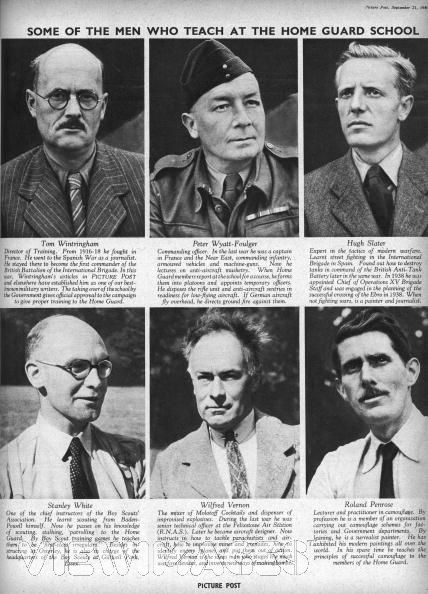
Tom Wintringham
In Britain, there is an even more interesting story. During the 1930’s repeated demands had been raised, by Tom Wintringham, for Britain to introduce adequate Air Raid Protection (ARP) measures. Wintringham had been a founding member of the British Communist Party. On the outbreak of the First World War he had given up his studies at Oxford University and signed up for the Royal Flying Corps. His politics are somewhat eclectic. Long before the policy was adopted by the Comintern he argued for cross class Popular Fronts. But, Wintringham also seems to have developed fairly early on some unease at the polciies being adopted by Stalin, and his Popular Frontism seems also to have been driven by a concern that change should be driven from the bottom up, rather than from the State down, as his later political activity demonstrated.
In the 1930’s he went to fight on the Republican side in the Spanish Civil War, and became the Commander of the English Battalion of the International Brigade.
See: Wintringham .
There he learned guerilla tactics, and as WWII loomed he argued not only the need for ARP measures, but also that the British people should be trained in such tactics to fight against any invaders. He argued strongly in favour of the Local Defence Volunteers (LDV), which was to become the Home Guard. But, when the LDV was first established it was a haphazard affair, much like the portrayal in “Dad’s Army”. Wintringham was brought in to organise proper training at Osterley Park.
See: Wintringham and the Home Guard .
Wintringham worked for the Picture Post, and when the film “The Life and Times of Colonel Blimp” was made it was Wintringham whose role was portrayed.
See: Picture Post
Ironically, although a large part of the initial organisation and training for the Home Guard is attributable to Wintringham, he was not allowed to join it himself, because he was a member of the Communist Party!!!! Again, this demonstrates the real nature of the bosses patriotism. A similar thing could be seen after the War in Germany. The Allies completely turned a blind eye to the Nazi industrialists, because they were more concerned to ensure that German Capitalism once again began to function as part of the world Capitalist system. At the same time Nazis were allowed to take up positions as judges, and Civil Servants. Yet, those forces in Germany in the Communist underground that had continued to fight the Nazis throughout the War were the ones who were blacklisted. A policy called “Berufsverbot” was introduced that restricted Communist activity, and even into the 1960’s opposition to the attacks on democracy by the State could get you murdered as happened to Rudi Dutshcke.
See: Here ,
And
Rudi Dutshcke.
In Spain, Wintringham had an affair with an American Trotskyist, Kitty Bowler, who became his wife. His refusal to leave her led to his expulsion from the Communist Party. Wintringham’s political trajectory then led him to advance positions close to what would today be called Libertarian Socialism. His Popular Frontism led him into an alliance with Liberals, and together with J.B. Priestley he set up the Commonwealth Party, which sought to advocate politics based upon Co-operation. Having said that, at a time when the LP itself was in a Popular Front, National Government with the Tories, and the Communist Party was banned, the Commonwealth Party, did stand candidates in elections against the National Government candidates, in order to provide a socialist choice for workers, and did achieve some degree of success.
See: Commonwealth party
For more information on Wintringham and his writings see:
Wintringham Index
and
Tom Wintringham .
Democratic Rights and Marxist Politics
This shows how, under conditions of War, Marxists can determine their politics in such a way as to address the immediate concerns of workers, advancing a Proletarian Policy of Defence, that offers the potential for workers to assert their own class interests, and to demonatrate why workers can never rely on the bourgeoisie to provide such defence. It demonstrates how, under these conditions, the potential exists for undertaking class struggle politics within the armed forces, and all sections of society mobilised for Defensive purposes. The main requirement here is that Marxists have correctly oriented themselves to the conditions, and created the conditions under which they can engage in action to organise, and develop the working class in these areas around such a class struggle perspective.
Under current conditions, its necessary to recognise basic facts and frame tactics and strategy accordingly. Although, the development of Co-operative Housing and Estate Management – perhaps through a development of existing Tenants and Residents Associations, and their closer linking to Trades Councils, and other Local Labour Movement bodies – offers the potential for developing local workers defence as the bais of a Militia, we are clearly a long way from such a development. Although we are in favour of Universal Conscription, we are not in favour of that outside the context set out above. And, although we argue for the basic rights of troops, we recognise that the reality of the current military, as a professional army under the direct control of the bosses state, is that it is the physical force intended for use by that State against the working class, whatever the politics or intentions of the individual soldier. We cannot then, under current conditions, be in favour of a Military Trade Union, or its integration into the Labour Movement, when part of its function is to act AGAINST the Labour Movement. We have to differenetiate between our attitude to the military as an organisation, as an arm of the State, and our attitude to the individual soldier on whose side we must be as against that State. Our task is to change those conditions.
We can then demand that the same rights be applied to soldiers as to any other worker in regard to, for example, Health and Safety. Just as no worker should be asked to perform any duty without the necessary safety equipment and clothing, so no soldier should be asked to undertake actions without similar protection. Soldiers should have the right to establish their own Health and Safety representatives and Committees to determine what such equipment should consist of, and should have the right to refuse any activity without the provision of the equipment they deem necessary. In the same way they should have the right to determine what training is required to undertake particular types of activity, and to demand that it be provided prior to any soldier being asked to undertake such action.
Soldiers should have the right to hold regular mass assemblies to discuss action they are being asked to undertake, and the review those they have undertaken. Partly in order to ensure that from such experience the best officers are selected, and to remove those that have proved inadequate, and partly so that soldiers should feel free to express their views without fear of reprisals from above, they should have the right to elect their immediate commanders.
Clearly, operationally, it is not possible to engage in fighting on a democratic basis. There has to be a clear chain of command, but that is precisely why the individual soldiers need to have the utmost confidence in those giving the orders. This was one of the main strengths of the Red Army created by Trotsky. The effectiveness of that was demonstrated by the fact, that despite the terrible devastation that Russia had suffered during WWI, despite the attempts of the old Tsarist rulers and the bourgeoisie to sabotage production and the fucntioning of the State, despite the crushing war weariness that weighed on the Russian people, the thousands of workers and peasants that flocked into the Red Army, were able not only to defeat the forces of the counter-revolutionaries, but also to defeat the armies of the 18 imperialist powers that invaded Russia to try to overturn the revolution.
Similarly, society as a whole should have the right to elect the Military Top Brass, and given the links between the Military and defence companies that exists in every Capitalist State as demonstrated by Galbraith, society should demand the opening of the books of all Defence contractors, and the disclosure of all such links in the same way that we are now demanding that MP’s come clean about their expenses.
On this issue as on many others the Left needs to move away from the Statist, and petit-bourgeois conceptions that have debased it for too long, and to return to the path of proletarian policy, and its scientific elaboration according to the principles of Marxism. On this issue as on others we do not have to simply accept that all that is possible is to call for reforms by the existing State, which sow illusions both in the neutrality of that State, and the fallacy of being able to control its actions short of its overthrow. We can advance an independent working class solution that not only is not dependent upon that State, but is in opposition to it! We do not have to settle for simply hanging on to the coat-tails of the Moralists and Pacifists, but can address the real fears and concerns of the working-class in a way that undermines the Nationalists and Fascists, who otherwise play upon and exploit those fears. In fact, in so doing, in orienting towards a proletarian military policy of the kind outlined here, we set the basis for its extension across borders, building on the natural co-operative instincts of the working class and its desire for peace and security. In fact, we provide the basis for establishing the kind of international working class force that can intervene to assist workers facing oppression at the hands of vicious dictators and militarists without relying on intervention by some supposedly “progressive”, or “democratic” imperialism.
We lay the basis in military terms for implementing the basic idea – “Workers of the World Unite”, and thereby of preventing those workers being slaughtered in some new conflagration.
Showing posts with label Pacifism. Show all posts
Showing posts with label Pacifism. Show all posts
Saturday, 29 August 2009


Saturday, 18 April 2009
Imperialism and War

This last of the three-part series of documents from the early 1980’s, looks at the question of “Imperialism and War”. The reason for Lenin’s original pamphlet – “Imperialism – The Highest Stage of Capitalism”, was to explain what appeared to be the senseless slaughter of WWI. Lenin sought to explain that the War was a necessary consequence of Imperialism, and showed the need for Workers to overthrow Capitalism in order to avoid a descent into barbarism. The argument at first glance appeared very powerful. Lenin said, Capitalism had become characterised by Monopoly. National economies were now dominated by huge Monopolistic trusts under the control of the Banks – Finance Capital. Just as National Economies were dominated by these Monopolies, so the world was divided up by Imperialistic countries who turned each Colony into their own Monopoly. Finance Capital was driven to do this because it could no longer find profitable avenues to invest at home, and needed protected markets to invest in abroad. By the end of the 19th century Lenin argued the entire world had been divided up amongst these imperialist powers, so that all that was left was for them to go to war in order to obtain for themselves a re-division.
But, even a casual inspection showed what was wrong with this theory. Firstly, Lenin argues that the division of the world, the monopolisation of colonies is a consequence of the development of the monopolisation of production and rise of Finance Capital. There are two problems with this. Firstly, the division of the world amongst the imperialist powers was already completed by the end of the 19th century, and the main scrabble for colonies occurred at that time. Yet, even according to Lenin, the rise of Finance Capital, and the dominance of the Monopolies did not occur until the beginning of the twentieth century. So, if that occurred AFTER the world had already been divided up, it could not have been the cause of that division! Secondly, Finance Capital as analysed by Hilferding, was a description of the situation in Germany, but it did not fit the picture in Britain or France, and yet it was Britain and France who WERE the main imperialist powers, the biggest holders of Colonies. In fact, the British economy was the one, probably LEAST characterised by Monopoly at the beginning of the twentieth century.
But, there were further problems with Lenin’s theory as Bill Warren points out in “Imperialism – Pioneer of Capitalism”. For example, there does not seem to have been any particular increase in overseas investment into the colonies by the imperialist powers during this period compared with the investment of previous decades, and Lenin’s argument that it was this rather than the colonies being simply markets for the imperialist powers surplus production does not seem to be born out by the facts either. Moreover, Lenin says that there is a causal link between Monopoly economic power and colonisation, but he does not make clear what that causal link really is. In fact, the theory seems to contradict another fundamental aspect of Marxist, including Lenin’s own analysis, and that is the theory of combined and uneven development. That theory, which is readily observable, states that different economies develop at different rates, that at any one time, the world will have economies at different stages of development. But, in that case it beggars belief that all of these “imperialist economies” could have arrived at the same stage of development at the very same time i.e. the stage where there economies were dominated by monopoly. It even further beggars belief that this point in time just also happened to coincide with the moment when the entire world had been completely divided up!!! As Warren says, it is difficult not to see Lenin’s pamphlet as anything more than a first draft, and the many caveats that Lenin includes in almost every section – some as Warren says, to the extent of making the statements therein meaningless, is testament to that. Yet, on the basis of this pamphlet, many on the Left still base their explanations of the world economy, and more importantly their attitude towards “anti-imperialism”, and questions of War.
In fact, as the previous documents have shown the division of the world into colonies can much better be explained in terms of the dynamic of feudalism, and of Merchant and Money Capitalism leading to Colonialism than it can by a Finance Capital dominated Imperialism. And when that basic element of Imperialism set out by Lenin – the need for Productive/Industrial Capital to search out new sources of exploitable Labour – does arise, it takes the form not of Colonial powers seeking to divide up the world, but of Multinational companies, whose interest is increasingly to develop global institutions to carry out the functions of the State, and far from seeing their interests lying in the establishment of Colonial rule – which was always extremely costly – see their interests lying in the carrying through of the bourgeois democratic revolution in order that a bourgeois state can arise to shoulder those costs, and to create via some form of bourgeois democracy the best conditions under which Capital in general can operate and accumulate.
This document begins the process of looking at some of those issues, and the consequences for the drive to War, and how Marxists should relate to it. It also foretold of the looming crisis facing Stalinism six years before its collapse, and locates some of the factors involved in that. I think it contains not only some useful historical material, but some important contemporary ideas. Written in September 1984, it appeared as IB 130 in March 1985.
*************************************************************************************
Introduction
Trotskyism since its inception has been marked by a drive for ideological clarification. It is not only post-war Trotskyists who have demonstrated ideological confusion. Much of Trotsky’s work during the 1930’s in preparing the way for the Fourth International, was arguing for clarity within the movement. He insisted on the need to be guided in action by Marxist analysis rather than political slogans (for example, the discussions over entry into the French SFIO).
If the problems of building a revolutionary movement, which correctly understood and interpreted Marxist ideas, was difficult for Trotsky and the Trotskyists before the war, then the problems following Trotsky’s death and the Second World War have been immense. It is the scale of those problems, which has caused the disintegration of the Trotskyist movement. Faced with new phenomena, new problems, and with only tiny forces, the post-war Trotskyists have essentially gone down one of two paths (sometimes a combination of both). Either they have responded to situations by blithely repeating old formulas, as an alternative to Marxist analysis, or else they have taken on board ideas, which are alien to Marxism. Probably in no other sphere has this been clearer than in respect to imperialism and war. It is not surprising that the most heated arguments with the expelled Worker Leadership Faction were over these questions e.g. the Falklands, Ireland.
Over the last year or so, we have begun to analyse modern imperialism. This document attempts to contribute to that task, and to build on some of the ideas I have already put forward in past IB’s. The document is divided into the following sections:
1) A General Description of Modern Imperialism
2) The contradictions of World Capitalist Development
3) Sub-Imperialism
4) Permanent Revolution and Anti-Imperialist Struggles
5) Soviet Expansionism
6) War
7) The WSL and the Peace Movement
Section 1
Modern Imperialism – Combined and Uneven Development
In IB’s 67 and 82, I have attempted to describe in some detail the way in which imperialism is bringing about a new division of labour on a world scale. This new division of labour involves a de-industrialisation (in terms of the % employed in [particularly the old] manufacturing industries) of the advanced capitalist countries, and the industrialisation of selected “Third World” countries (concentrated on production of “mature” commodities requiring unskilled labour).
I have also sought to demonstrate a connection between this “internationalisation” of Capital, and a loosening of the link between sections of Capital and the nation state in favour of the creation, or use, of larger international bodies, which can carry out state functions (See IB67 pp8-9). here . There is a logic to this process. When Capitalism first began to develop it needed a national market in which certain conditions existed – common currency etc. Upon this economic base was created a political and juridical superstructure designed to meet the needs of the economic system. Having created a world market, therefore, capitalism also needs to create a world political and juridical superstructure for this economic base. It is unable to achieve this, but it is forced, through the contradictions it faces, to make certain attempts at creating larger bodies than the nation state. For example, faced with the power of US capitalism, and the need for a larger domestic market, European capitalism has been forced to create the EEC. Similar attempts at creating Common Markets have been made elsewhere e.g. the Andean pact. Yet, even at this level, capitalism is racked by the contradiction between the need to form an international state, and he continuing conflicts between the component nation states.
In addition to these bodies, other international institutions have been created – the IMF, World bank, NATO – which take on certain state functions at an international level. For Lenin, and other Marxists at the turn of the century it was the link between Capital (Finance Capital) and the state, which created the inevitability of imperialist war. As Capital competed on an international level for control of markets etc. this competition became inevitably a competition of nation states and hence war. If, however, the link between Capital and the Nation state is broken then there is no necessary competition of nation states. Of course, competition still exists, but it is transferred to a higher level. For example, if the Soviet Union could be militarily defeated (without the annihilation of humanity) there would be a scramble between the US, EEC and Japan to divide up the spoils. It would be competition between these international blocs which would lead to war, not the competition of nation states.
However, the existence of the Soviet Union and other post-capitalist states is, for imperialism, an overriding factor. It welds together the competing blocs to protct capitalism as a world system. Later, I will attempt to show that maintenance of the system is the overriding concern of the capitalists.
As the conclusion to this section, I want to refer to the role of imperialist intervention into anti-capitalist revolutions. The stock-in-trade explanation of most Trotskyists for such intervention (e.g. Vietnam) is protection of economic interest. This explanation is a crude economism, and stems from the various dependency theories of development. In Vietnam, US Capital had no investment, nor was Vietnam particularly vital in terms of trade routes. US intervention was not based on protecting ITS investments, but with maintaining the capitalist system, because it is the development of the capitalist system, which creates the conditions for ALL capitalists to expand capital.
Section 2
The World Economy – Contradictions
The driving force of Capitalism as a SYSTEM is profit. Each individual capitalist is forced to maximise profit in order to expand his capital so as to compete with other capitalists. Competition between the various capitalists forces each to expand production, and meanwhile to reduce the relative amount of labour power employed and to reduce labour costs, as a means of increasing profit. The combination of expanded production and restricted potential consumption creates a crisis of overproduction and a breakdown in the system. These breakdowns also provide a basis for working class revolt. They demonstrate to the working class that the system is unable to meet their basic needs, that it is reactionary, a fetter on development.
Herein lies a contradiction for the capitalists. On the one hand competition is intrinsic to the system. This competition, however, leads to breakdowns in the system, and the potentiality of the system being overthrown. If the system is overthrown there is no more profits, and no more capitalists. For the capitalists AS A CLASS, therefore, MAINTENANCE OF THE SYSTEM is their overriding concern, more important even than short term pursuit of profit. Whilst, therefore, competition between capitalists creates conflicts this is always SUBORDINATE to their UNITY as a class against the working class. The contradiction between the driving force of the SYSTEM i.e. maximisation of profit/competition and the overriding concern of the CAPITALIST CLASS to maintain the system is continually in a process of being resolved. This process can be viewed on two levels.
a) The Economic Level – The Level of the Firm or Industry
At first, there is competition between capitalists on price, for markets etc. But, during strikes, employers combine to beat the workers (employers federations know a defeat for one is a defeat for all i.e. they are class conscious). This same competition between firms becomes its own negation as Capital becomes concentrated.
Under late Capitalism, competition even on price between firms begins to disappear as oligopolists recognise that such competition threatens their existence. Instead competition takes place through advertising etc. Contrary to what some economists argue, however, there is no reason to believe that such oligopolists have no incentive to continue to try to maximise profits by reducing costs. Failure to do so would (a) ultimately leave one company susceptible to attack by its competitors and (b) reduce its ability to diversify into other markets/commodities.
b) The political level – The level of The State
On another level the capitalist class needs a force to ensure the rules of the game are adhered to, and that if necessary there is adequate force available to maintain the system. As Marx puts it, this force – he State – is the Executive Committee of the ruling class. The State, therefore, mediates BETWEEN CAPITALISTS to manage their conflicts, and ORGANISES them AGAINST the working class.
It was the relation between capital and the nation state, which, as I have said was seen by Marxists as the foundation of imperialist war. Competition between competing Capitals becoming competition between nation states. However, this thesis begins to break down if:
1) Capital becomes less nationally based, if it looks more to international bodies to carry out state functions, and, if, therefore, it has less direct ties to any one nation state.
2) The threat to the “maintenance of the system” on a world scale results in capitalists finding methods of managing their conflicts.
Do either of these conditions apply? Yes.
1) For multinational capital it is not any one particular state which is important, but ANY state, which guarantees it certain conditions for operation. For example, Ford is able to locate factories in Britain, Germany, Spain etc. confident in the knowledge that the Capitalist state in these countries will protect it, ensure that the rules of the game are adhered to etc. Indeed, the State may be prepared to provide it with incentives to set up shop as did the British State with Ford in South Wales.
2) Capital has become more international (at least the dominant sections). They are the ones, which look to international bodies to carry out state functions. The development of these international bodies is itself a contradictory process, proceeding in fits and starts as the need to create larger international bodies conflicts with the remaining self-interest of individual nation states.
3) These international bodies are also a means of managing conflicts e.g. EEC measures on overproduction of steel. Interestingly, military conflict (other than imperialist interventions) since the Second World War has not been between competing “imperialist” states, but between less developed capitalist states e.g. Iran/Iraq, India/Pakistan, Israel/Arab States. I will come back to this in the next section.
Certain international bodies e.g. NATO have the explicit function of maintaining the system internationally. In this respect protection of the investments of this or that “imperialist” state is not paramount in determining the intervention of imperialism. I have already referred to the example of Vietnam. For the US the main concern in Vietnam was not that its investments were being threatened, but that CAPITALISM was being threatened. The existence of Capitalism in Vietnam was the precondition for its reproduction, for the existence of a Capitalist State, the installation of Capitalist ideas, norms and values in that society, which would provide the basis for the expansion of Capital – including, of course, US Capital.
A different example can be quoted – that of the Falklands. It is quite clear that the cost to Britain of the Falklands War was far greater than the value of any economic interest it has in the Falklands. Why then did Britain engage in the War. I think Donald McKenzie is right when he said in Capital and Class 19, “What was being punished in the Malvinas War was an offence against the British state, against the system of states, and against Britain’s claimed place in that system”
In other words one of the functions of the State is to ensure that all capitalists adhere to the rules of the game. For modern imperialism, concerned with managing conflicts, an important function of the “system of states” is to ensure that the rules of the game are adhered to internationally, because these rules of the game are the way the ruling class internationally presents a united front against revolution. Once someone is allowed to break the rules that united front begins to break down, it sets an example for others to break the rules.
McKenzie also challenges the idea that the cause of militarism is basically economic. “The costs of militarism are so huge that they can quite possibly exceed even the returns on total worldwide investment. Harman claims that ‘at no stage in the 1940’s or 1950’s did total US overseas investment (let alone the much smaller return on that investment) exceed US spending on arms’” This is an important point raised by McKenzie, but I think he is wrong, because he mistakes what is a real contradiction for Capitalism for simply a logical contradiction, and concludes on the basis of formal logic that economic motives are not, therefore, the cause of militarism. I will return to this in Section 6.
Section 3
Sub-Imperialism
Before we can talk about sub-imperialism it is first necessary to clarify what is meant by imperialism. The term imperialism has, it seems to me, been used so indiscriminately that it has lost its meaning. For example, Lenin refers to Tsarist Russia as imperialist when he is advocating a position of revolutionary defeatism. Yet, in the sense that most Marxists (including Lenin) refer to imperialism (export of Capital) Russia could in no sense be considered imperialist. On the contrary, Trotsky talks of the consequences for Russia had the revolution not taken place in terms of its complete subordination to imperialism. He compares it to China.
Trotsky himself in “In Defence of Marxism” refers to the Moscow bureaucracy’s tendency to “expand its power, its prestige, its revenues” as the “element of imperialism in the widest sense of the word which was a property in the past of all monarchies, oligarchies, ruling castes, medieval estates, and castes.”
Some basic definitions are needed. Trotsky, in the above quote refers to forms of imperialism in non-capitalist societies. “History has known the ‘imperialism’ of the Roman state based on slave labour, the imperialism of feudal land ownership, the imperialism of commercial and industrial capital, the imperialism of the Tsarist monarchy etc.”
But, capitalist imperialism is something quite different from past forms of imperialism. It is, as Lenin put it, “the highest stage of capitalism”. It is the stage where it has created a world market, and is attempting to forge a world economy. The nature of imperialism does not remain constant throughout this process. I have outlined the various stages I think can be identified in the process in IB67.
To the extent, therefore, that imperialism is the stage of capitalism where it is attempting to create a world economy it is incorrect to refer to this or that country or bloc as imperialist, because imperialism refers to the stage of development on a world scale, not to the stage of development in this or that country. It is as meaningless as saying that within any given capitalist economy small firms are not capitalist (or as capitalist) compared to large trusts, because they don’t have the same power in the market etc., that they are in some way in our ‘class camp’. That is the logic which the CP has pursued, and which leads it to its anti-monopoly alliance.
In short, imperialism is capitalism on a world scale. It is clearly different from capitalism on a national scale in so far as the continuing existence of nation states (and blocs of states) results in conflicts, and whereas within a single country the State acts to resolve conflicts between different sections of Capital, on a world scale capitalism has no such body. Nevertheless, I have referred to certain bodies, which attempt – in embryonic form – to take on some functions of the State.
Just like capitalism on a national scale contains a range of firms from Unilever to a small firms, so imperialism contains a range of economies from the US to Upper Volta. Just as in a national economy some firms grow and others decline, so too for imperialism some economies grow/develop others decline. And, just as on a national scale, capital diversifies whilst at the same time becoming more concentrated, so under imperialism, capital disperses from one country to another, spreading its fingers across the globe and then clenching its fist as it pulls these separate economies together becoming more concentrated in economic blocs.
The US had a head start in this. The Civil War pulled together the separate economies of the US into a whole, giving US capital the kind of market, which the EEC is now trying to create. The problem for the EEC is that it wants to avoid another war to achieve the process.
If imperialism is understood in this way it makes no sense to talk about this group of countries being imperialist, and that group of countries being oppressed by imperialism. All are part of the same imperialist SYSTEM. Firstly, such a method of analysis is not Marxist. Marxist analysis is based on CLASS, not NATIONALITY. Secondly, what is often meant by ‘oppressed’ is not oppressed in the military/political sense, but oppressed in the sense of being ripped off by multinational companies, and banks etc. In fact, these are two separate issues. For those countries which are oppressed in the first sense of the word, we would obviously fight for the right of self-determination, whilst struggling for socialist revolution, building the revolutionary party etc. But, for countries in the second category it makes no sense to talk about self-determination or national liberation – liberation from what? Its like arguing for national liberation for the corner shop which is being ‘oppressed’ by the bank manager, and the giant food wholesalers. As Lenin points out in the ‘Theses on the National and Colonial Question’
“It is not sufficient for the Communist Parties to expose unflinchingly in their propaganda and agitation both on the Parliamentary tribune and elsewhere the continually repeated offences in every capitalist state, in spite of all the ‘democratic’ constitutions, against the equality of nations and the guaranteed rights of national minorities. It is also necessary first to clarify constantly the point that only the soviet order is capable of assuring nations true equality by uniting first the proletariat and then the whole mass of the toilers in the fight against the bourgeoisie, and secondly to give direct support to the revolutionary movements in dependent nations and those deprived of their rights, through the Communist Parties of the countries in question.
“Without the last particularly important condition the struggle against oppression of the dependent nations and the colonies and the recognition of their right to a separate political existence remains the kind of mendacious hypocrisy that we see in the parties of the Second International.” (emphasis added).
We should in this sense stop talking about oppressed nations, and get abck to talking about oppressed classes. For the oppressed classes in these countries it is not imperialism which oppresses them, but Capital. For workers in Taiwan, for example, it makes no real difference whether that Capital is Taiwanese, American or British, any more than for a British car worker it matters whether they are exploited by BL, or Ford, or Nissan.
It is more useful to see that within the imperialist system there is a gradation. Within that gradation it is possible to identify certain countries which are qualitatively more powerful than all the rest – the ‘imperialist’ countries i.e. those which have been the ones which have carried capitalism out into the world and been responsible for forging the world economy, and which consequently dominate it; it is possible to identify others which are of second rank in terms of their wealth etc. (e.g. Argentina), and others which are industrialising rapidly (the NIC’s); and it is possible to identify others which remain in abject poverty and misery, whose societies more resemble barbarism than capitalism.
Given this ranking, it is possible to refer to certain countries within the second rank as ‘sub-imperialist’. Certain criteria can be set out to define what this sub-imperialism amounts to. For example:
1. The existence of a substantial economic infrastructure i.e. communications, education, administration
2. The existence of a capitalist state apparatus
3. The existence of a modernised capitalist economy in which the Agrarian Revolution has been accomplished.
4. The existence of a developed financial system.
5. The existence of a sizeable domestic bourgeoisie
6. Moves by this bourgeoisie to expand its influence outside its national borders by (a) export of capital, or (b) attempts to expand its territory by military strength, or (c) becoming the local agent of imperialism, becoming a regional policeman e.g. Iran under the Shah.
It is not necessarily the case that a sub-imperialist country is militarily active in those countries to which it is exporting capital or commodities. As Fred Halliday points out, “There is little reason to believe that Brazil’s strategic role in Latin America has a dependent connection to its economic role; its exports, for example, are not in the main, sent to those countries where its support for right-wing military forces has been exercised.” Halliday suggests the following concept of sub-imperialism, “(a) a continuing if partial strategic subordination to US imperialism on the one hand, and (b) an autonomous regional role on the other.” (Iran: Dictatorship and development p283).
What is noticeable is that many of the wars that have taken place since the Second World War have been between countries which might be described as sub-imperialist, or which at least fall into the category of the second rank. A parallel could be drawn with the fact that just as early capitalism sees all out competition which is transformed to a more regulated competition under late capitalism, so under imperialism, the ‘imperialist’ states passed through a stage of all out competition, including two world wars, which has given way to a regulated competition as ‘maintenance of the system’ on a world scale has become the main concern of the bourgeoisie. Similarly, the second rank nations are passing through a stage of all out competition, each trying to become the dominant force in its region e.g. Argentina/Chile, Iran/Iraq. The conflicts between India/Pakistan, and Israel/the Arab states could also be cited, but obviously these are more problematic and other factors are involved.
This is not to say that these countries are at the same point on the same path as the ‘imperialist’ states were 50 or so years ago. No. They are at a different point on a different path. Nor is it to say that the economies of these countries are developing in the same way that the economies of the ‘imperialist’ states did. The way the economies of the ‘imperialist’ states developed was conditioned by the fact that they were first. When they began to expand overseas they did so into virgin territory, boldly creating capitalism where no capitalist had gone before. As Marx put it,
“The cheap prices of its commodities are the heavy artillery with which it batters down all Chinese walls, with which it forces the barbarians’ intensely obstinate hatred of foreigners to capitulate. It compels all nations, on pain of extinction, to adopt the bourgeois mode of production; it compels them to introduce what it calls civilisation into their midst, i.e. to become bourgeois themselves. In one word, it creates a world after its own image.”
(Communist Manifesto - emphasis added)
The economies of the ‘non-imperialist’ countries, including those in the second rank have been affected in the way they developed by the existence of the ‘imperialist’ states, and by the way those states have structured the World Economy, just as a small firm starting out in Britain today is affected by the existence of huge monopolies. Where the two imperialist wars were about dividing up the world between the ‘imperialist’ states, the wars between Argentina/Chile, Iran/Iraq are about who will be the dominant local power, and essentially, therefore, who will be the agent of the ‘imperialist’ states, and in particular the US.
Section 4
Permanent Revolution and Anti-Imperialist Struggles
What is the basic postulate of Permanent Revolution? That the ‘national’ and ‘democratic’ revolutions could only be accomplished via the Dictatorship of the Proletariat. Has that been true? No, many national revolutions have taken place led by petit-bourgeois nationalists; none have established the Dictatorship of the Proletariat. In many countries the tasks of the ‘democratic’ revolution have been established without the Dictatorship of the Proletariat. The post-war period has seen the Dictatorship of the Proletariat (albeit in a deformed bureaucratised manner) established in China by a Peasant Army, in Cuba by petit-bourgeois nationalists, and in Vietnam by Stalinists.
In Permanent Revolution, Trotsky says, “A Democratic Dictatorship of the Proletariat and Peasantry, as a regime that is distinguished from the Dictatorship of the Proletariat by its class content, might be realised only in a case where an independent revolutionary party could be constituted, expressing the interests the peasants and in general of petit-bourgeois democracy – a party capable of conquering power with this or that degree of aid from the proletariat, and of determining its revolutionary programme. As all of modern history attests – especially the Russian experience of the last twenty-five years – an insurmountable obstacle on the road to the creation of a peasant’s party is the petit-bourgeoisie’s lack of economic and political independence and its deep internal differentiation. By reason of this the upper sections of the petit-bourgeoisie (of the peasantry) go along with the big bourgeoisie in all decisive cases, especially in war and in revolutions; the lower sections go along with the proletariat; the intermediate section thus being compelled to choose between the two extreme poles….. there is not and cannot be any intermediate stage, that is no Democratic Dictatorship of the Workers and Peasants. (pp277-8)
Permanent Revolution
Trotsky based this on the experience up to then, but as pointed out above, recent history provides many instances of successful revolutions carried out under the leadership of the petit-bourgeoisie. As Marxists, we have to acknowledge that and develop our theory accordingly, not ignore it simply because it does not fit in with orthodox theory. Such an attempt to analyse how and why the petit-bourgeoisie has been able to successfully lead revolutions in Cuba, Nicaragua, Mozambique etc. etc. and to characterise the nature of the subsequent regimes (are they a form of he Democratic Dictatorship or Workers and Peasants?) is not attempted here, but such an analysis should be undertaken by the League.
Marxists from Marx onwards have always underestimated the resilience of Capitalism, and the ability of he bourgeoisie to adapt in order to stave off revolution and maintain the system. Trotsky’s Theory of Permanent Revolution was partly based on such an underestimation. Not only has the ‘democratic’ revolution been achieved in country after country without socialist revolution, but the US has used its power and influence to persuade some ruling groups to carry through the ‘agrarian revolution’ as a means of increasing stability, and staving off rural revolt. As Halliday says,
"The function of such a policy is both to eliminate a real or possible revolutionary threat from a discontented peasantry, and to create a new social grouping in the rural areas which will support government policies…. This two-pronged policy also explains why since the Second World War the US government has encouraged land reform in countries under its influence. The initial thinking on this was developed in relation to Japan, where a group of sociologists including Talcott Parson saw the need for a stable state to have a contented peasant class. Subsequent to reform in Japan, US advisers helped supervise reforms in China (prior to 1949), Korea, Taiwan, the Philippines, Egypt, Bolivia – and Iran. (Iran pp134 –5)
Does this mean that the Theory of Permanent Revolution is no longer relevant? No. As a description of what has happened the theory has obviously been wide of the mark, but the main importance of any Marxist theory is not as a description of events, blindly unfolding, but as a guide to action. Had large revolutionary parties, and a Communist International existed in the post-war years then the events of the post-war period would have been different, and probably more in line with Trotsky’s description.
Whilst ‘national’ and ‘democratic’ revolutions have taken place without establishing the Dictatorship of the Proletariat, the subsequent regimes have not provided any great steps forward for the working class, and poor peasantry. There is still a need to point out the need for, and fight for socialist revolution. Indeed, there is more need to do so than ever. In a world where capitalism has been turned into a world system the ONLY way to achieve any kind of independence of the economic consequences of that system is by breaking from it. The ONLY way to break free from the system is by SOCIALIST not nationalist revolution. Even then, the economy of even the largest country cannot totally free itself from the effects of the world economy. For that reason Permanent Revolution is also more relevant than ever in another sense.
“The conquest of power by the proletariat does not complete the revolution but only opens it. Socialist construction is conceivable only on the foundation of the class struggle, on a national and international scale. This struggle, under the conditions of an overwhelming predominance of capitalist relationships on the world arena, must inevitably lead to explosions, that is, internally to civil wars and externally to revolutionary wars. Therein lies the permanent character of the socialist revolution as such, regardless of whether it is a backward country that is involved, which only yesterday accomplished its democratic revolution, or an old capitalist country which already has behind it a long epoch of democracy and parliamentarism.”
And,
“The above outlined sketch of the development of the world revolution eliminates the question of countries that are ‘mature’ or ‘immature’ for socialism in the spirit of that pedantic, lifeless classification given by the present programme of the Comintern. Insofar as capitalism has created a world market, a world division of labour and world productive forces, it has also prepared world economy as a whole for socialist transformation.”
Permanent Revolution pp 278-9 Pathfinder Press 1974)
And for Lenin,
“A determined fight is necessary against the attempt to put a communist cloak around revolutionary liberation movements that are not really communist in the backward countries. The Communist International has the duty to support the revolutionary movement in the colonies only for the purpose of gathering the components of the future proletarian parties – communist in fact and not just in name – in all the backward countries and training them to be conscious of their special tasks, the special tasks, that is to say, of fighting against the bourgeois-democratic tendencies within their own nation. The Communist International should accompany the revolutionary movement in the colonies and the backward countries for part of the way, should even make an alliance with it; it may not, however, fuse with it, but must unconditionally maintain the independent character of the proletarian movement, be it only in embryo.”
(Theses on the National and Colonial Question pp 181-2 from Vol. 1 The Second Congress of the Communist International – New Park 1977)
Second Congress of the Comintern
Trotskyists in the post-war period have had an extremely opportunist attitude to ‘anti-imperialist’ struggles. The worst variant has been the USFI which has sat on the sidelines acting as cheer leaders for the various petit-bourgeois nationalist forces, has abandoned the task of establishing Trotskyist parties in these countries, and which has had a totally uncritical attitude to the petit-bourgeois nationalist regimes which have subsequently been established. But, most other Trotskyists have shared a similar attitude. The process goes something like (a) give pretty much uncritical support, (b) raise every so often the need to establish Trotskyist parties, (c) wait until the petit-bourgeois actually win power and hen start to slag them off.
This attitude is not only unserious, but a criminal dereliction of the revolutionary duty to patiently explain why the petit-bourgeois nationalist programme is inadequate, why the petit-bourgeoisie, if they win power, will attack the working class, and why, therefore, we need to group the revolutionary forces from within the ranks of the nationalists to build a revolutionary party.
Section 5
Soviet Expansionism
The Soviet Union is not imperialist in the sense describe earlier. Is it, however, expansionist? Yes, and no. Trotsky, in “In Defence of Marxism”, refers to the element of ‘imperialism’ in the policies of the Kremlin bureaucracy, and discusses its expansionism in relation to Poland and elsewhere.
“The Kremlin participates in a new division of Poland, the kremlin lays hands upon the Baltic states, the Kremlin orients towards the Balkans, Persia and Afghanistan; in other words, the Kremlin continues the policy of Czarist imperialism. Do we not have the right in this case to label the policy of the Kremlin itself imperialist” (p26 Pathfinder)
In Defence of Marxism
Trotsky distinguishes himself, however, from the petit-bourgeois and Menshevik description of such expansion as imperialist. “This historical geographical argument is no more convincing than any of the others… The lines of revolutionary expansion were the same as those of Czarism, since revolution does not change geographical conditions. That is precisely why the Mensheviks at that time already spoke of Bolshevik imperialism as borrowed from the traditions of Czarist diplomacy.” (Ibid – emphasis added )
Wherein, therefore, lies the difference between ‘revolutionary’ expansion, and the Kremlin’s expansion into say Afghanistan? Again Trotsky.
“Robespierre once said that people do not like missionaries with bayonets. By this he wished to say that it is impossible to impose revolutionary ideas and institutions on other people through military violence. This correct thought does not signify, of course, the inadmissibility of military intervention in other countries in order to co-operate in a revolution. But, such an intervention, as part of a revolutionary international policy, must be understood by the international proletariat, must correspond to the desires of the toiling masses of the country on whose territory the revolutionary troops enter. The theory of socialism in one country is not capable, naturally, of creating this active international solidarity, which alone can prepare and justify armed intervention. The Kremlin poses and resolves the question of military intervention, like all other questions of its policy, absolutely independently of the ideas and feelings of the international working class. Because of this, the latest diplomatic ‘successes’ of the Kremlin monstrously compromise the USSR and introduce extreme confusion into the ranks of the world proletariat.”
And, he goes on, “We have never promised to support all the actions of the red Army, which is an instrument in the hands of the Bonapartist bureaucracy.”
In other words, revolutionary expansion is an expression of class solidarity, bureaucratic expansion is an attempt to expand the sphere of influence of the bureaucracy, and to create not socialism, but a society assimilated to the reactionary model of the Soviet Union.
In the post-war period we have seen the Kremlin expand into Eastern Europe, and now Afghanistan. However, the expansion into Eastern Europe was with the agreement of imperialism. In Afghanistan, it was forced into a situation of invading or else losing face as a client regime was kicked out. Another factor, detrmining the invasion of Afghanistan was almost certainly a concern by the bureaucracy about the spread of ‘Islamic Revolution’ to the rapidly growing Soviet Islamic population. Both Eastern Europe and Afghanistan act as a buffer zone against hostile states on the Soviet borders. Both in Eastern Europe and Afghanistan the process of transformation (E. Europe) or military conflict (Afghanistan) has been pretty much directly under the control of the Kremlin.
At the same time, the bureaucracy has shown a marked reluctance to expand its influence by coming to the aid of revolutions in Korea, Vietnam, Cuba, Nicaragua, El Salvador, Angola, Mozambique, Ethiopia etc. Only after the event has it extended its influence. Simply to describe the bureaucracy as ‘expansionist’, therefore, is inadequate. It is expansionist under certain conditions i.e. where it is not going to come into conflict with imperialism., and where it can keep the situation under its control. Afghanistan is a partial exception to that because there was the possibility that it might bring the bureaucracy into conflict with imperialism. They obviously decided, however, that it was worth the risk with the US having little stomach after Vietnam, and being in a situation of having to do something to save face.
I think there is a danger of putting Soviet expansion down to purely economic motives in the same way that some Trotskyists have put down all imperialist intervention to economic motives. The Soviet bureaucracy certainly is greedy, but that is not a sufficient reason to explain its expansionism. For example, if the Soviet bureaucracy, when it invaded Afghanistan, was simply motivated by greed, and saw its opportunity because of the weakness of imperialism, why choose Afghanistan? Why not invade Iran? After all in many ways the conditions were better. Firstly, there is a working class in Iran; secondly there is a Stalinist Party with at least some support in the working class; there was mass opposition to the Shah, which at first had no organised expression (it was only towards the end of the revolutionary situation that the clerics hijacked it). Certainly, its difficult to see what the bureaucracy can gain economically from Afghanistan, but the potential for looting Iran is obvious.
Again, if we look at the discussions at the recent Comecon summit there were apparently big arguments over the amount of economic support that Comecon countries were making to Cuba, Vietnam, Ethiopia, Mozambique etc. A number of Soviet satellites which had applied for membership were apparently turned down because of the economic burden that Eastern European members of Comecon felt this would place on them. Within Comecon too, the financial flow is not all one way. When oil prices increased in 1974, for example, the Soviet Union continued supplying oil to other Comecon countries way below the world price. To have increased the price of oil would have been easy for the Soviet Union, and if it were solely motivated by greed, a rational thing to do, but the cost would have been crisis in the economies of Eastern Europe, and political instability similar to what happened in Poland. Instead, the Soviet Union acts a bit like a bank, controlling Comecon, taking out resources, and handing out subsidies and loans. IN this way it can maintain some control.
The Soviet Union has increased its oil price to Comecon members steadily, and encouraged them to get supplies from elsewhere as it diverts its oil resources more to domestic use. Nor is Comecon immune to the crisis of the world capitalist system. Bob Sutcliffe in WSR 1 described the crisis in the economies of the Stalinist states. Increasingly, it becomes clear that the Kremlin is more and more losing control over the Eastern bloc. For example, Hungary and Rumania have become members of the IMF. There is more and more dissent – Rumania sends a team to the Olympics, and now simply to prevent East Germany’s Honecker from going to West Germany, Pravda launches a massive campaign against both East and West Germany, even saying the East Germans were liquidating ‘socialism’ in East Germany.
Ever since the bureaucracy developed the theory of socialism in One Country, it has had a policy of peaceful co-existence with imperialism. This means that whilst the bureaucracy acts demagogically, and spouts anti-imperialist rhetoric it does nothing, which could bring it into direct conflict with imperialism. Imperialism is free to intervene anywhere in the world, unhindered, and should it be defeated the bureaucracy then steps in to ensure that the new state is brought into the fold.
Ernest Mandel, therefore, is totally wrong when he says, “Thus the fact that the Soviet Union has built and stockpiled nuclear weapons has saved humanity from a nuclear holocaust. Without this ‘balance of terror’ it is practically certain that imperialism would already have used nuclear weapons against the ‘Chinese volunteers’ during the Korean War, against the Indo-Chinese revolution during the second Indo-chinese war, and indeed against other revolutions.”
In fact, however, the Soviet Union has failed to support any of these revolutions with conventional weapons let alone be prepared to use nuclear weapons. These revolutions have taken place despite Stalinism, not because of it.
Mandel’s position is based on an incorrect understanding of the principle of ‘Defence of the Soviet Union’. Such defence does not mean supporting the diplomatic and military manoeuvres of the Kremlin, nor does it mean supporting their right or ability to annihilate the world working class. Indeed, there are a number of reasons why it seems we should support nuclear disarmament in Eastern Europe, the Soviet Union, China and other Stalinist states.
If the Soviet Union is unconditionally expansionist then it is as much responsible for the arms race as imperialism. If, however, as I have argued it is expansionist only under certain conditions, then it is still possible to argue that the Soviet Union only responds to imperialism’s escalation of the arms race. It is also possible to draw a distinction between the fact that imperialism is necessarily expansionist whilst there is no such necessity contained within Stalinism. However, even if we continue to lay responsibility for the arms race solely at the feet of imperialism this is still not an argument for retaining nuclear weapons by the Stalinists. Property relations in the Stalinist states will not be defended if we are all blown up. Moreover, imperialism wants to capture lost markets and outlets for capital, not blow them up. Imperialism would be unlikely to start a nuclear war just because the Stalinists had no nuclear weapons. Even if they did it would be better that the Stalinists could not retaliate. At least then we live to fight.
Nuclear warfare is clearly different from conventional warfare. When wars were fought with conventional weapons, the red Armies could be used simply to defend property relations in the Stalinist states. That we would support. It also meant that in order to fight a reactionary, expansionist war the bureaucracies had to win the acceptance, or passive resignation of the working class, which would have to do the fighting. In that sense it left open the possibility of opposition to the bureaucracy. Nuclear warfare, however, requires just a small number of people prepared to push the button – there is no reason to doubt that a sufficient number of such people exist in the Stalinist states. The only avenue for the working class to oppose reactionary nuclear adventures by the rulers in the Stalinist states is by campaigning for nuclear disarmament now.
At the same time, it is important that we link clearly support for nuclear disarmament in the Stalinist states to an insistent demand for ‘Defence of the Deformed and Degenerated Workers States’ through total disarmament of imperialism, opposition to any military moves against the Stalinist states, blacking of all war supplies, and above all by fighting for socialist revolution in the West, and Political Revolution in the East.
Section 6
War
I have said a number of times that imperialism is concerned with managing conflicts within itself, because of its desire to maintain the system. Such ideas are anathema to many Trotskyists, so I had better explain more clearly what I mean by this. What this does not mean is that Capitalism is no longer racked by contradictions, or that the capitalists are able to overcome these contradictions. What it does mean is that they are able to undertake certain measures which stave off or modify the resolution of the contradictions. Just as Capitalism was for a time able to use Keynesianism to stave off and modify economic crisis within national economies, so too imperialism has found ways of temporarily staving off the need to resort to military conflict as a means of resolving its crisis at an international level. However, Keynesianism was only a palliative, a way of staving off the inevitable. It built up problems for capitalism and has found its negation in monetarism, and political reaction. At an international level too, imperialism has not solved the problem of creating a unified world economy with an authoritative state apparatus at its head. All it has managed is to create larger economic blocs, and a range of international institutions. As the crisis of imperialism continues, the need to restructure, to recapture lost markets, and sources of exploitable labour, will become greater. In other words, the fact remains that we live in an epoch of wars and revolutions.
Modern imperialism, then, sees the contradictions raised to a higher level, with economic competition within imperialism now concentrated on competition between the major economic blocs, and between the massive, super multinationals which operate across these economic blocs. At the same time account has to be taken of the post-capitalist societies when analysing today’s lines of conflict. I have argued earlier that the main concern of the capitalist class is maintenance of the system, and that as far as the capitalist class on a world scale is concerned, their internal conflicts are subordinate to their unity as a class against the working class, and the post-capitalist states.
What then is the dialectic of modern war? Earlier I referred to an article by Donald McKenzie. McKenzie argued that militarism could not be put down solely to economic motives, because the cost of arms expenditure far outweighed the return on overseas investment. I would agree with McKenzie that this or that particular intervention cannot always be put down to economic motives, but it is another thing to say that militarism, or the massive amount being spent on arms are unrelated to the workings of the capitalist system.
Firstly, its important to separate out the different types of military expenditure. There is the expenditure on conventional weapons, troops etc. which imperialism needs for interventions, and for use against the working class. Then there is the expenditure on strategic weapons for fighting world wars.
In relation to the first type of expenditure imperialism faces a very real contradiction. On the one hand it is trying to create a World Economy, to bring more and more labour power under the control of Capital. It has expanded beyond its own borders. On the other hand the cost of military expenditure, to protect these overseas investments is higher than the return on the investments. Capitalism is a system of such contradictions (the cost of policing the Miners’ Strike is greater than the cost of conceding on closures). The solution to this contradiction for imperialism has been to concentrate its investment in selected countries, to establish in those countries a capitalist state apparatus, and capitalist norms and values so that the cost of protecting its investments is removed from its shoulders. At the same time, the ‘sub-imperialist’ states, by acting as regional policemen, also lift some of the cost of protection off the ‘imperialist’ states.
The contradiction imperialism faces over strategic weapons are quite different. At first sight, the situation seems quite ludicrous (and from a socialist perspective is ludicrous). There is already massive overkill, and yet the world total for annual expenditure on arms is 600 billion dollars. Some Marxists (Kidron and now Mandel) have tried to put this down to attempts by capitalism to stabilise itself, to overcome the effects of the falling rate of profit – the Permanent Arms Economy. This theory – basically Keynesian – is no answer. For example, why arms? Why not spend on hospitals or schools?
The most likely explanation for the arms race is not any one factor, but a complex intermeshing of factors. The build up of nuclear weapons is not simply a quantitative one. It is successive twists up a qualitative spiral. The aim of both sides is to develop ever more sophisticated weapons systems, which each hopes will enable them to launch a devastating first strike, preventing the other from retaliating. As new weapons are developed, old ones become redundant, and add to the stockpile. What is going on, therefore, is rational within the context of the game being played, even if the result is totally irrational.
Within this context, the military-industrial complex, existing in both blocs, acts to get as big a share of the cake as possible. Within the imperialist bloc the motivation is profit, within the Stalinist bloc it is bureaucrats in the particular sector seeking more prestige. For both blocs too the arms race by presenting an external threat plays an important ideological role, diverting attention from the workers domestic plight. The Stalinist bureaucracy would love to be able to reduce its arms expenditure in order to develop Siberia, improve the Soviet economy, and thus pacify Soviet workers. Imperialism would love to reduce arms expenditure in order to raise surplus value. Neither is able because any reduction would allow the other side to gain a dangerous advantage. What both sides can attempt, however, is to negotiate a reduction in the size of the stockpiles of more or less redundant weapons. Through these negotiations both sides are able to play global, diplomatic chess, presenting proposed reductions in redundant weapons as genuine steps towards disarmament.
The following can be identified as types of war:
1) Wars like the Falklands where the international ‘rules of the game’ are infringed, and alternative means of managing conflict have failed.
2) Wars like Vietnam where imperialism intervenes to prevent socialist revolution.
3) Wars between second rank capitalist states, or by a ‘sub-imperialist’ state against a neighbour, in an attempt to assert regional dominance.
4) Wars/military intervention between the Soviet Union and its neighbours (Afghanistan, Hungary, Czechoslovakia)
5) World wars stemming from economic conflict between the major imperialist blocs.
6) World Wars between imperialism and the Stalinist states.
Types 1,2, and 3 have been the small change since the Second World War, and imperialism has been involved to some extent in all such wars. But, the main motivation behind these wars has not been on the economic level, but the political – ‘policing the rules of the game’ (Falklands), or ‘maintaining the system’ (Vietnam, Korea) or ‘strategic advantage’ (Iran/Iraq).
The Soviet Union prefers to have the Stalinist rulers of each state control the situation for it (Poland), but it has shown itself quite prepared to intervene when it considers things have gone too far. A question mark hangs over the Soviet Union’s ability to carry out such actions in Eastern Europe in future. In Afghanistan it has found itself trapped in a prolonged war, and appears to have learned nothing from the experience of the US in Vietnam. In Czechoslovakia in 1968, it faced dissent amongst its ranks as they fraternised with the workers. With increasing dissent within the Warsaw Pact – Rumania will not allow Russian troops on its soil even for exercises – it could well find itself taking on more than it can chew.
Type 5 remains a remote possibility. There has been a Trade War between the major imperialist blocs for a number of years waged through various measures of protectionism. More and more voices are raised calling for “European” Defence, and in America too there have been calls for America to pull out. There is an increasing militarisation of Japan. The Japanese state has been attempting to re-write school history books, and several films have appeared glorifying Japan’s role in the Pacific War. However, imperialism must recall that after the First and Second inter-imperialist wars they lost territory (first to revolution then to Stalinism).
The most likely arena for future global war, therefore, is between imperialism and Stalinism – given that there are no healthy workers states. As the contradictions for imperialism mount, as the crisis intensifies, those who have developed concepts of limited nuclear war are likely to become more vocal and influential. The deployment of Cruise, the development of the neutron bomb, the concept of limited nuclear war, and increased arms expenditure by imperialism are not accidents. Trotsky argued that war was “the continuation of politics by other means”, but, he also said that war has its own “independent character”, its own “inner technique”, structure, its methods, its traditions, and prejudices. “This means that the profession of war and its problems cannot be dissolved into social and political categories.” We cannot underplay the possibility of nuclear war, because in the event of its occurrence, by accident or design, the socialist project will be destroyed alongside humanity.
Section 7
The WSL and the ‘Peace Movement’
For the last four years the peace movement has experienced rapid growth. It is a different movement to that of the 50’s and 60’s. It has sprung to life when world capitalism is in the most severe crisis since the 1930’s, and, therefore, when imperialist war is more likely. Where direct action split CND in the 60’s, today it is an accepted tactic. The militancy and determination of the Greenham women far surpasses anything produced in the 60’s. That militancy results from a feeling of desperation at a world that appears to be heading for annihilation. Yet, despite the determination and militancy, despite he growth of support for the peace movement, the arms race continues, Cruise missiles have been installed. In response, the CND leaders are in retreat, looking towards state to state negotiations, and witch hunting their opponents inside CND in order to get away with it.
The Peace Movement has become a truly mass movement. Its size and strength have enabled it to do more than similar movements (for example the ANL) have been able to do in the recent past. For example, many Labour controlled Local Authorities have become Nuclear Free Zones, and through non-co-operation forced the Tories to abandon the Hard Rock exercise. Even right-wing Labour controlled authorities like my own in Stoke have made facilities available to CND, and regularly send representatives to the NFZ’s meetings. This is more the result of the pressure they feel from CND activists than of conviction.
Given the importance of youth within the peace movement there have been massive opportunities for revolutionaries. In my opinion, the WSL has missed most of them. Despite conference decisions our involvement in CND has been minimal, and the success of some of our comrades in getting elected to positions in YCND and CND seems more to me to do with their involvement at an individual level rather than the work put in by the WSL. Last year, for example, I had a discussion with a member of the SL who thought our lack of involvement in CND was due to it being one of the major issues in the faction fight with the WLF.
At CND events and demos we have a much lower profile even than groups like Militant and the Sparts, who are opposed to CND. Yet, the possibilities of linking up the nuclear issue with workers in struggle is immense. A recent example was the Women’s March for Mines not Missiles. The march was extremely poorly organised, and in many ways reflected the lack of a link between the Peace Movement and the Labour Movement. From the experience of Stoke, for example, it appeared that there had been almost no attempt to work through the local Labour Party to organise support for the March. A single letter was sent to the Secretary of the Miners Support Committee only a couple of weeks before the March, and even that wasn’t chased up. Our co-thinkers in the LP can play a vital role in providing this necessary link, especially via Labour CND and the YS.
Our co-thinkers in the LP should in my opinion make a big push to build LCND and TUCND, as well as YCND, because the division of CND into sections can be sued as a lever. Our aim should be to use this lever to turn CND towards the Labour Movement, to organise within it a sizeable section based in the Labour Movement so that at some future point a split with the Liberal/Pacifist wing can be accomplished. Such a split is necessary because of the politics of CND, and its popular frontist character.
To achieve this aim of building a Labour Movement core we need to develop a set of demands with which to intervene. Those demands must demonstrate that (a) simply talking about nuclear disarmament is useless, (b) the social democratic reformist programme of bit by bit disarmament, and of ‘defensive’ rather than ‘offensive’ weapons is equally nonsense. We need, therefore, to link the use of basic conventional weapons (like plastic bullets) to the development of counter-insurgency measures, to the use of those measures against the miners, to the use of troops for strike-breaking, and to the development of a national police force, in order to show that “the main enemy is at home”, and that that enemy cannot be disarmed piecemeal, and does not need ‘offensive’ weapons to attack the working class.
In the article by McKenzie referred to earlier he says, “To talk of militarism rather than ‘exterminism’ – E.P. Thompson’s preferred term – is to say, amongst other things that it is not only the drift towards mass destruction that matters. To talk of militarism rather than the ‘arms race’ is to say that it is not the weapons that matter. To talk of militarism rather than the Cold War is to say that it is not only the East-West divide that deserves attention. To talk of militarism rather than ‘war drive’ is to remind us that the politically effective use of military force often stops short of actual fighting.” (McKenzie Capital and Class 19)
“Without the slightest confidence in the capitalist programme for disarmament or arms limitation the revolutionary proletariat asks one question: in whose hands are the weapons? Any weapon in the hands of the imperialists is a weapon directed against the working class, against the weak nations, against socialism, against humanity. Weapons in the hands of the proletariat and of the oppressed nations are trhe only means of ridding our planet of oppression and war.”
Trotsky – “Declaration to the Anti War Congress at Amsterdam” in Writings 1932)
Such thoughts are anathema to the leaders of CND and to social democrats like Kinnock – today’s “champions of peaceful development” as Trotsky called them. Kinnock was opposed to the mass picketing at Warrington in the NGA dispute, and his disgraceful condemnation of miners pickets throughout the Miners Strike has continued the trend. The idea of taking the arms from the bosses and giving them to the workers would be unthinkable for Kinnock. Kinnock in attempting to persuade the T&G to withdraw their unilateralist motion to last year’s Labour Party conference was again demonstrating the similarity of ideas between himself, the Liberal Pacifists leading CND, the Euro-Stalinists of the CP, and, of course, the Liberal-SDP Alliance. All are anxious to replace the independent mobilisation of the working class for disarmament with the more civilised and politically safe – for them – policy of nuclear freeze, and state to state negotiations. His support for the viciously anti-working class bunch of international gangsters in NATO is well known, and, of course, he supported the servile nationalism dished up by the Labour leadership, in support of British ‘imperialism’ during the South Atlantic War.
“The most influential pacifist force is the Social Democracy. In a period of peace its not stingy with cheap tirades against war. But, it remains tied to ‘national defence’ (in the case of Kinnock Western Defence). This is decisive. Every war, however it may begin, menaces each of the warring nations. The imperialists know in advance that the pacifism of the Social Democracy at the first roar of cannon will be transformed into the most servile patriotism and becomes the most important reserve for militarism.”
(Trotsky ibid.)
We should raise the following demands:
1) Britain out of NATO, NATO out of Britain
2) Troops Out of Ireland
3) Oppose any use of troops for strike-breaking with an immediate General Strike
4) Oppose all military spending
5) Build Workers Defence squads as a preliminary to organising a workers militia
6) Disband the standing army, SPG, and ‘intelligence’ services
7) Ban the use of plastic bullets
8) For Workers Control of the armaments factories, oppose privatisation
At the present time, LP policy is based on a contradiction of unilateral nuclear disarmament, but continued support for NATO. Whilst opposing NATO on this basis we must make it clear that the main opposition to NATO is not its nuclear capacity, but its role as the armed fist of imperialism. We must drag the Peace Movement away from its sole concern with nuclear weapons, and broaden the agenda. This will enable us to raise the question of Troops Out of Ireland, the use of plastic bullets, and he development of counter-insurgency techniques.
Given the recent police riot in Belfast and the repeated police riots against Miners we should also be able to link this with the need for workers defence squads, and opposition to the use of troops, the SPG etc. for strikebreaking. Immediate calls for the disbandment of the standing army are unlikely to take hold, so we should raise separately the question of building workers defence squads as a preliminary to a workers militia. Such a militia would almost certainly exist side by side with the standing army, and in opposition to it.
Again, calls for an end to military spending are unlikely to take hold at the present time, so we should raise separately the demand for workers control of the arms industry, and opposition to privatisation. Such a demand raises a number of possibilities. Firstly, it means that workers in the industry can be won away from the idea that the ‘Left’ wants to throw them on the dole. Secondly, it means that workers in the industry can decide what to produce, and who to sell it to. For example, should they continue to produce arms and sell them on favourable terms to liberation movements, and to workers, or should they use the factories resources and their skills to produce something else. Thirdly, it seems to me that the demand for workers control of the arms industry is better than simply calling for an end to all arms production. For one thing, short of a Workers’ Government the bosses are not going to concede the demand for an end to arms production anyway, and secondly the working class needs an arms industry for its own protection (a) in a revolutionary situation, and (b) after the revolution to protect us from external intervention. The current fight against privatisation of ROF’s is an opportunity to raise the demand for workers’ control.
In addition to building LCND, TUCND and YCND we should also do all we can to extend the links already established with END. Given our position on the EEC we are in a much better position than others on the Left to build END, and through it to link up workers throughout Europe. There appear to be a number of aspects as to how this should be done.
1) Work in END itself
2) Work with the Solidarity TU Working Group
3) Work through the European Parliament
Already, there are a number of MEP’s who could be approached to turn END more towards the Labour Movement in Europe, and there is time now before the next Euro elections to start making links and building for a campaign at the next elections in which we could stand candidates (through the LP) on the same sort of basis as the SCLV (Socialist Campaign for a Labour Victory). Such a campaign could enable us to build links with other revolutionaries in Europe.
Conclusions
This document has attempted to set out an analysis of modern imperialism, and to draw practical conclusions from that analysis about the kind of demands we should raise in situations like the South Atlantic War, and for our work in the Peace Movement. An adequate theory of imperialism is something, which the Trotskyist Movement has been lacking for some time. This document does not pretend to be such a theory, but is intended as part of the discussion on the development of that theory. A discussion on work in the Peace Movement is something, which the WSL has been lacking for some time, and again, hopefully, this document will stimulate such a discussion. But, at the end of the day, discussion is only useful if it produces decisions. We should in the next few months begin to reach some decisions from the discussions on imperialism, ‘anti-imperialist’ struggles, and the Peace Movement. We should produce pamphlets and magazine articles putting over our ideas, and begin to develop our work in the Peace Movement so that we do not miss any more opportunities.
Back to Imperialism and the New International Division of Labour
Subscribe to:
Posts (Atom)