Showing posts with label Communism. Show all posts

Wednesday, 1 July 2020

Defund The Police

The slogan defund the police is being taken up across the globe, as part of the Black Lives Matter movement, which is a movement and not just a moment whatever Starmer might want to believe.  In various places, reformists have already tried to draw the teeth of the demand, trying to interpret it as not really meaning defunding the police, but only as serious reform and reconstitution of police forces.  But the demand to defund the police is, in fact a serious, and necessary demand.

The police are the immediate armed fist of the capitalist state, the manifestation of its attempt to exercise a monopoly of force.  Given the increasingly rapid drift towards Bonapartist regimes, and the imposition of restrictions on liberty, egged on by the very socialists and liberals that should have been opposing such moves, under cover of the COVID19 moral panic, it is even more important, even aside from the numerous cases of violence by racist cops against members of Black and other ethnic communities.  Today, on the BBC's Politics Live, right-wing Tory, Iain Dale was even talking about imposing road blocks and further restrictions on liberty, and as citizens increasingly rail against such impositions the calls will come from the law and order brigade and Bonapartists for greater police powers to put down any such rebellions.

Of course, such road blocks and the blockading of towns and villages is not new.  The Tories did it during the 1984-5 Miners Strike, at the same time using further powers to prevent free movement across the country.  The left itself has led itself into this disaster as a result of its mindless backing of the so called lockdown in response to the COVID19 moral panic, and its desire to give all power to the capitalist state as the saviour of the people in doing so.

The example of the Miners Strike and many others such as the print workers strikes of the 1980's, show that for the working-class as well as for ethnic communities we need to defund the police as a hostile anti-working class force that acts like a dagger aimed at our hearts.  That Starmer should recoil from any such demand is, of course, no surprise, because he is not a champion of the working-class.  He is a conservative social-democrat.  His whole ideology starts from the necessity of the working-class making compromises with capital so as to remain within the confines of the capitalist system, and those compromises, along with the requirement to remain inside he confines of the capitalist system means that the interest of workers must always be subordinated to those of capital.  The police, and if they are not sufficient, as at Orgreave, the army are there to ensure that they remain within those confines.

We need to defund the police as the first step in disbanding them as an armed class force organised to defend the interest of capital as against the interests of workers.  A consistent democracy requires that the people should defend and police itself, and the large majority of the people are constituted of the working-class.  The rich have their gated communities and private security forces, as well as the police force and army to protect their interests, we should have the same rights.  The money that goes to fund the bosses' police should go instead to fund local communities to police themselves, organised via local democratic bodies on each estate.  Community policing, on a rota basis, should be a civic responsibility for every able bodied adult, in the same way as Jury Service.  Workers should get paid time off work to undertake it,, as well as for training.  We should use individual current police officers to provide immediate training and assistance, absorbing them into such organisations, where they are shown not to be themselves racists of fascists.

Defunding the police, and establishing day to day democratic bodies on each estate, able to exercise not only these kinds of community policing functions, but democratic control over estates and communities in general, is a basic element in the Marxist programme of developing workers' self activity, and self government.

Saturday, 11 October 2014

Man is Just A Means To The End

“Time is everything, man is nothing; he is, at the most, time’s carcase.”

Earlier in the week I wrote about Brian Cox's new series Human Universe. He used several times a phrase I developed back in 2011, that, with the development of modern Man, 250,000 years ago, this represented the “Universe becoming self-aware.”. As I outlined there, this process is a perfect example of Marx's materialist method and the philosophical concept of the dialectic, as a means of understanding it.  Brian himself applied that method, in describing the way, it was the facility provided by the fertility of the Nile Delta, which enabled humans to begin settled agriculture, and thereby to produce more of their basic requirements in less time, so that at least some of them were released from that task, in order to have time to think, which starts the process of developing, science, mathematics, astronomy etc., which in turn lead to our greater ability to change the material world, in which we live, and thereby to develop science and technology further, to the stage where we can explore not just our own world, but the Universe itself. But, as the current Ebola pandemic demonstrates, as a means of pursuing its self-awareness, for the Universe, humans are a fragile vessel.

That Brian Cox should essentially use Marx's method of materialist analysis is no coincidence. Every natural scientist adopts the materialist method, because it is inseparable from the scientific method of analysing the material world. Its not surprising, therefore, that Einstein, when he came to analyse the social world, adopted that same method, and arrived at pretty much the same kind of conclusions as Marx, as set out in Einstein's article, “Why Socialism?”.

Einstein is correct, in that article, in pointing out that the materialist method of natural science cannot be applied mechanically to analysis of the social world, precisely for the reason Marx and Engels set out, that Man himself, as a thinking being does not just respond mechanically to material stimulii, but acts consciously to bring about preconceived objectives, whether or not he succeeds in achieving those objectives fully, partially, or not at all. Man is limited in being able to achieve those objectives for the reason Marx outlines that he operates not in a world of his choosing, but one he inherits from the past.  In this sense, too, the development of modern man, as a self-aware, thinking being reflects this idea of matter itself becoming self-aware. 

Previously, I wrote that freedom should be considered to exist on a spectrum, depending upon the degree of control that can be exerted. The only totally free thing could be God, because God would be free to act without any restrictions whatsoever, because God would make the rules. At the other end of the spectrum is a piece of inorganic matter that has to simply accept what the Universe throws at it, within the context of those rules/natural laws. In between are various forms of organic matter, which are able to respond to their environment, and thereby exert various degrees of control over their existence – a plant grows towards the sunlight, animals run away from danger, and stalk prey – whilst still having to operate within the limits of natural laws. Closer to God than the rock, there is modern man, not only able to respond to his environment, but also to analyse it, and change it, and thereby to exert an increasing degree of control, but still only within the confines of those natural laws.

The more Man is able to understand the nature of reality, and those natural laws, the more control over both can be exerted, the more this represents the Universe becoming more self-aware via the agency of Man, and the more Man, thereby approaches God. In this, as in all of his other production, however, Man is not the centre of the Universe, but only, as Marx states above, “time's carcase”. Man is not the end, but only a means to the end. And, unfortunately, as stated above, for the purposes of the Universe, whose time is measured in trillions of years, Man's allotted three score years and ten, seems wholly inadequate. As Brian Cox pointed out, the knowledge we have today is the knowledge, in large part, handed down to us, over that previous 250,000 years. Even a genius like Newton, admitted that he was able to arrive at his findings, because he stood on the shoulders of giants.

Yet, the sum of human knowledge is now amounting to such a great mass that no one can hope to be an expert in everything, or even just in any particular sphere of knowledge. Only by the same kind of division of intellectual labour, that has occurred with physical labour, has it been possible to maintain and extend the pace of discovery, and innovation. But, more importantly, it has only been possible because of the development over the last seventy years of computing power. The decoding of the human genome is an illustration of that.

Marx's Law of Value is not difficult to understand, though it has been badly mangled over the last century. It amounts to this. Every society, whatever its mode of production, going back to the dawn of time, must produce to consume.

“Every child knows that any nation that stopped working, not for a year, but let us say, just for a few weeks, would perish.”

(Marx - Letter to Kugelmann, 11th July 1868)

But, each of these products require different amounts of time to produce.

“And every child knows, too, that the amounts of products corresponding to the differing amounts of needs demand differing and quantitatively determined amounts of society’s aggregate labour.”

(ibid)

In order to maximise the society's wealth, to meet its needs, therefore, requires that this time be used as efficiently as possible, and that it be allocated in the appropriate proportions so as to achieve this aim. Whether, the society goes about this aim using the mode of production of the primitive commune, the feudal peasant village, capitalism, or communism this natural law of value continues to operate of the need to produce to consume, and of needing to use labour-time as efficiently as possible, and to allocate it in the appropriate proportions.

“It is self-evident that this necessity of the distribution of social labour in specific proportions is certainly not abolished by the specific form of social production; it can only change its form of manifestation. Natural laws cannot be abolished at all. The only thing that can change, under historically differing conditions, is the form in which those laws assert themselves.”

(ibid)

And, in fact, that this Law of Value is such a law of nature, is shown by the fact that it applies throughout Nature itself. Nature is bound to attempt to achieve its aims, by a similar efficient use of time, and this is seen in all areas of natural science. Water like everything else, is drawn by gravity to the centre of the Earth. It tries to complete that journey by the most direct, fastest route available to it. When it encounters an obstacle, because it is not self-aware, like humans, it cannot act to directly remove the obstacle. It goes around it, for the next most direct route, but in the process, by erosion, wears away at the obstacle until it is removed, and its more direct path is made available.

It is not just humans that allocate their labour-time so as to obtain the greatest output or production of use-value in the shortest amount of time. Cows, sheep etc. grazing in a field, go first to where the most easily obtainable, lushest, most nutritious grass is available, which is why farmers have taken to wiring off parts of their fields, in turn, to force the cows to graze the field evenly.

In biology, we find that evolution, once it has discovered a useful organ like the eye, does not waste time continually reinventing the wheel, but replicates it across species, developing it, and improving it. Even so, Nature itself achieves this blindly, by trial and error, and only by operating within the confines of these natural laws. It is only when Nature itself produces Man, who is able to understand those laws, and to apply them consciously to achieve these ends that the process can be undertaken by qualitatively different methods.

James Brindley did not have to wait thousands of years for the process of erosion to cut a channel for water to move from A to B by the most direct route. Instead, he was able to use dynamite, and mechanical tools, along with lots of labour to dig canals that took water from A to B, by the most efficient route. He was even able to use those same laws of nature to defy the law of nature that requires water to flow downhill, by building locks to mechanically move it in the opposite direction!

Modern genetics achieves in a few years what evolution requires thousands and even millions of years to achieve. In this sense too, Man is “time's carcase”.   Man is achieving the aims of Nature, acting as the self-aware conscious agent, as the Universe becomes self-aware. But, it is precisely in that context that we should understand Man's true role, as merely an agent of change. In the same way, the working-class is the historical agent of social change, not an end in itself. The aim is not to simply make the working-class the ruling class, but to create a society in which class itself disappears as a category.

We might then answer, the old question, what comes after Communism, with the suggestion, that as Man is freed to develop even more qualitatively, as the self-aware manifestation of the Universe, it is a transition to where Man himself disappears as a category separate from Nature, from the rest of the material world. In fact, because of the fragile nature of Man, such a transition is necessary.

The human lifespan is no longer sufficient for accumulated knowledge to be efficiently transmitted from one generation to the next. Already, part of that function has been passed to computer storage. The human brain is at its most efficient operating size and design. Were it larger, the gaps between the synapses would be too large for efficient operation. Again, computers can perform the calculations and analysis that humans are increasingly inadequate to perform. Work is already being undertaken to explore the potential to transfer human consciousness to computers, and we now have the technology to read human brainwaves, as a means of controlling computers. This is a long way from being able to replace human brains with computer brains, but the pace of development is accelerating, in large part because computers themselves are facilitating that development.

Having developed the Internet in just the last twenty years, we are already moving to the "Internet of Things", whereby machines and appliances are constantly and instantly connected across the globe, and into space.  The capacity of humans to convey information to each other is highly restricted, but every machine can be connected to every other as one single brain, throughout the Universe.  The ability convey information instantaneously irrespective of distance has already been demonstrated by Quantum Entanglement.

Even aside from the short duration of the human lifespan, humans have a tenuous existence as a species, as Ebola demonstrates. Computers only suffer viruses, because they are inflicted on them by malicious humans. Computers and robots are increasingly able to be built with sufficient redundancy to deal with any malfunction, as well as to be able to repair themselves. Self-replicating machines are no longer purely a science fiction fantasy. Set aside the potential for humans to die from pathogens or by destroying each other in wars, there is the potential to be destroyed by asteroids etc. But, also, if humans are to obtain a greater understanding of the Universe, it requires more direct investigation, and humans are simply not the best means of carrying out that function.

In the 1960's, when the US were attempting to land men on the Moon, I remember at school we had this debate, and some of us pointed out that the technological achievement of the USSR in sending robots to the Moon, to carry out the same functions, was both superior, and more sensible. Given that humans are likely to die, or suffer terribly from radiation once out of the protection of the Earth's magnetic field, any prolonged period of deep space travel requires either a huge advance in technology for humans to be able to endure it, or else it means developing robots to carry out that function.

Machines also have the benefit that they are not dependent on the inefficient means of consuming fuel that humans are limited to. Machines can function for long periods simply using stored energy, but that energy can quickly be replenished from a wide variety of energy sources, including use of the sun and stars, as well as more closer at hand nuclear reactions. That applies whether those machines are functioning in adverse conditions here on Earth or some other planet, or on epic journeys in deep space.

Humans have fulfilled a useful function in taking the first steps of the Universe becoming self-aware. They were a necessary stepping stone within that process, so that they could produce machines, and uncover the Laws of Nature. But, having done so, the next stage of the Universe becoming self-aware, must pass inexorably to those machines, that are better suited to the task. That is simply the inevitable process of evolution that proceeds with time itself. A process within which “Time is everything, man is nothing; he is, at the most, time’s carcase.”

Sunday, 12 June 2011

The AWL's Idiot Reformism

Is it any wonder that the vast majority of workers reject the solutions put forward by the Left sects? Is it any wonder that, despite their illusions, that the majority of workers are just gagging for a revolution, and their revolutionary leadership, the left sects, whenever they stand candidates, fail to even register on the electoral seismometer?
The AWL, at the last General Election, received just seventy-five votes; the kind of vote you'd expect to get from a single street, not an entire Constituency. Why is it no wonder? Because these sects are not just totally removed from the lives of ordinary workers, but they increasingly seem removed from reality, or any kind of rationality. The AWL's response to the Care Home crisis is a case in point. In an article setting out the extent of the Liberal-Tory cuts in social provision they put forward as a solution to the situation in the Care Homes,

“Expropriate Southern Cross and all the private care-home chains, with no compensation for the profiteers. Reorganise care homes, and professional care provided to elderly people in their own houses, as a public service, free at the point of use, and staffed by qualified workers paid at trade-union rates.”

This is not just Reformism, it is “Idiot Reformism”.
It does not seem to occur to the AWL that there is any kind of logical contradiction between setting out the extent of the Liberal-Tory attacks on the working-class, attacks which are, in part, themselves responsible for the crisis in Social Care, and at the same time calling on that Government to resolve the crisis in workers interests by the kind of measures the AWL ask them to introduce!!! As I pointed out in my blog, Occupy The Care Homes, asking Cameron to intervene to rescue the Care Homes – a reformist policy the AWL share with Dave Prentice – is like asking Hitler to intervene to stop the Brownshirts attacking Jewish property.

If Cameron, and the Liberal-Tory Government, did intervene to take over Care Homes, it would not be in order to meet the needs of workers. If Hitler had intervened to stop attacks on Jewish property, it would only have been in order to ensure its more efficient transfer into the hands of non-Jews. If Cameron intervenes it would be to avert an immediate crisis, in order to introduce a vicious rationalisation, mass redundancies, a recapitalisation, paid for out of workers' taxes, prior to selling the homes off again on the cheap to their friends in the City and Big Business.
For every nationalisation that the Capitalist State has undertaken, not just in Britain, but throughout the Capitalist world, that has been the experience. The only people who can propose such a course of action, are people who are content to settle for workers being exploited in one form rather than another, in the hope that it might prove a lesser evil – i.e. Reformists.

I was reading an article from “Capital & Class 29”, from 1986, the other day. It was entitled “Nationalised Industry policies and the destruction of communities: Some evidence from North-East England” by Huw Beynon, Ray Hudson and David Sadler.
It looked at the nationalised industries that dominated the economy of the North-East at the time, Coal, Steel, Shipbuilding and Electricity Generation. Far from being any kind of progressive force, acting in workers interests, they were the very opposite. Ian McGregor, who, the year before the article was written, had successfully smashed the NUM, and begun the process of the final rationalisation of the mines out of existence, had, before joining the NCB, carried out a similar task in British Steel.
The article shows, not only how these processes of Capitalist rationalisation were introduced, by a powerful State Capitalist employer, to undermine workers interests, but how the more general policies of these industries acted against workers interests in the area in relation to the environment etc.

They conclude,

“In the British experience 'nationalisation' has been a form of 'state capitalism', and in their world of operations these publicly owned trusts have danced to the tune of the market. In this process what has been lost is an important critical sense of the purpose of production and the nature of a socialist or communistic alternative to capitalist forms of organisation and life. This - in the face of a rampant privatising tendency in the Tory government – is a major requirement for progressive forces in Britain. And the starting point for such a programme and a rethink is an open and honest appraisal of the experiences to date of the state sector industries. In such an appraisal the nagging reality from the North of England is that it is just these industries (state owned coal, steel, railways, shipyards) and not the multinationals which have heaped most havoc upon the local economy. This is the fact which socialists need to come to grips with and go beyond.” (p55)

So, even were it not absurd to demand that a right-wing, privatising, Tory Government nationalise the Care homes without compensation etc., it would still be an idiot form of reformism to raise such a demand, precisely because all experience of such nationalisation, of State Capitalism, demonstrates that, contrary to the implication of the AWL's demand, it will be merely a means by which to make the working-class pay for the crisis that has erupted within them.
After WWII, when Attlee's Government nationalised the mines, it not only paid out massive, on going compensation to the former owners, but its first acts were to introduce massive rationalisation. It closed far more mines than Thatcher managed, and that continued under the Labour Government of Harold Wilson, when Tony Benn was Energy Minister. If those Labour Government's used State Capitalist nationalisation to carry out such anti-working class measures, what hope do the AWL have that Cameron's Government will be more amenable to workers interests???

But, the idiot reformism of the AWL is manifest in this instance in other ways. There are a number of ways in which revolutionaries can raise demands for reforms.
Marx argued that in order to avoid “revolutionary phrase mongering” - which is essentially what the AWL's demand here amounts to – demands for reforms should be ones that Capital CAN concede. These demands should be ones that enable or facilitate the workers own organisation and struggle, their self-activity and government.
As Lenin points out some demands for political reforms, such as those for national and minority rights, can be a stepping stone to a revolutionary break of oppressed minorities from an oppressing majority.
Finally, as Trotsky sets out in the Transitional Programme, there are demands, which, during specific periods i.e. revolutionary periods, where dual power exists in society, which have a transitional nature forming a bridge from the programme of reforms, to a programme of revolution.

The AWL's demand here is revolutionary phrase mongering precisely because there is no way the Capitalist State is going to concede it. At least certainly not in workers interests. But, there is no means by which the AWL could force them to accede to it either. There is probably no way they could have forced Wilson's or Attlee's Government to accede to it either, under current conditions. In other words, it is just meaningless hot air – revolutionary phrase mongering. The AWL's response would probably be that they anticipate it as a demand that a Workers Government would introduce. But, where is this Workers Government???
They can neither tell us how a working-class that has just voted in a Liberal-Tory Government, whilst giving the AWL just 75 votes, is going to magic this Workers Government into existence, nor tell us who the Left MP's are, who are going to comprise it!

But, let us assume that, by some miracle, the Government accepted this demand. Let us assume, by some further miracle, that it did not do what has been the experience of all nationalisation, and start cutting jobs and wages, and rationalising the provision. What then? Marx in his debates with Weston showed why such a situation is unsustainable. The laws he uncovered in relation to the way the Capitalist system works, show why, over a period, that reduction in wages, that rationalisation and so on, would be inevitable. It is because, so long as capitalism exists, the laws relating to Capital Accumulation, and which in turn determine the laws of Supply and Demand for Labour-Power, will assert themselves, and that applies as much to the State Capital-Labour relationship as it does to the overall Capital-Labour relation. What makes the AWL form of reformism idiotic, is precisely that it tries to counter the laws of Capitalism while remaining within a Capitalist framework, whilst continuing to accept the Capital-Labour relation itself.

Virtually all Marxist economists accept the view that the reason for the Thatcherite revolution was because, for a considerable period, prior to Thatcher, there had been a virtual stalemate between workers and bosses.
Workers had been able, as a result of strength built up during the post-war, Long Wave Boom, to utilise their organisation to resist attempts at rationalisation by Capital. That stalemate could not continue. Either workers had to make a revolutionary break with Capital, or Capital would be forced to inflict a crushing defeat on workers. The latter was the result, carried through by Thatcher. It meant using North Sea oil to finance mass unemployment, to break the power of organised Labour, with the consequent effect on the British economy, which could otherwise have benefitted from those revenues to carry through a capital restructuring. But, it also meant that changes in work practices that not only could, but had been introduced in Germany and elsewhere, in a more rational, gradual manner, were instead introduced brutally – the changes in the print industry were a good example, but the car industry was another.
In Germany, the reformist agenda had incorporated workers into the process, changes were introduced more smoothly, and the consequence was a more vibrant German economy, which was able to then raise German workers living standards by higher wages, and better welfare. If you are going to be a reformist then it makes sense to be a reformist along the German model, not the idiot model proposed by the AWL.

But, ultimately, as Marx pointed out, in response to both Lassalle and to Weston, our objection to Capitalism is not that it lowers workers' living standards – on the whole it does not, it raises real living standards – our objection is that even an affluent worker remains a slave under Capitalism, forced to hand over a part of the product of his Labour to the Capitalist for free, in order to be allowed to work. That is why Marx emphasised the need to break the Capital-Labour relationship, including the State Capital-Labour relationship. It is why Marx argued that workers have to free themselves by establishing their own Co-operative property, and developing their own self-government in opposition to that of Capital.
That is the essence of revolutionary programme and practice, to break from the Capitalist norms and regulations, by acting to transform/revolutionise existing property forms and relations, and on that basis to create new social relations.

That is why a revolutionary praxis here and now has to reject reformist demands for the bosses state to intervene, and instead calls on the working class to occupy the Care Homes, to establish new worker owned property relations within that important sector of production, and to build new social relations upon it, spreading out into ever increasing areas of workers lives.

Tuesday, 10 August 2010

Proletarian Strategy - Part 1


Once More Into The Breach

“The history of these Unions is a long series of defeats of the working-men, interrupted by a few isolated victories. All these efforts naturally cannot alter the economic law according to which wages are determined by the relation between supply and demand in the labour market. Hence the Unions remain powerless against all great forces which influence this relation. In a commercial crisis the Union itself must reduce wages or dissolve wholly; and in a time of considerable increase in the demand for labour, it cannot fix the rate of wages higher than would be reached spontaneously by the competition of the capitalists among themselves.”

Engels Condition of The Working Class in England p243

”….It is far more important that the movement should spread, proceed harmoniously, take root and embrace as much as possible the whole American proletariat, than that it should start and proceed from the beginning on theoretically perfectly correct lines. There is no better road to theoretical clearness of comprehension than "durch Schaden klug tererden" [to learn by one's own mistakes]. And for a whole large class, there is no other road, especially for a nation so eminently practical as the Americans. The great thing is to get the working class to move as a class; that once obtained, they will soon find the right direction, and all who resist, H.G. or Powderly, will be left out in the cold with small sects of their own.”

Engels (ibid)


Marx and Engels, as the first of these quotes above demonstrates, rejected completely the idea that workers could advance their position as a result of “class struggle” via what Marx called “guerilla” actions through the Trades Unions. Lenin described such an approach as “Economism”. For Marx and Engels, the Trades Unions function was to act as organising centres for the working class from where support for workers actions elsewhere, that really did advance their position, could be launched. In short, the Trades Unions acted like a rallying point for irregular forces to come to the aid of workers in establishing bridge heads against Capital. Such an approach is far from the strategy of the Left today, which relies almost entirely on that “guerilla” strategy of repeated conflicts – which as Marx points out the Trades Unions lose in 99 cases out of 100 – in the hope of building their own organisations on an incremental basis, ready for the fateful day when the workers launch an all out assault on the Capitalist bastions of power.

As a strategy it sucks. I cannot think of a single instance in history where a war has been won by such tactics. In every War the victorious side has had to establish its own strongholds, not only win territory but be able to hold on to it. An important aspect of victory is the ability to be able to resupply your forces with food, clothing and ammunition. One of the most successful strategists and commanders of the Second World War, Irwin Rommel, could only survive for so long on the basis of launching scavenging raids. But, the holding of your own territory is important for another reason, besides the production of your own supplies, and that is that while guerilla raids can disrupt the enemy, an all-out assault on their power requires the ability to mass forces not in small bands of guerillas, but as a single fighting force. That concept is clear in Engels' quotes above. Firstly, he speaks about the Trades Unions themselves having to “reduce wages or dissolve wholly” in a crisis. That statement alone would be enough to get Engels vilified by today's Utra-Left as a class collaborator and sell-out. But, the reason for him making that statement is precisely because he and Marx had a much more strategic, much longer-term vision than just immediate economic struggles. Their aim was to weld the workers together as a single fighting force, to maintain their organisations for that purpose, because as he says in his second quote above, “ The great thing is to get the working class to move as a class.” There is not one single example in history of a victorious army either winning on the basis purely of a guerilla strategy, or of going straight from guerilla tactics to an all-out assault.

Yet, the working-class is involved in a War – a Class War. And, throughout history the same rules have applied. No revolutionary class has secured victory purely on the basis of launching “guerilla” raids, no revolutionary class has succeeded by launching an all-out assault on its enemy, without first having established its own territory i.e. in this case its own power bases rooted in its own property. The examples of where such revolutions have occurred, primarily Russia in 1917, are examples of failure. The Russian workers never secured control of property, even after the bourgeoisie and landlords had been deprived of it. The Russian workers became the ruling class by default, and the State became a deformed workers state, but for that reason it could never progress towards Socialism. Moreover, it is more correct to say that in Russia what occurred was a bourgeois revolution – Trotsky describes the first few years as precisely that – carried through largely by means of a Peasant War, and the Peasants, of course, did own property. Every revolutionary class has had to combine fighting those guerilla actions against its enemy with the building up of its own redoubts, its own territory from which it could build its own resources, and prepare the basis for its assault. In short, it has had to develop its own forms of property, and where possible its own forms of government, decision-making, and state as an alternative to those of its enemy. These are its best means of defence, its fortresses and redoubts against attack, but they are also the bases in which it can educate and organise its forces, can demonstrate in practice what they are fighting to defend and to extend, and they are the centres in which it builds up its resources, and musters its army as a single force ready to launch the all-out attack.

Its on that basis that Marx and Engels argued for the establishment of Workers' property, of Worker owned and controlled Co-operatives. They had no illusion that these Co-operatives could simply spread unopposed by Capital, though Marx did suggest that in Britain the size and power of the working-class could enable it to actually buy-out the Capitalists as an alternative to a violent revolution. It would be necessary for the Workers to develop such Co-operatives as part of a determined strategy of their extension nationally using Credit, and the centralisation of profits within a national federation. But, it would also be necessary to back that up with industrial struggle, and with political struggle via the establishment of a Workers Party that would fight within the corridors of bourgeois power against attempts by the representatives of Capital to frustrate the spread of workers' property. Just as the political power of the bourgeoisie had grown step by step with its advancing economic and social power, so would that of the workers, and the more Capital attempted to frustrate the spread of the workers' property, the more it would become apparent to workers that they were involved in a “class struggle”, as opposed to the merely sectional struggles of the Trades Unions.

Forward To Part 2

Thursday, 22 July 2010

The Politics And Programme Of The First International - Part 2

3.
Limitation of the working day


A preliminary condition, without which all further attempts at improvement and emancipation must prove abortive, is the limitation of the working day.

It is needed to restore the health and physical energies of the working class, that is, the great body of every nation, as well as to secure them the possibility of intellectual development, sociable intercourse, social and political action.

We propose 8 hours work as the legal limit of the working day. This limitation being generally claimed by the workmen of the United States of America,'40 the vote of the Congress will raise it to the common platform of the working classes all over the world.

For the information of continental members, whose experience of factory law is comparatively short-dated, we add that all legal restrictions will fail and be broken through by Capital if the period of the day during which the 8 working hours must be taken, be not fixed. The length of that period ought to be determined by the 8 working hours and the additional pauses for meals. For instance, if the different interruptions for meals amount to one hour, the legal period of the day ought to embrace 9 hours, say from 7 a.m. to 4 p.m., or from 8 a.m. to 5 p.m., etc. Nightwork to be but exceptionally permitted, in trades or branches of trades specified by law. The tendency must be to suppress all nightwork.

This paragraph refers only to adult persons, male or female, the latter, however, to be rigorously excluded from all nightwork whatever, and all sort of work hurtful to the delicacy of the sex, or exposing their bodies to poisonous and otherwise deleterious agencies. By adult persons we understand all persons having reached or passed the age of 18 years.


Its necessary to ignore the rather sexist or at least patronising tone of the last section given the time it was written. The section follows rationally from the previous one in that it uses the evidence of working hours in the US, as the basis of demonstrating that such a demand could be conceded by Capital. That is also another aspect of Marx's political method. In the Grundrisse he had set out how Capital, in its need to expand, and because of its continual drive to reduce the value of Labour Power by cheapening wage goods, is also led to expand the range of Use Values it produces and sells to workers, who increasingly form the majority of consumers. In other words, it is led by its own development to raise the living standards of workers, and this does not extend just to physical goods, it extends to things such as education and culture. He calls this Capitalism's “Civilising Mission”. No individual capitalist seeks to voluntarily raise their workers wages, but each wants the wages of the workers of other employers to rise so that those workers can buy more of their goods. It is a contradictory process, and the actual raising of wages arises through a combination of means including strikes, and the simple action of Supply and demand for Labour Power, particularly in periods of rapid Capital Accumulation. In short, what Marx calls the production of Relative Surplus Value, that is increased Surplus Value within the same duration of working day, as a result of increased Labour productivity, allows each capitalist to grant higher real wages, whilst at the same time increasing their profits through a higher rate of exploitation. The limit of how much those real wages can rise, however, remains constrained by the factors he outlined in his debates with Weston, that is the needs of Capital Accumulation, the ability of capital to introduce machinery, reduce investment etc. if wages rose beyond those limits.

“But during these eleven years they introduced machinery of all sorts, adopted more scientific methods, converted part of arable land into pasture, increased the size of farms, and with this the scale of production, and by these and other processes diminishing the demand for labour by increasing its productive power, made the agricultural population again relatively redundant. This is the general method in which a reaction, quicker or slower, of capital against a rise of wages takes place in old, settled countries.”

Value, Price and Profit

Marx, recognised that it was necessary for workers to engage in such struggles, because it was possible for capital to make such concessions, and if workers were not to degenerate, if they were to build up their resources then such struggles were essential. More than that, workers WERE engaging in such struggles, and if socialists were to take them forward, they had to support the workers in those struggles. But, he was at pains to point out that a) there were limits to what Capital COULD grant at any particular stage, and b) even where workers were succesful in winning such battles, it took them no closer to a fundamental change in society. On the contrary, it could in fact, tie them even closer to the existing social relations.

On the first point his writings above in Value, Price and Profit illustrate those limits within, which Capital could grant concessions. But, he did not restrict that analysis to just wage struggles, he extended it to what we would today refer to as the “Social Wage”. In the Critique of the Gotha Programme Marx states,

“Right can never be higher than the economic structure of society and its cultural development conditioned thereby.”

He is speaking here about the fact that even in a socialist society inequality would exist, because choices would have to be made, and distributions would be on the basis of equality. But, as he says human beings are not equal. Some are stronger others weaker, some more, some less skilled. Equal distributions would, therefore result in inequality. Only a Communist Society, where abundance meant that the Law of Value no longer applied, where choices over the use of resources were no longer needed, could introduce real equality on the basis of the principle - “From each according to their ability, to each according to their need.”

But, if that applies to a socialist society, it applies all the more to a capitalist society! And in the other parts of the Critique he makes that clear. He writes,

“"Equal elementary education"? What idea lies behind these words? Is it believed that in present-day society (and it is only with this one has to deal) education can be equal for all classes? Or is it demanded that the upper classes also shall be compulsorily reduced to the modicum of education — the elementary school — that alone is compatible with the economic conditions not only of the wage-workers but of the peasants as well?”

and,

“A general prohibition of child labor is incompatible with the existence of large-scale industry and hence an empty, pious wish. Its realization -- if it were possible -- would be reactionary, since, with a strict regulation of the working time according to the different age groups and other safety measures for the protection of children, an early combination of productive labor with education is one of the most potent means for the transformation of present-day society.”

And this last point is also significant for understanding Marx's method. In the programme of the French Socialists, which Marx and Engels formulated with Guesde, they included a number of these “Minimum” demands, which Marx believed Capital was quite capable of conceding, and which would benefit the workers. There was no difference essentially in such demands fought for by the class as a whole, as there was in sections of workers fighting for higher wages or better conditions. There was no point Marx believed in including within the programme demands that Capital could not concede just for the purposes of propaganda against the existing State. Guesde disagreed, he argued that by raising such demands, the workers would be led to lose their faith in the Capitalist State. It is the same logic that some Trotskyists put forward today in calling for the Capitalist State to do this, that or the other, not because they believe it will, but because they argue it will lead workers to lose their illusions in that State. Marx called such an approach “revolutionary phrase-mongering”, and it was in this connection that he made his famous remark that if their politics represented Marxism, “ce qu'il y a de certain c'est que moi, je ne suis pas Marxiste” (“what is certain is that I myself am not a Marxist”).

But, what Marx most certainly was not arguing here was that workers could count on the Capitalist State to act as their friend, or even to act impartially in implementing any of these demands. It was not a demand for the State to act on their behalf, but only a demand that it make a concession in the same way that an employer is forced to make a concession of a pay rise. It is merely a demand that rather than one Capitalist make a concession that ALL Capitalists make that concession. As Marx, puts it elsewhere in the Instructions,

“In enforcing such laws, the working class do not fortify governmental power. On the contrary, they transform that power, now used against them, into their own agency. They effect by a general act what they would vainly attempt by a multitude of isolated individual efforts.”

Moreover, the nature of the concessions are such as to enable the workers themselves to better organise, to better educate themselves, and so on. In that respect, these demands are no different than the demands for bourgeois freedoms. Socialists do not advocate a struggle for them, because they have any faith in them as a solution to workers' problems, do not suggest to the workers that having agreed to them, the Capitalist State will stick to them, but merely argue that they facilitate the workers struggle to really make significant changes, to overthrow the power of Capital. That is why he says,

“A preliminary condition, without which all further attempts at improvement and emancipation must prove abortive, is the limitation of the working day.
It is needed to restore the health and physical energies of the working class, that is, the great body of every nation, as well as to secure them the possibility of intellectual development, sociable intercourse, social and political action.”


But, he also goes on,

“For the information of continental members, whose experience of factory law is comparatively short-dated, we add that all legal restrictions will fail and be broken through by Capital...”

and so on.

In other words there is no suggestion that even if the workers were to win such a concession they would not have to continue to struggle for its actual implementation. In Capital, Marx relates how the demand for a restriction of the working day did not just come from workers. Employers like Wedgwood petitioned for such a limitation, because they recognised that competition between employers had meant that voluntary agreements between them, broke down, as each tried to obtain an advantage. Yet, the working days of 18 hours and more, were destroying the very working class, which was the source of their profits! He also goes on to demonstrate that after the defeat of Chartism, and a period of reaction set in, with the workers weak, the existence of such legislation was meaningless, because the employers simply ignored it, and the State connived with them to do so. The simple lesson Marx gives is that although workers have to struggle for such concessions, they can offer no solution to the workers problems. They have to rely on their own strength, on their own “self-government”, and where possible on their own forms of property. The discussions within the First International, in its requests for information are replete with questions about whether workers in different countries had established Co-operatives as a solution to the repeated attacks of employers.

As Marx put it in “Value Price and Profit”,

“At the same time, and quite apart from the general servitude involved in the wages system, the working class ought not to exaggerate to themselves the ultimate working of these everyday struggles. They ought not to forget that they are fighting with effects, but not with the causes of those effects; that they are retarding the downward movement, but not changing its direction; that they are applying palliatives, not curing the malady. They ought, therefore, not to be exclusively absorbed in these unavoidable guerilla fights incessantly springing up from the never ceasing encroachments of capital or changes of the market. They ought to understand that, with all the miseries it imposes upon them, the present system simultaneously engenders the material conditions and the social forms necessary for an economical reconstruction of society.”

And, in line with that approach he had set out the relative importance he placed on things such as the Ten Hours Bill compared to the workers utilising these “social forms necessary for an economical reconstruction of society.” In his Inaugural Address To The First International he said,

“After a 30 years’ struggle, fought with almost admirable perseverance, the English working classes, improving a momentaneous split between the landlords and money lords, succeeded in carrying the Ten Hours’ Bill. The immense physical, moral, and intellectual benefits hence accruing to the factory operatives, half-yearly chronicled in the reports of the inspectors of factories, are now acknowledged on all sides....

But there was in store a still greater victory of the political economy of labour over the political economy of property. We speak of the co-operative movement, especially the co-operative factories raised by the unassisted efforts of a few bold “hands”. The value of these great social experiments cannot be overrated. By deed instead of by argument, they have shown that production on a large scale, and in accord with the behests of modern science, may be carried on without the existence of a class of masters employing a class of hands; that to bear fruit, the means of labour need not be monopolized as a means of dominion over, and of extortion against, the labouring man himself; and that, like slave labour, like serf labour, hired labour is but a transitory and inferior form, destined to disappear before associated labour plying its toil with a willing hand, a ready mind, and a joyous heart.”


And, in the end the extent to which workers could improve their position vis a vis Capital was not determined by their ability to win such guerilla fights. Nor could it be improved by measures of so called redistribution through the Tax system. In the Critique of the Gotha Programme, he says in relation to the first,

“Any distribution whatever of the means of consumption is only a consequence of the distribution of the conditions of production themselves. The latter distribution, however, is a feature of the mode of production itself. The capitalist mode of production, for example, rests on the fact that the material conditions of production are in the hands of nonworkers in the form of property in capital and land, while the masses are only owners of the personal condition of production, of labor power. If the elements of production are so distributed, then the present-day distribution of the means of consumption results automatically. If the material conditions of production are the co-operative property of the workers themselves, then there likewise results a distribution of the means of consumption different from the present one. Vulgar socialism (and from it in turn a section of the democrats) has taken over from the bourgeois economists the consideration and treatment of distribution as independent of the mode of production and hence the presentation of socialism as turning principally on distribution. After the real relation has long been made clear, why retrogress again?” ,

and criticising the Lassallean notion of redistribution contained in the idea of a progressive Income Tax, he writes,

“That, in fact, by the word "state" is meant the government machine, or the state insofar as it forms a special organism separated from society through division of labour, is shown by the words "the German Workers' party demands as the economic basis of the state: a single progressive income tax", etc. Taxes are the economic basis of the government machinery and of nothing else. In the state of the future, existing in Switzerland, this demand has been pretty well fulfilled. Income tax presupposes various sources of income of the various social classes, and hence capitalist society. It is, therefore, nothing remarkable that the Liverpool financial reformers — bourgeois headed by Gladstone's brother — are putting forward the same demand as the program.”

The struggle for reforms that Capital could concede was no different than those other “guerilla” fights that workers had to engage in from time to time. But, their importance could not be exaggerated. The ultimate goal was not the achievement of these reforms of the Minimum Programme, but the establishment of a Socialist Society as set out in the Maximum Programme. The bridge between the two was the increasing development of the workers “self-government” within Capitalist society, the utilisation of Credit and co-operative production, to bring about those real changes in distribution and the economic and social relations that went with them, and alongside that the political struggle of the Workers Party, defending and advancing the cause of the workers property from Capitalist attack.

Wednesday, 21 July 2010

The Politics & Programme of The First International - Part 1

“2.
International combination of efforts, by the agency of the association, in the struggle between labour and capital

(a) From a general point of view, this question embraces the whole activity of the International Association which aims at combining and generalising the till now disconnected efforts for emancipation by the working classes in different countries.

(b) To counteract the intrigues of capitalists always ready, in cases of strikes and lockouts, to misuse the foreign workman as a tool against the native workman, is one of the particular functions which our Society has hitherto performed with success. It is one of the great purposes of the Association to make the workmen of different countries not only feel but act as brethren and comrades in the army of emancipation.

(c) One great "International combination of efforts" which we suggest is a statistical inquiry into the situation of the working classes of all countries to be instituted by the working classes themselves. To act with any success, the materials to be acted upon must be known. By initiating so great a work, the workmen will prove their ability to take their own fate into their own hands. We propose therefore:

That in each locality, where branches of our Association exist, the work be immediately commenced, and evidence collected on the different points specified in the subjoined scheme of inquiry.

That the Congress invite all workmen of Europe and the United States of America to collaborate in gathering the elements of the statistics of the working class; that reports and evidence be forwarded to the Central Council. That the Central Council elaborate them into a general report, adding the evidence as an appendix.
That this report together with its appendix be laid before the next annual Congress, and after having received its sanction, be printed at the expense of the Association.

General Scheme of Inquiry, which may of course be modified by each Locality

1. Industry, name of.
2. Age and sex of the employed.
3. Number of the employed.
4. Salaries and wages: (a) apprentices; (b) wages by the day or piece work; scale paid by middlemen. Weekly, yearly average.
5. (a) Hours of work in factories. (b) The hours of work with small employers and in home work, if the business be carried on in those different modes. (c) Nightwork and daywork.
6. Meal times and treatment.
7. Sort of workshop and work: overcrowding, defective ventilation, want of sunlight, use of gaslight. Cleanliness, etc.
8. Nature of occupation.
9. Effect of employment upon the physical condition.
10. Moral condition. Education.
11. State of trade: whether season trade, or more or less uniformly distributed over year, whether greatly fluctuating, whether exposed to foreign competition, whether destined principally for home or foreign competition, etc. [The Minute Book of the General Council has the word "consumption" instead of "competition." -- Ed.]”


This section demonstrates Marx's scientific mind at work. The fundamental basis of his theory was to begin with “material conditions”. As he puts it, “To act with any success, the materials to be acted upon must be known.” In Capital, he cites such statistics at length in relation to Britain. Those figures he obtained from Government Statistics, but here he insists that the workers gather these figures for themselves, from their own experience. Why? Even at this level, Marx is insisting that the workers rely on themselves, and not on the bourgeois State. There is a political message there, both not to trust that State, and for the Workers to insist upon and develop their independence of it. By workers conducting such a survey they demonstrate their ability to do so, and build their own self-confidence. Moreover, the idea here was that workers in one country should be able to compare their condition to that of workers in other countries. On that basis the workers in the worst position would have arguments for raising their conditions. But, there would be no reason why workers in Country A should trust the data for country B, if that data was provided by Country B's bosses. The very collection of the data by workers, and the sharing of that data amongst workers was in itself an act of solidarity.

In some ways it might be difficult to understand how powerful this is, but I can give an example from my own experience. As late as 1973 when I went to work for a very large pottery firm the office staff were not unionised. Coming from another factory where the union had just been established, it was the first thing I was involved in doing. In fact, I was able to unionise most of the office staff very quickly. But, again, even at that time, because there was no union, there was no annual wage negotiation for office staff. It was similar of the kind of set up you read in a Dickens novel. Every Christmas, the Director, would invite staff into his office, one at a time, and hand them a note of how much, if any pay rise they would be granted. His final comment would always be, “Now you must not share this information with anyone.”

By this kind of paternalistic arrangement, and by keeping each worker atomised, the management were able to divide the workers, and weaken them. The first thing I did was to turn to the other young workers who were on my team, and say, “I've had X, its not very good, is it, how much have you had.” In itself this was saying I have no secrets from you, we are in this together. Before long all the young workers were discussing their wages with each other, which highlighted some glaring anomalies. It took longer to get the older workers to break the habits of a lifetime. But, one upshot was that on one occasion a young worker was asked to train another young woman who moved from another factory. It turned out that the woman being trained was earning about 50% more than the young woman training her. Both agreed this was untenable. Management argued that it was because one was older, but that argument clearly could not hold, especially given the huge variation. By this stage, a degree of confidence and solidarity amongst many of the young workers had been developed that when I asked if they would like me to go in with them to the Director, as their Shop Steward, they said no, they felt confident enough to go in themselves – the younger worker was only about 20 years old. In the end I did have to go into to confront the Director after they told me what crap he had come out with to them, and we did get them to phase in an equalisation of their salaries up to the higher salary. That event soon caused the older workers to begin discussing their salaries for fear that they might be losing out.

This proposal by Marx is that approach writ large. It is a fundamental basis of establishing common cause between workers, and in the process undermines the attempts of the bosses to divide workers. There was another example of this method of collecting and sharing data as a means of asserting workers self-government, and building solidarity at the beginning of the twentieth century. In the aftermath of WWI, there was rapid inflation, and widespread profiteering, including price fixing by the large cartels. The London Co-operative Society worked with the London Trades Council and Labour Part to create the London Food Vigilance Committee, which monitored food prices. Not only was the Co-op as a major retailer in a good position to monitor prices, but at that time, the Co-operative Wholesale Society was a major concern that could monitor wholesale prices, as well as itself having a range of productive facilities through which it could monitor producer prices. Similar alliances existed in other parts of the country. Its an example, of how the element of the Transitional Demand of a Sliding Scale of Wages, which calls for the monitoring of prices by Committees of workers could be practically implemented.

The Co-op used this exercise in combination with its educational work to propagandise against Capitalist enterprise. The Co-operative Women's Guild produced pamphlets on this basis warning of the dangers of Capitalist Trusts. The Co-operative News carried reports attacking Capitalist exploitation, and a cartoon depicted a Co-operative St.George slaying a Capitalist dragon, with the caption, “The People's Co-operative Fights With The Capitalist Menace.” Thirty such committees were established and campaigned for the Government to control imports, sell at cost price, and introduce the rationing of necessities, a measure the Co-op had itself introduced during the War. On the back of this campaign a demonstration of 50,000 people took place in Hyde Park.


Another example of that was that after WWII, the Co-op established its own Research Department that was able to conduct its own analysis in relation to food and materials and processes. The Co-op had been established originally, partly due to the adulteration of workers' food. Even after WWII, milk was one of the most adulterated foods, as well as the problem of brucellosis from unpasteurised milk that could cause blindness. As the country's biggest farmer, the Co-op had been well placed to lead the way in the production of clean milk, and thereby put pressure on other producers long before the government introduced the Milk (Special Designations) Bill in 1949. The danger of relying on the Capitalist State for such analysis or regulation rather than the workers themselves conducting such actions was illustrated with the example of asbestos, where the capitalist State knew of the dangers of its use for a long time, but kept quiet about it, because to have taken action would have badly affected Capitalist profits!

Tuesday, 20 July 2010

The Programme And Politics Of the First International

The First International was the first attempt by Marx and Engels to put into practice the ideas they had developed on the basis of their theory of Historical Materialism. It was not the first political organisation they had belonged to, of course. As Young Hegelians they began as radical Liberals via the Rheinische Zeitung to advocate the cause of the German bourgeoisie against Prussian autocracy. In the 1830's they were members of the League of the Just, which, typical of the socialist sects of the time, was organised on an elitist, and conspiratorial basis. As Marx and Engels developed separately the theory of Historical Materialism, they came to understand the role that the working class was to play in the revolution, and rejected these previous ideas about small conspiratorial groups. They insisted when the Communist League was established that it reject such ideas, and forms of organisation and orient towards the working class. But, Engels, in his History of the Communist League, points out that it too was not really a Workers organisation. Its members were almost exclusively artisans, and like the League of the Just their ideas were still based on ideas about universal brotherhood and love, rather than the scientific socialism that he and Marx were developing. This was not surprising, the Communist League was made up mostly of German emigres, but at the time, the only place where a working class of any size existed, was in Britain.

In 1848, when the European bourgeois revolutions erupted, Marx and Engels, believing that the working class would have to play a major role in them, and that they would quickly roll over via a process of Permanent Revolution, into socialist revolutions, applied their method, and the dictum they had set out in the Communist Manifesto.

“The Communists do not form a separate party opposed to the other working-class parties.”

They joined the bourgeois German Democrat Party, because it had the ear of the German workers. Engels described their attitude in a letter towards the end of his life to German socialists in the US, in giving his advice on how they should go about building an American Workers Party. He wrote,

”When we returned to Germany, in spring 1848, we joined the Democratic Party as the only possible means of getting the ear of the working class; we were the most advanced wing of that party, but still a wing of it.”

Engels to Florence Kelley Wischnewetsky

By the 1860's, the British Labour Movement had developed considerably, though it had not yet developed the mass New Unionism, based on the organisation of unskilled workers, nor consolidated the kind of National Structure, that arose at the end of the century, and beginning of the 20th Century. In the US, an Industrial Revolution was already well underway, and in France, Louis Bonaparte was using the power of the State to bring about a rapid industrialisation, and Bismark was doing the same thing in Germany. The analysis they had made in the Communist Manifesto, that Capitalist production “compels all nations, on pain of extinction, to adopt the bourgeois mode of production; it compels them to introduce what it calls civilisation into their midst, i.e., to become bourgeois themselves. In one word, it creates a world after its own image” was being verified before their eyes, and so was the concomitant of that process, the creation of vast working classes, who were the gravediggers of that Capitalism. One of the central features of Marx and Engels theory was that their role was to observe the real movement, to take its actual development, codify it, and develop it. It was not to start from their own ideas, their own perception of what the workers should do, and try to impose it upon them. As Engels put it,

“… Communism among the French and Germans, Chartism among the English, now no longer appeared as something accidental, which could just as well not have occurred. These movements now presented themselves as a movement of the modern oppressed class, the proletariat, as the more or less developed forms of its historically necessary struggle against the ruling class, the bourgeoisie; as forms of the class struggle, but distinguished from all earlier class struggles by this one thing, that the present-day oppressed class the proletariat, cannot achieve its emancipation without at the same time emancipating society as a whole from division into classes and, therefore, from class struggles. And Communism now no longer meant the concoction, by means of the imagination, of an ideal society as perfect as possible, but insight into the nature, the conditions and the consequent general aims of the struggle waged by the proletariat.”

“History of the Communist League”

and

“do not make the inevitable confusion of the first start worse confounded by forcing down people's throats things which at present they cannot properly understand, but which they soon will learn.”

Engels to Florence Kelley Wischnewetsky

The workers had been making great strides in developing their own alternative to Capitalism. Marx wrote in Capital,

“The co-operative factories of the labourers themselves represent within the old form the first sprouts of the new, although they naturally reproduce, and must reproduce, everywhere in their actual organisation all the shortcomings of the prevailing system. But the antithesis between capital and labour is overcome within them, if at first only by way of making the associated labourers into their own capitalist, i.e., by enabling them to use the means of production for the employment of their own labour. They show how a new mode of production naturally grows out of an old one, when the development of the material forces of production and of the corresponding forms of social production have reached a particular stage. Without the factory system arising out of the capitalist mode of production there could have been no co-operative factories. Nor could these have developed without the credit system arising out of the same mode of production. The credit system is not only the principal basis for the gradual transformation of capitalist private enterprises. into capitalist stock companies, but equally offers the means for the gradual extension of co-operative enterprises on a more or less national scale. The capitalist stock companies, as much as the co-operative factories, should be considered as transitional forms from the capitalist mode of production to the associated one, with the only distinction that the antagonism is resolved negatively in the one and positively in the other.”

It was a message he echoed in his Inaugural Address to the First International,

“But there was in store a still greater victory of the political economy of labour over the political economy of property. We speak of the co-operative movement, especially the co-operative factories raised by the unassisted efforts of a few bold “hands”. The value of these great social experiments cannot be overrated. By deed instead of by argument, they have shown that production on a large scale, and in accord with the behests of modern science, may be carried on without the existence of a class of masters employing a class of hands; that to bear fruit, the means of labour need not be monopolized as a means of dominion over, and of extortion against, the labouring man himself; and that, like slave labour, like serf labour, hired labour is but a transitory and inferior form, destined to disappear before associated labour plying its toil with a willing hand, a ready mind, and a joyous heart. In England, the seeds of the co-operative system were sown by Robert Owen; the workingmen’s experiments tried on the Continent were, in fact, the practical upshot of the theories, not invented, but loudly proclaimed, in 1848.”

It was not just the Co-operative Factories. Workers throughout Europe, beginning in Britain, had responded to the adulteration of food, and high prices by establishing their own retail Co-operative Societies that had grown rapidly in competition with private retailers. They had begun to branch out into areas of production to meet their own needs, and to create Co-operative Wholesale Societies. In the absence of any other education for workers, these Co-ops had established Libraries and Reading Rooms over the stores, and as early as 1852, devoted a portion of their profits to Education, for their workers and members. In Britain they had set up a Co-operative College, to which workers from all over the world came to study, emphasising the nature of this Co-operative Movement as by nature International. They had set up Co-operative Funds to cover workers as employees or Members for events such as sickness and medical costs, and aimed to provide employment for members who found themselves out of work, or perpetually facing reductions in their wages. That was in addition to the Friendly Societies that the workers had set up to cover similar eventualities.
It is what Marx refers to as workers “self-government.”

But, he also recognised that just as the bourgeoisie had faced not just economic competition from the feudal guild monopolies, but had had to contend with political interference and attacks by the feudal state, so a developing co-operative mode of production would face not just economic competition from Capital, but attempts by the Capitalist State to frustrate its development, to keep it within bounds.

“.. the lords of the land and the lords of capital will always use their political privileges for the defence and perpetuation of their economic monopolies. So far from promoting, they will continue to lay every possible impediment in the way of the emancipation of labour. Remember the sneer with which, last session, Lord Palmerston put down the advocates of the Irish Tenants’ Right Bill. The House of Commons, cried he, is a house of landed proprietors. To conquer political power has, therefore, become the great duty of the working classes. They seem to have comprehended this, for in England, Germany, Italy, and France, there have taken place simultaneous revivals, and simultaneous efforts are being made at the political organization of the workingmen’s party.”

Here then was the basis of the First International. It was not some desire on the part of Marx or a few revolutionaries to create such a party in the hope that Workers might join it. It was an actual movement by the workers themselves that Marx was responding to. And in that vein, he proceeded accordingly. As Engels put it,

“When Marx founded the International, he drew up the General Rules in such a way that all working-class socialists of that period could join it -- Proudhonists, Pierre Lerouxists and even the more advanced section of the English Trades Unions; and it was only through this latitude that the International became what it was, the means of gradually dissolving and absorbing all these minor sects, with the exception of the Anarchists, whose sudden appearance in various countries was but the effect of the violent bourgeois reaction after the Commune and could therefore safely be left by us to die out of itself, as it did. Had we from 1864, to 1873 insisted on working together only with those who openly adopted our platform where should we be to-day? I think that all our practice has shown that it is possible to work along with the general movement of the working class at every one of its stages without giving up or hiding our own distinct position and even organisation, and I am afraid that if the German Americans choose a different line they will commit a great mistake.”

I believe the conditions of today mutatis mutandis are similar to those that faced Marx and Engels at that time. Although, large Workers Parties exist in most countries, these parties are similar to the German Democrats, they are parties that have the ear of the workers, are largely composed of workers, and yet are bourgeois parties in terms of their ideology. There are numerous “socialist” sects, but they are largely composed of petit-bourgeois, and isolated from the working class and its parties. The task is not to force down the workers throats ideas they are not yet ready to accept, but which they will soon understand, if the Marxists act accordingly, not to transform the Left's own desire to create a new Party that is to its taste in the hope that workers will flock to it, but to relate to the working class where they are now, including in its Party. From that perspective, as well as for the purpose of removing some of the muck of ages that has accummulated over authentic Marxism during the last century, looking at the Politics and Programme of the First International is a useful exercise. That is what this series of posts will seek to do.

Sunday, 11 July 2010

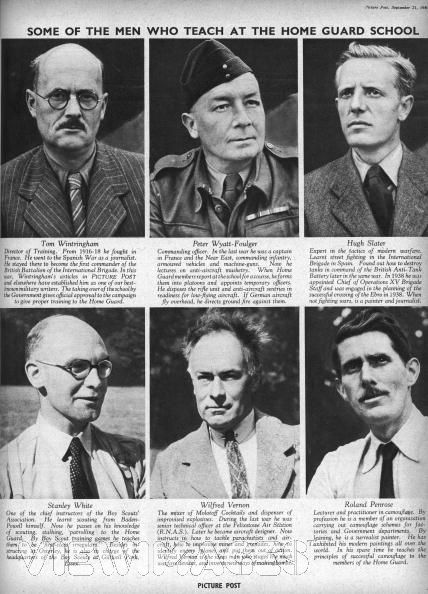
The Home Guard 70 Years On


This year marks the 70th Anniversary of the establishment of the Home Guard. The BBC has reported that it is being marked by a number of events such as archaeological work at Osterley Park, where the Home Guard trained its members. Part of the Transitional Programme echoes the US Constitution, which guarantees the right to bear arms as part of a well-regulated militia, and calls for the establishment of a Workers' Militia. Engels also favoured Universal Conscription, which he said was the necessary concomitant of Universal Suffrage. The history of the establishment of the Home Guard is important for socialists in all these respects, and more. It owed its establishment ot the work of one Communist – Tom Wintringham.


During the 1930’s repeated demands had been raised, by Tom Wintringham, for Britain to introduce adequate Air Raid Protection (ARP) measures. Wintringham had been a founding member of the British Communist Party. On the outbreak of the First World War he had given up his studies at Oxford University and signed up for the Royal Flying Corps. His politics are somewhat eclectic. Long before the policy was adopted by the Comintern he argued for cross class Popular Fronts. But, Wintringham also seems to have developed, fairly early on, some unease at the polciies being adopted by Stalin, and his Popular Frontism seems also to have been driven by a concern that change should be driven from the bottom up, rather than from the State down, as his later political activity demonstrated.

In the 1930’s he went to fight on the Republican side in the Spanish Civil War, and became the Commander of the English Battalion of the International Brigade.

See: Wintringham .

There he learned guerilla tactics, and as WWII loomed he argued not only the need for ARP measures, but also that the British people should be trained in such tactics to fight against any invaders. He argued strongly in favour of the Local Defence Volunteers (LDV), which was to become the Home Guard. But, when the LDV was first established it was a haphazard affair, much like the portrayal in “Dad’s Army”. Wintringham was brought in to organise proper training at Osterley Park.

See: Wintringham and the Home Guard .

Wintringham worked for the Picture Post, and when the film “The Life and Times of Colonel Blimp” was made it was Wintringham whose role was portrayed. Osterely Park was established not as a Government facility, but a private facility by the Picture Post.

See: Picture Post

Ironically, although a large part of the initial organisation and training for the Home Guard is attributable to Wintringham, he was not allowed to join it himself, because he was a member of the Communist Party!!!!

In Spain, Wintringham had an affair with an American Trotskyist, Kitty Bowler, who became his wife. His refusal to leave her led to his expulsion from the Communist Party. Wintringham’s political trajectory then led him to advance positions close to what would today be called Libertarian Socialism. His Popular Frontism led him into an alliance with Liberals, and together with J.B. Priestley he set up the Commonwealth Party, which sought to advocate politics based upon Co-operation. Having said that, at a time when the LP itself was in a Popular Front, National Government with the Tories, and the Communist Party was banned, the Commonwealth Party, did stand candidates in elections against the National Government candidates, in order to provide a socialist choice for workers, and did achieve some degree of success.

See: Commonwealth party

For more information on Wintringham and his writings see:
Wintringham Index

and

Tom Wintringham .

See Also:proletarian Military Policy