Showing posts with label Nationalisation. Show all posts

Wednesday, 27 September 2017

Labour Is Getting Bamboozled Over Nationalisation

Labour has committed to renationalising a series of industries from rail to mail. The policy presents a gift to the Tory media to ask the question of where the money for such policies will come from. In fact, there is no reason for Labour to “nationalise” these industries, because their capital is already “socialised”. All that Labour needs to do is to change the laws on corporate governance, so as to prevent shareholders from exercising any control over it, and that would cost a Labour government nothing. It also deals with the problem of “capital flight”.

Let's deal with the facts. When an individual sets up a company, and uses their own money-capital to do so, they use their money to buy premises, machines, materials and to employ labour-power. They no longer then own money-capital, because it has been metamorphosed into productive-capital. Instead of owning money-capital, they now own productive-capital, and it is up to them what they do with it. 

But, such an individual may also borrow some money-capital from a bank, which they then metamorphose into productive-capital. The bank lends this money-capital for a given period of time, at a given rate of interest. The bank continues to own this money-capital, even though it is not in their possession. They can ask for it back within the terms of the loan agreement, along with the interest. However, the bank does not own the productive-capital that the individual private capitalist has bought with this money. That belongs to the individual capitalist, and they control it, not the bank. Provided the individual capitalist conforms to the loan agreement, and makes the required repayments, the bank has no more right to tell them how to use their capital, than it does to tell a homeowner, what colour to paint their living room, just because they gave them a mortgage to buy a house.

But, larger businesses require more money-capital, in order to be able to undertake business on a larger scale than does an individual private capitalist. Moreover, the cost of borrowing these larger sums is lower if other means of financing are used. A large company might, for example, issue bonds or debentures, and these can be bought by the public, and financial institutions. Such bonds offer to pay a fixed amount of interest, or coupon, for the duration of the bond, and to give back the face value of the bond to the buyer at the end of this period. Once again, the lenders, who buy these bonds, do not have control over the productive-capital that the company buys with the borrowed money.

An economic and legal agreement is entered into by the borrower and lender, the bond issuer and bond buyer. The former agrees to pay the latter the market rate of interest on the money-capital they lend, and to return their money-capital to them at the due date. But neither the economic nor legal agreement requires the borrower to give the lender control over what they do with the borrowed money, or over the productive-capital they turn it into. Once again, the lender, the bond buyer, remains the legal owner of the money-capital, although in return for interest, they have temporarily given up possession and control over it. The borrower, the company issuing the bond, does not own the money-capital, but they have possession of it, and control over its use, including the right to use it as capital, to metamorphose it into productive-capital. The interest they pay, is the price for that usage of the money-capital, of its potential to create for them the average rate of profit.

The company that has borrowed the money-capital does not own the money-capital, but owns the real capital that it has been metamorphosed into. It is that real capital that produces the profit, that enables the interest to the money lender to be paid. The money lender, or bondholder, owns the money-capital, that they have rented out to the productive-capitalist, in return for a bond that pays them interest. This bond is not real capital. It is fictitious capital. That is, unlike the real capital represented by the factory, machines, materials and labour-power, it has no power of its own to create profit. Its own value increases, only because the productive-capitalist uses it to acquire productive-capital to engage in production of goods and services, and thereby to create a profit.

A company that issues shares, is then no different than a company that borrows money from a bank to use to turn into productive-capital, or which issues bonds to obtain money, which it uses to turn into productive-capital. These are just different ways of a company obtaining money, to use as money-capital, which can be turned into productive-capital, which the company owns, and uses to produce profits. Logically, those who lend money to companies by buying the company's shares, have no more right to demand control over the productive-capital that the company acquires with that money, than do bondholders, or banks who make such loans. Yet, they do.

As FT columnist and author John Kay writes, in a piece with Aubrey Silberston,

“... do BT shareholders own BT? Begin by noting the difference between the statement “BT shareholders own their shares in BT” and the statement “BT shareholders own BT”. There is not much doubt that the first of these is true. They enjoy the rights of possession of their shares – even under CREST, you can still insist on holding a physical share certificate if you want one. And no-one will dispute your right to the income from the shares, or to the capital value of your shares, or argue with you if you want to sell them or give them away. You may not use your shares harmfully – it is difficult to think of how you might – and your creditors may take them over when you fail to meet your obligations.

But none of this means that the owners of BT shares own BT – after all, investors own BT bonds, landlords own BT premises, and lessors own BT equipment, but no-one would suggest that BT itself is owned by these investors, landlords or lessors. The claim that BT is owned by its shareholders implies that there is something special about their contract with the company which means that they are owners, not just of that contract, but of the company itself.”

There is no logical, economic or juridical reason that shareholders should be any different to bondholders, or a bank that lends money to a business, in terms of being able to exercise control over capital, which they do not own, i.e. the firm's productive-capital, which has been bought with the borrowed money. Indeed, there is no such reason why they should exercise any control over the use of the money they have lent either. By agreeing to pay interest, in the form of dividends, the company has agreed to pay the market rate of interest to the lender of the money, precisely in order that the company, not the lender should be able to exercise that control, and obtain the use value of the capital to produce profits. To use Kay and Silberston's example, taken from Honore, it would be like someone agreeing to lend you an umbrella, for a given charge, but then continuing to use the umbrella themselves, or dictating how and when it could be used.

The only reason that shareholders have this unwarranted right, to determine company policy, to appoint Boards of Directors, and company executives comes down to a question of political power, just like, in the past, the political power of the landed aristocracy allowed them to pass legislation through Parliament that gave them unwarranted rights and privileges. The owner of a company's actual productive-capital, is the company itself as a legal entity in its own right. And, the company can be nothing other than the people employed by it, from the most important manager, down to the day labourer who sweeps the floor. The company is nothing other than these “associated producers”, and it is they who should exercise democratic control over the company's capital not the shareholders, who merely loaned money to the company in return for interest, and the potential for capital gains, if the company's shares increased in price.

Other countries have recognised this simple fact, and at least partially acted upon it. Germany, for example, established co-determination laws, back in the middle of the 19th century. They guarantee the workers in company's over a minimum size the right to elect half of the supervising boards of the company. In 1975, Harold Wilson asked Alan Bullock to undertake an inquiry into industrial democracy in Britain, along similar lines. The Bullock Report, proposed changes to company law that were slightly more far reaching than the co-determination laws in Germany, which still enshrine a majority for shareholders by giving them the casting vote of the Chair. And at the same time the EU, in its Draft Fifth Company Law Directive, made proposals to extend such industrial democracy across the whole of the EU.

But, in the late 1970's, conservative governments, like that of Thatcher in Britain came to power. These conservative parties are based upon the owners of fictitious capital, share and bondholders, as well as the remaining small private capitalists. Despite the fact that the Tory media talk about Labour being hostile to business, it is actually these conservative parties that are hostile to actual business, because instead they look after the interests of these money lenders, that seek to drain money from businesses, in dividends and other such payments, and thereby reduce the ability of businesses to invest and to expand. The political power of conservative parties and politicians from the 1980's onwards, prevented the further development of industrial democracy that was required to ensure that large-scale socialised capital could be managed and organised rationally and democratically, and instead increased the power of the money lenders, and of fictitious capital. It was part and parcel of blowing of financial asset and property bubbles, and of massively increasing debt that these parties promoted in the 1980's and 90's, and which led to the financial meltdown of 2008, and the even bigger one to come.

So, there is no need for a Labour government to spend any money nationalising any companies. The large companies are already socialised. They already own their own capital. It is merely that current company law allows shareholders to exercise unwarranted control over capital they do not own, and which actually belongs to the company, to the workers and managers within each company. Why on Earth would a Labour government pay money to shareholders to buy back real capital that does not belong to those shareholders in the first place? That makes no sense. They could, of course, pay money to buy back the shares that those shareholders own, but again why would you want to do that? In order to to raise the money to buy the shares, the government, or the workers in the company would have to borrow the money on the capital markets, and by and large, the people who would be lending the money on those capital markets, for example to buy government bonds, are the same people who already own the majority of shares. It would simply be swapping shares for bonds!

All that a Labour government need do is to change Company Law. That overnight would change the relationship in every company. It would simply say that shareholders had no right to elect boards of directors, or to appoint executives of companies. It would vest that right where it belongs, democratically in the hands of the company itself, of its associated producers, the workers and managers within the company. The shareholders would continue to have the right to exercise control over the only thing they do own, their shares. They could buy and sell them as they wish, and would be entitled to receive a dividend on them. The company would have an economic imperative to pay dividends that matched the market rate of interest, because if they did not, they would be unable to raise additional funds by selling more shares, and the price of their own shares would fall, so that they were less able to use those shares as collateral.  In the end, that is even beneficial to shareholders and bondholders, because with more of the profits being invested productively, rather than paid out in dividends or inflated salaries to executives, all companies would produce more profits, which means they could then pay out more in interest.

There would be no cost to workers or to a Labour government of such a policy. Moreover, it does away with the problem of capital flight. What a company is actually concerned with, what enables it to make profits so as again to be able to invest, is not its shares, but its actual capital. Shareholders can be free to sell their shares, as part of a process of capital flight, if they choose. It will not affect the real capital of the company, its buildings, machines and so on, which have been bought from the money raised long ago, in the issue of those shares. All of that real capital would continue to function unchanged. It would be the shareholders who would lose out, because all they own is shares, bits of paper, and the more they sell those shares, the more the value of the shares they own gets reduced. They would simply be reducing their own fictitious wealth.

In fact, as I've set out previously, its because of that fact, that if I were a Labour Chancellor, one of the things that I would do, alongside changing the laws on corporate governance, as described, would be to scrap Corporation Tax, and instead to place that tax burden on dividends, capital gains, and via a wealth tax. After all, we want companies to use their corporate profits to expand the company, and with workers exercising control over those profits, they would have a direct interest in doing so. Workers in control over their own companies would not take kindly to a large chunk of their profits, and potential for growth being taken by the taxman. Instead, by more heavily taxing dividends, and other forms of unearned income, along with heavier taxation of capital gains, which are by definition unearned income, and through a wealth tax on all financial assets, and property over a minimum level of say £10 million, a Labour government could bring about a powerful economic boost that would itself generate the tax revenues to finance other aspects of its agenda. 

Friday, 6 December 2013

Where The AWL's Policy of Nation- alisation Leads

A clear example of where the Stalinist (national-socialist) politics of the AWL (and others), who call for nation-alisation by the capitalist state, leads is given in their recent article on Npower.

N-power, is making a large number of workers in the UK redundant, because it is transferring the work to call centres in India, where it can pay workers less.  In reality, this is no different than consumers in Britain buying cheap imported commodities from China and elsewhere, because they can obtain better value than buying the same commodities made in the UK.  This, unfortunately, is the way capitalism works.  Traditionally, socialists, as internationalists, have refused to blame those foreign workers for producing these commodities more cheaply than workers in their own country, and thereby obtaining the work.  They have blamed the unplanned and chaotic nature of Capitalism, for the fact that their fellow workers lose their job in the process, and pointed to it, as a reason that Capitalism needs to be replaced.

In that process, they have certainly refused to line up with their own domestic bosses to demand import controls, or any other measure that amounts to a reactionary, nationalistic call for "British Jobs For British Workers".  If the UK were a Workers State, with the means of production owned by their workers, then matters would be different.  It would then be a matter of using whatever means were necessary to defend that Workers State, and worker owned property against capitalist property wherever it was located.  The same is true where a firm is owned by its workers within Capitalism, socialists should call for its defence by whatever means are necessary against capitalist competition.

But, the UK most certainly is not a Workers State, and what the AWL propose is not to place the ownership of Npower or any other means of production into the hands of workers.  Instead, what they call for is for Npower, and other means of production to be gathered up into the hands of the workers main enemy - the Capitalist State!  They argue,

"We need to defend every job and at the same time campaign for social ownership of the energy sector."

But, its obvious under current conditions what this means.  It is a call to join forces with British Capital against those foreign workers.  It is a demand for Npower to be taken over by British Capital, so that it will keep those jobs in Britain, rather than them being taken over by foreign workers.  The clue to what the demand for Nation-alisation really means is given in the name.  It is precisely a Nation-alistic demand for British workers to join forces with the British national, capitalist state, and thereby with British capital, against foreign workers.  That is the reality of the demand for national-isation within the context of a capitalist state.  A thoroughly reactionary, and nationalist demand.

Sunday, 21 July 2013

The NHS – Another Failure Of State Capitalism

Go to any anti-cuts demo, and you will see the placards proclaiming - “Save Our NHS”. If it really was OUR NHS, then we should feel mortally ashamed of ourselves! How on Earth could we live with the shame that an organisation that was OURS has such an appalling record as that illustrated in the Keogh report, which itself it only the latest in a litany of such revelations about the appalling treatment that people, particularly elderly people are subjected to. It is not just a failure to provide the kind of health outcomes that should be expected from the vast amounts of our money that is paid into it, but simply the lack of care and compassion that exists within an organisation for which those should be the core principals. 

But, of course, the NHS is not OURS at all, it never has been and never will be. Like every other state capitalist organisation it was created in the interests of Capital in General, like every other state capitalist organisation it is under the control of the same elite of bureaucrats, the highly paid executives that come from the same privileged backgrounds, that run their other businesses, and run the state itself for and on behalf of the capitalist class. The only shame we should feel in relation to the NHS is that we allowed ourselves to be conned into believing that the Capitalist State was in some way class neutral, that it even acted in our interests rather than those of the capitalist class.

State capitalist organisations like the NHS, or the education system, are instruments of class rule the same as all the other arms of the capitalists' state, such as the police, the armed forces, the judiciary and the civil service. There is no more chance that the entrenched power of capital will simply hand over control of any of these instruments of its rule over us, than there is of Al Assad handing over control of the Syrian state to the Syrian workers. And the British capitalist class and its state are far more powerful, far more entrenched than Assad could ever be. If we ever wanted that kind of control, it would require a revolution far more thoroughgoing than that started in Syria. It would require overwhelming numbers and determination on the side of the British working-class to bring about.

No one seriously believes that workers could obtain democratic control over the police or the army, or that any time short of the revolution the judges are suddenly going to start representing the interests of workers, so why on Earth would anyone believe that other arms of the state such as the NHS, or education would be any different? Of course, that doesn't mean we shouldn't demand at least some basic elements of democracy for all these aspects of the state. Even the US has elected judges, and other state officials. Workers in the armed forces have as much right to Health and Safety protection, and so on, and other democratic rights, including election of their superiors as anyone else.

But, in reality, we know that in order to exercise control you need ownership, and for so long as its not our state, none of these things will be allowed to be under our control. Instead of some elusive democratic control over the police and armed forces, we know that what we need are workers defence organisations and workers militia. Again, even the US Constitution calls for a Militia. In the same way, if we want workers control over health and education, we will need to build our own alternative provision to that owned and controlled by the capitalists state.

But, the failure of the NHS is only the latest example of a series of such failures of state capitalism. Marx and Engels set out the way that capitalism developed. From the first, small scale, individual capitalists developed bigger capitalists, that became smaller in number, and bigger still in size as the smaller capitalists were squeezed out. In the end, this monopoly of private capitalists could go no further. As Marx describes it there then took place an expropriation of the expropriators, as these large private capitalists were themselves replaced by social capital in the form of the joint stock companies financed by credit, which in turn developed into the giant trusts.

As Engels says, the development of state capitalism was merely the logical extension of that process. In “Anti-Duhring”, Engels describes how this process establishes the basis for a transformation to socialism, because such a situation, where the means of production were in the hands of the capitalist state, which in turn operated on behalf of the capitalist class, who were now reduced to a class of rentier's, 'coupon clippers' who simply drew their surplus value in the form of interest payments on their government bonds, would be so obviously unjust, so patently exploitative, so manifestly parasitical, that the workers would quickly sweep it away, and replace it with their own ownership and control of the means of production. If only!

As Kautsky pointed out, In the 'Erfurt Programme'

“If the modern state nationalizes certain industries, it does not do so for the purpose of restricting capitalist exploitation, but for the purpose of protecting the capitalist system and establishing it upon a firmer basis, or for the purpose of itself taking a hand in the exploitation of labour, increasing its own revenues, and thereby reducing the contributions for its own support which it would otherwise have to impose upon the capitalist class. As an exploiter of labour, the state is superior to any private capitalist. Besides the economic power of the capitalists, it can also bring to bear upon the exploited classes the political power which it already wields.

The state has never carried on the nationalizing of industries further than the interests of the ruling classes demanded, nor will it ever go further than that. So long as the property-holding classes are the ruling ones, the nationalization of industries and capitalist functions will never be carried so far as to injure the capitalists and landlords or to restrict their opportunities for exploiting the proletariat.”

There are no shortages of such examples, the most striking, in Britain, being the way the nationalised col industry, backed by the entire might of that capitalist state was used to smash the miners in 1984-5, and thereby to inflict a devastating defeat on the working class as a whole. But, the experience of all the other nationalised industries was no different. Every nationalised industry was compelled by law to sell its output at prices equal to the marginal cost of production. No large scale capitalist business does that, even though bourgeois economic theory says they should. They all set prices higher than that. In effect, the nationalised industries were giving direct subsidies in their pricing to large non-state capitalist enterprises. Those subsidies amounted to a direct transfer of the surplus value created by workers in the nationalised industry to the non-state companies. On many occasions they also amounted to a subsidy from workers in general who provided the money to cover those subsidies.

The NHS was no different. A rational health service would focus its resources on preventing ill-health as much as possible. That would require tackling the causes of ill-health in workers poor working and living conditions, in the way they are encouraged to consume things that make them ill and so on. It would focus on Primary Care, to spot ill-health at an early stage and deal with it. All of these things are not only better for workers, who thereby avoid chronic ill-health, but they are also low cost solutions, thereby costing workers less to achieve.

Ultimately, for that reason they are rational solutions for capital too, because they reduce the value of labour-power and thereby boost relative surplus value. But, capital does not act rationally, even in terms of achieving its own ends, because capital also exists as “many capitals”. Powerful individual capitalist enterprises benefit to the tune of billions of pounds a year from selling drugs to the NHS to treat illnesses that have been allowed to develop; from selling hospital buildings, technology, computer systems and so on required for the extensive range of highly expensive forms of healthcare required to deal with chronic illnesses. Moreover, the state bureaucrats who run the NHS and Department of Health, who like all such bureaucrats flit from the state to non-state employment, themselves have a vested interest in building their own empires on the back of these forms of healthcare sold as a commodity, as opposed to a rational system of primary healthcare and prevention. And once that method has developed, it is no wonder that it spreads throughout the organisation. Responsibility for the failings of the NHS rest with its top management whatever the individual failings of nurses and others. As the saying goes a fish rots from the head down.

In many ways, its like what Marx said in relation to agriculture.

“The moral of history, also to be deduced from other observations concerning agriculture, is that the capitalist system works against a rational agriculture, or that a rational agriculture is incompatible with the capitalist system (although the latter promotes technical improvements in agriculture), and needs either the hand of the small farmer living by his own labour or the control of associated producers.” (Capital III, Chapter 6) 

Going back to the hand of the small doctor is certainly not something any Marxist would propose. But, a rational health system does require an alternative to the NHS, one under the direct ownership and control of workers themselves.

In reality, of course, workers themselves have recognised what Engels hoped they would about state capitalism. The trouble is that their leaders, including those within the supposed revolutionary organisations have not. The reformists would always present the state as class neutral. For the Stalinists, Socialism was state ownership and control by state bureaucrats. But, the supposed anti-Stalinist Left has been no better. It has acted as cheerleaders for state capitalism itself, with only the ridiculous calls for Workers Control  tagged on to provide revolutionary cover for a reformist demand, in a way that Marx would have labelled “revolutionary phrase-mongering”.

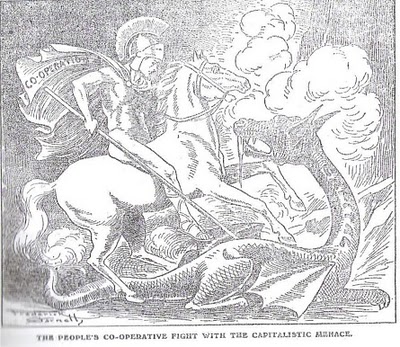
Workers have had to scrabble for an understanding themselves. Every 20 years, the number of worker co-operatives rises significantly, and the number of people involved in co-ops continues to rise. Slowly, quietly they have been far more successful than has been the workers parties that have continued to decline. But, without the kind of guidance that a Workers Party could provide, without the coming together of those Co-ops with the workers parties and trades unions, and the creation of a large co-op federation, even their progress must be fitful.  What would once have been called the Left is now not distinguishable from the Tories; the revolutionary left has ceased being revolutionary, if it every really was, and instead is reduced to trade union style activism, economism, and the reformist ideas and politics that arise from it. Its height of real political ambition is only to recreate the failed Labourist model that previously developed on the back of trade union politics, but even that has no resonance within the working class. At home its politics is reduced to old style social democracy, and abroad it is reduced to old style radical Liberalism, acting as cheerleaders for one or other faction of the bourgeoisie alternately under the mask of democracy or authoritarianism.

Its understandable that Stalinists should adopt this approach to the State. In many ways the NHS is no different from the huge bureaucratic monstrosities it created, which makes the actions of those that refused to defend the USSR, because it was “state-capitalist”, all the more hypocritical, in being uncritical defenders of the actually state-capitalist NHS! But, its also understandable why the revolutionary sects adopt this approach rather than actual worker ownership and control, which usually they not only do not support, but vehemently oppose!

The reality is that those sects, whilst proclaiming the role of the workers as the agent of revolutionary change are as dismissive of the real working class as the Stalinists. The workers are fine provided they know their place, and provide the foot soldiers the “professional” revolutionaries need to implement their plans. But, their ultimate view of socialism is one in which they are the ones making the decisions that the workers rubber stamp. That is why they are as happy as the Right to engage in the kind of machine politics seen in Falkirk to obtain a majority, be it to pass a resolution or to win a position. It is only the same kind of machine politics that the left sects have engaged in in trade union “Broad lefts” and “rank and file” groups for decades. The function was never to build a real mass rank and file organisation, but only to build sufficient votes to obtain a majority. The problem being, of course, that a mandate, from an insignificant minority of the working-class, is, in practice, a mandate to be able to do absolutely nothing!

If the working class is to move forward it has to move beyond these kinds of toy town politics, beyond the romantic fantasies of the student revolutionaries, and return to the ideas of Marx and Engels and others that starts with the real working-class, warts and all, and the need for it to develop its own organisations separate from the capitalist state. The more the Left seeks to defend the indefensible in the form of state capitalism in its various guises, the more it will simply make itself even more irrelevant.

Workers faced with the reality of bureaucratic and oppressive, state capitalist housing provision, and offered no socialist alternative, jumped at the chance provided by Thatcher to create their own alternative by buying their houses. Other than for railways, there has been no great desire by workers to demand the restoration of the old bureaucratic state capitalist enterprises either. Even in the case of railways its hardly as though workers are rioting in the streets demanding it be carried out either. Faced with only a tweedle-dee, tweedle dum alternative of state capitalist provision or some other form of capitalist provision, workers at best sway between the two, just as they sway between voting Tory or Labour.

To build Socialism will require that the working class in its vast majority feels far more committed to a different solution, and one it can create and control itself from the beginning.

Tuesday, 8 May 2012

AWL Stalinism, Once More - Part 4

The Reality of Worker Ownership & State Ownership

Co-op Consumer Research & Protection
But, the AWL's argument is factually and historically wrong anyway. Take the example of the Co-op itself, which, as a Consumer Co-op, is the least favourable variant of Co-op for those who work for it. In her book, "The Co-operative Movement and Communities in Britain, 1914-60", Nicole Robertson sets out a number of ways in which the Co-op certainly did not simply respond to the needs of the market, as I set out in my review of the book in The Weekly Worker.

From the beginning, the Co-op provided Education and Healthcare both for its members and its workers long before the Capitalist State did so. It also provided social facilities within working class communities, providing them with a focus around which to organise their activities from weddings to Trades Union meetings.

Co-op International College
As early as the 1850's, the Co-op had built extensive international links, including the establishment of its International College at Stanford Hall. It continued to argue its internationalist message during the two World Wars, including sending educational and propaganda material to its members fighting at the front. In fact, the Co-ops history of internationalism is far better than that of either the Trades Unions, or any of the Internationals.

After WWI, the Co-op began an open political campaign against Capitalism, and against the rampant profiteering of the time. It provided its resources, and knowledge of prices obtained from the CWS, to create a workers cost of living index, which it implemented with the London Trades Councils through the London Food Vigilance Committee.

During the 1919 railway strike, co-ops supplied food to the strikers. The shopworkers union in 1921 devised a plan to get supplies to members of the Triple Alliance, in case of a strike, via a national strike food committee, made up of the alliance, the co-operative movement and its employees. Co-op societies would be urged to move stocks lying at railways and in warehouses, “so that stores can be in our hands before the government commandeers the larger accumulation of supplies”. In case of shortages, committees would rely on the wartime experience of co-ops in organising rationing.

During the General Strike retail societies contributed £48,000 to national appeals, food and clothing worth £131,000 was handed over, and trade union credit of nearly half a million pounds was extended. It was alleged that £400,000 was transferred from the USSR to the Miners’ Federation, through the Co-operative Wholesale Society.

When the Tories attempted to prevent a repeat by introducing the Trades Dispute and Trades Union Bill in 1927, the central board of the Co-operative Union noted that “capitalist interests that have demanded this bill from the government are the same business and political interests that are striving to hamper the legitimate development of co-operation” and called upon “all co-operators to assist the trade unions in every possible way to defeat this reactionary measure”.

In the 1930s the Co-op Union organised support for the National Unemployed Workers Movement and the hunger marches, even though they were ignored at a national level by the Trades Unions and Labour Party.

At the beginning of the twentieth century the Co-op was the first to introduce a 48 hour week for its workers when most other workers were still working a 50-60 hour week. That went along with paid holidays, the provision of health insurance and more.

But, of course, none of this is of concern to the Stalinist sectarians of the AWL, whose vision remains constrained within the limits of a purely Trades Union consciousness at best.

The AWL talk about,

“the socialist demand for publicly-owned, publicly-funded services run under democratic control.”

The Popular Front
That again is a clear example of the Stalinist nature of their politics. Talk of the “Public” or “The People” is common coin amongst all Stalinists, precisely because it is a class neutral term that disguises the true nature of the class politics that underlies it. For Marxists, all talk of “The People” or “The Public” is meaningless precisely because it hides the fact that society is divided into classes with contradictory interests. In a society where the Capitalist Class is the dominant class, what such terms are cover for is action in the name of that dominant class. Ownership by the Capitalist State can never be in the interests of the vast majority of that “People” or “Public” - the workers – but is always carried out by that State in the interests of the dominant class i.e. the Capitalists!

And as Anton Pannakoek described it,

“The acknowledged aim of socialism is to take the means of production out of the hands of the capitalist class and place them into the hands of the workers. This aim is sometimes spoken of as public ownership, sometimes as common ownership of the production apparatus. There is, however, a marked and fundamental difference.


“Public ownership is the ownership, i.e. the right of disposal, by a public body representing society, by government, state power or some other political body. The persons forming this body, the politicians, officials, leaders, secretaries, managers, are the direct masters of the production apparatus; they direct and regulate the process of production; they command the workers. Common ownership is the right of disposal by the workers themselves; the working class itself — taken in the widest sense of all that partake in really productive work, including employees, farmers, scientists — is direct master of the production apparatus, managing, directing, and regulating the process of production which is, indeed, their common work…


“As a correction to State-managed production, sometimes workers’ control is demanded. Now, to ask control, supervision, from a superior indicates the submissive mood of helpless objects of exploitation. And then can you control another man’s business; what is your own business you do not want controlled, you do it. Productive work, social production, is the genuine business of the working class. It is the content of their life, their own activity. They themselves can take care if there is no police or State power to keep them off. They have the tools, the machines in their hands, they use and manage them. They do not need masters to command them, nor finances to control the masters.

Public ownership is the program of “friends” of the workers who for the hard exploitation of private capitalism wish to substitute a milder modernized exploitation. Common ownership is the program of the working class itself, fighting for self liberation….”


The AWL, are usually not averse to quoting the words of US Third Campist, Hal Draper, but on the question of Statism and Plannism even Draper speaks against them. In his pamphlet The Two Souls Of Socialism, Draper writes,


“These two self-styled socialisms are very different, but they have more in common than they think. The social democracy has typically dreamed of “socializing” capitalism from above. Its principle has always been that increased state intervention in society and economy is per se socialistic. It bears a fatal family resemblance to the Stalinist conception of imposing something called socialism from the top down, and of equating statification with socialism. Both have their roots in the ambiguous history of the socialist idea...


“But at least he seems to have read Marx, and realized that nowhere, in acres of writing and a long life, did Marx evince concern about more power for the state but rather the reverse. Marx, it dawned on him, was not a “statist”:” … (Ch. 5)

“But Marx made no fetish of “total planning.” He has so often been denounced (by other Marx-critics) for failing to draw up a blueprint of socialism precisely because he reacted so violently against his predecessors’ utopian “plannism” or planning-from-above. “Plannism” is precisely the conception of socialism that Marxism wished to destroy.” (ibid)


Its no surprise that the original State Socialist, Ferdinand Lassalle, was, like the AWL, led into advocating Nationalistic and Imperialist positions. Draper cites Lassalle's biographer,


“This is what made Marx and Lassalle “fundamentally opposed,” points out Lassalle’s biographer Footman, who lays bare his pro-Prussianism, pro-Prussian nationalism, pro-Prussian imperialism.”

Rather than seeking to build up the power of the State by encouraging it to take on a greater role in society, Marx's position was the very opposite. In, The 18th Brumaire, Marx writes,

“All revolutions perfected this machine instead of breaking it. The parties, which alternately contended for domination, regarded the possession of this huge state structure as the chief spoils of the victor.”


Marx recognised in his analysis of the State that it continually attempted to set itself free from Civil Society, and to stand over it. That is what Bonapartism is. It can only be held in check by a strong and secure ruling class. But, the working-class can never be in that position. In respect of the Capitalist State it is an oppressed class, and, even after the Revolution, its position as ruling class is necessarily neither strong nor secure. By the time it is strong and secure, the need for such a State no longer exists. It can never be in the interests of workers then to make the State strong by ceding to it increasing amounts of economic power, from which it derives social and political power. Lenin seems to have realised that too late in relation to the Russian Revolution. In 1923, in his speech On Co-operation he said,


“We went too far when we reintroduced NEP, but not because we attached too much importance to the principal of free enterprise and trade — we want too far because we lost sight of the cooperatives, because we now underrate cooperatives, because we are already beginning to forget the vast importance of the cooperatives from the above two points of view.”

Tuesday, 1 May 2012

AWL Stalinism, Once More - Part 2

Third Period Ultraleftism and the Requirement For Purity and Perfection


Of course, there are parts of what the AWL say, which is correct. They are correct to point to the inadequacies of the John Lewis model, and of the Co-op. Neither of these organisations are the kind of Worker Owned Co-operative advocated by Marx and Engels. But, it is typical Stalinist, Third Period Ultraleftism to reject out of hand the experiments of the workers in this manner, simply because they do not yet conform exactly to the perfection that the sectarians demand! That is not at all the method of Marx and Engels, who argued that workers would have to make such mistakes in order to learn and progress from them. It is for that reason that in the Programme he wrote for the First International, Marx argued against being prescriptive about the forms of Co-operative the workers should establish. He wrote,


“It is the business of the International Working Men's Association to combine and generalise the spontaneous movements of the working classes, but not to dictate or impose any doctrinary system whatever. The Congress should, therefore, proclaim no special system of co-operation, but limit itself to the enunciation of a few general principles.”


But, that did not prevent him, as part of those general principles, from arguing that workers should establish productive Co-operatives rather than consumer Co-operatives. As he puts it,


“We recommend to the working men to embark in co-operative production rather than in co-operative stores. The latter touch but the surface of the present economical system, the former attacks its groundwork.”


And of course, they are right to say that “Marx also argued that they cannot conceivably replace the capitalist economy, bit by bit.” Yet, unlike the Stalinists of the AWL, who openly argue against the building of Worker Owned Co-operatives, wherever Marx makes this statement it is combined with an open demand that workers SHOULD establish such Co-operatives. Rather than arguing that workers should not establish Co-operatives, because they cannot simply replace Capitalism, Marx argues that ultimately, this limitation will mean that workers have to struggle to win State power, and that they will be better placed to do that, the more they advance their own economic and social position, transforming themselves into becoming fit to rule in the process, and a central component of doing that will indeed involve the building of Worker Owned Co-operatives, as part of the overall class struggle. Moreover, Marx makes clear that he does see the building of such Co-operatives both as occurring within the continuation of the market, and extending nationally on a gradual basis. In Capital Vol.III, which was published by Engels near the end of his life, and without any note to say that changes had invalidated Marx's earlier argument, he writes,


“The co-operative factories of the labourers themselves represent within the old form the first sprouts of the new, although they naturally reproduce, and must reproduce, everywhere in their actual organisation all the shortcomings of the prevailing system. But the antithesis between capital and labour is overcome within them, if at first only by way of making the associated labourers into their own capitalist, i.e., by enabling them to use the means of production for the employment of their own labour. They show how a new mode of production naturally grows out of an old one, when the development of the material forces of production and of the corresponding forms of social production have reached a particular stage. Without the factory system arising out of the capitalist mode of production there could have been no co-operative factories. Nor could these have developed without the credit system arising out of the same mode of production. The credit system is not only the principal basis for the gradual transformation of capitalist private enterprises. into capitalist stock companies, but equally offers the means for the gradual extension of co-operative enterprises on a more or less national scale. The capitalist stock companies, as much as the co-operative factories, should be considered as transitional forms from the capitalist mode of production to the associated one, with the only distinction that the antagonism is resolved negatively in the one and positively in the other.”


He goes on,

“The two characteristics immanent in the credit system are, on the one hand, to develop the incentive of capitalist production, enrichment through exploitation of the labour of others, to the purest and most colossal form of gambling and swindling, and to reduce more and more the number of the few who exploit the social wealth; on the other hand, to constitute the form of transition to a new mode of production. It is this ambiguous nature, which endows the principal spokesmen of credit from Law to Isaac Pereire with the pleasant character mixture of swindler and prophet.”

So, it is clear that far from arguing for nationalisation by the Capitalist State, or even by a Workers State, Marx and Engels saw the transition to Socialism being achieved by “the gradual extension of co-operative enterprises on a more or less national scale”, and this would be achieved by the use of the Credit System, which “constitute(s) the form of transition to a new mode of production.”

This conforms to Marx's statement in the Grundrisse, where he writes,

"As the system of bourgeois economy has developed for us only by degrees so too its negation, which is its ultimate result." p712.

Similarly, Engels wrote later in a letter to Bebel,


“the workers should operate the factories shut down by the factory-owners on a cooperative basis. That is the great difference. And Marx and I never doubted that in the transition to the full communist economy we will have to use the cooperative system as an intermediate stage on a large scale.”


Thursday, 26 April 2012

AWL Stalinism, Once More - Part 1

Revolutionary Socialist Internationalism v Statist Nationalism


In a recent article, the AWL attack the Marxist strategy for developing worker-owned Co-operatives, and instead argue for the Lassallean demand for nationalisation by the Capitalist State, which was adopted by the reformists of the Second International, and later by the Stalinists. Marx's strategy of building Co-ops was both revolutionary and internationalist. Revolutionary, because it relies on the self-activity of the workers themselves, and immediately transforms Capitalist property relations, and internationalist because Co-operatives, and Co-operative Federations, can be built across national borders by workers acting in solidarity with each other. The demand for Nation-alisation, by contrast, is both reformist and nationalist. It is reformist because rather than transforming Capitalist property relations, it accepts their continuation explicitly, and restricts itself within them, as well as being based upon action to be taken, not by the workers themselves, but by the Capitalist State, which is their main enemy! It is a Nationalistic demand, by its very nature, because it involves the taking over of Capital, or a fraction of Capital, by the existing Capitalist State, and the existing Capitalist State is a Nation State. It is not surprising that such a demand fits comfortably with the Stalinist politics of the AWL, because Stalinism is characterised both by its reformism, and by its nationalism.


That is why back in the 1970's, the demand for Nation-alisation was a central plank of the Stalinists of the British Communist Party, and their fellow travellers, as part of the Alternative Economic Strategy. But, it was also a central plank of the Programme of the reformists of the Militant Tendency. In fact, at the time, the AWL's predecessors used to point to these demands as evidence of the reformist nature of both organisations. Where the AWL today raise the demand for Nation-alisation only on a piecemeal basis, as a means of bailing out failed private Capitalist businesses, the Militant, at least, used to argue for “Nationalising the 200 Top Monopolies”, which was more radical only in so far as it was more extensive, but which was no less reformist, no less nationalistic.


The Nationalistic rather than socialistic nature of the demand for Nation-alisation is shown by the fact, not only that it is a demand addressed to the existing Capitalist Nation State, but by the fact that it was also raised, and implemented by the Nazis. And, as Trotsky points out, in relation to Mexico, it is a measure that has been adopted by radical nationalist regimes, attempting to build “State Capitalism In One Country”. As in Mexico, some of these regimes have even been prepared to follow the other advice of the AWL, and include the gloss of “Workers' Control” in order to incorporate the working-class, and enlist it as an ally against external enemies – once again emphasising the Nationalist nature of the demand. In the case of economies like Mexico, described by Trotsky, which were under threat from Imperialism, the measure, introduced by such regimes, could have a certain progressive nature, which means that although Marxists would not advocate it, nor would they oppose it, instead attempting to drive the working-class beyond it, and all the time pointing out its true class nature. But, in Imperialist countries, like Britain, it can have no such progressive nature.


Take the example the AWL describe of Vestas. Vestas is an international company. As such, it is quite possible for workers within it, whichever country they are in, to unite in an attempt to take over the means of production and establish a Worker Owned Co-operative, acting similarly on an international basis – which is a precondition for Marxists in establishing Socialism, which can only be established on an international basis. But, the demand for nation-alisation could only ever be raised on a national basis, thereby immediately dividing the Vestas workers in Britain, from those employed in other countries. It is so, because it is a demand for the British Capitalist Nation State to act, to defend its national fraction of the Vestas Capital against its foreign competitors, including the other national fractions of Vestas Capital! That is why, in the past, even Conservative Governments, like that of Ted Heath, have been happy to nation-alise important sections of national Capital, as they did with Rolls Royce in the 1970's. It is why even the arch Neo-Liberals in the US, under George Bush, were happy to nationalise the Banks when they got into trouble.


But, as Trotsky points out, not only is it a “deception” of the working-class to suggest, as the Stalinists like the AWL do, that the road to Socialism can run through such nationalisation by the Capitalist State, rather than the revolutionary action of the workers themselves, but the demand for “Workers Control” is also a deception, which represents a trap for the workers. As Trotsky points out, it is only possible for workers to establish real Workers Control in revolutionary conditions, where a situation of Dual Power already exists in society at large. As Trotsky, says, such conditions themselves can only be short lived, because the question of who rules has to be decided one way or another very quickly. Outside a situation of dual power, there is no way that Capitalists, be they private Capitalists, or a more powerful State Capitalist, will concede real Workers Control. Instead, what they will introduce will be a measure of class collaboration in the name of “Workers Control”, which will be an alliance between the bosses and the Trade Union bureaucrats, whose real purpose will be to ensure the more efficient exploitation of the workers.


Imagine that the Capitalist State had nation-alised Vestas, or as some demanded, Bombardier, and had introduced such a form of “Workers Control”. How much more difficult, would it then have been for revolutionaries to oppose further nationalistic demands for Import Controls, and other such measures to protect this National Capital against foreign competition? Its no wonder that the BNP can support such nationalistic demands.

Monday, 13 September 2010

Why Won't The Unions Fight For Control Of Our Pensions

Over the last few years, I've written quite a few posts about Pensions. From early on, I was interested in the ideas put forward by Robin Blackburn, who spoke about the Swedish example, from the 1980's, where the Trades Unions were able to get a law passed whereby employers had to create new shares that were then paid into a central Pension Fund. Within a short time, it had grown to account for 7% of the value of shares on the Swedish Stock Market. I put forward a similar idea recently as a means by which the Liberal-Tories could raise the funds needed to pay for the deficit - How To Pay For The deficit. The problem with the Swedish model, as with any system that is in the hands of the bosses or their State, was that, when it suited that State, when it was in a position to do so, it simply scrapped the scheme. That should be no surprise. That is what bosses always do, it is what their State always does. Control comes from ownership, and if workers want to have control over their pensions, they have to own them.

But, the irony is that, in Britain, workers do own their Pension Funds, the money in them is our money to pay our pensions, and even the money paid into them by employers is done so as part of a bargaining process. It is their contribution to our deferred wages. Yet, even though these pensions, this money, is our property, we have no control over it. That is at odds even with every tenet of bourgeois property law, and bourgeois ideology, which stresses that the owners of property should have the unfettered ability to dispose of it as they choose. No one would dream of suggesting that if I buy a house, I should not be able to exercise control over how I use it, decorate it, or who I sell it to. So why, should I not have control over the money in my Pension Fund, why should I not, along with every other worker, be able to exercise a collective control over it, decide where it should be invested or not invested, and when and how I should be able to access it, to take my Pension? The Left frequently talks, in the abstract, about Workers Control. It does so by attaching it as a meaningless, utopian demand to the reactionary demand for nationalisation, in the hope, as Marx described, in attacking such demands, to hide their shame. But, when it comes to something immediate and practical, such as the simple demand for workers to have control over their own pensions the same Left is remarkably silent. Why?

In the last couple of decades, we have seen that workers cannot rely on the State Pension. It has been manipulated and mangled in every way conceivable. The Tories broke the link with earnings, at a time when earnings were rising faster than prices. New Labour failed to restore the link, and insulted Pensioners with a 75p rise. Now, in the midst of further cuts, the Liberal-Tories propose to restore the link with earnings just as wages are being frozen, and prices are let rip. Even in its guarantee against prices, it is changing the link from that with RPI to that with the much lower CPI. For the first few decades of the introduction of National Insurance and Pensions, the vast majority were paying in, whilst never living long enough to draw out. Now that workers are living long enough, that they might be able to actually draw Pension, for a few years of active life, the State proposes changing the rules, so that they can't draw their pension until they are much older. Yet, already, workers in Britain have to wait until they are 65, to draw a worse Pension than workers in France draw at 60!

I was watching the BBC's Newsnight last week, where they were discussing the issue. So much nonsense I have not heard in a long time. I've shown in the past that the argument about the increasing number of Pensioners to people in the working population is false. The reality is that since pensions were first introduced productivity per worker has increased many-fold, probably 100 times what it was. If 1 worker then could support 1 pensioner, then today they could support 100 pensioners. We should be reducing the retirement age not increasing it. The problem is not more pensioners, but the fact that an increasing amount of the surplus, produced by workers, is taken by Capital, to finance the Capitalists consumption, to finance the increasing amounts that go to buying means of production, and to finance the burgeoning Capitalist State. One worker on the programme put it succinctly. He had started work at 15, and paid NI for nearly 50 years since then, on the understanding that he had a contract with the State to retire at 65. Now, the State was breaking that Contract. Anne Widdicombe tried to deny this argument saying his contributions were not to pay for HIS Pension, but the pensions of all those who had gone before. But, this is nonsense. Firstly, she was right to say that the first pensioners had paid nothing or little in to the system. But, the reality is that these first pensioners took very little out of it either. The level of pension was a pittance, it was limited as to who could claim it, and most of them died within a few years at most of receiving it. And over the next few decades that continued to be true, money was paid in by workers who never got to take it out. Moreover, no one would agree, in the first place, to such an arrangement if they did not believe that the provision they were making for others would not likewise be made for themselves.

But, I did a quick calculation. I reckoned that, from when I left school, up to retirement age, I would have paid in £50,000 in NI contribuitons. A few years after I left school I started paying into a Life Insurance Endowment. Its currently worth around 4 times what I've paid into it. Given that for the last 10 years returns on Endowment Polices have been pretty abysmal, its not excessive to suggest that had I invested that £50,000 over the longer period, I should reasonably have been able to expect that it would be worth 6 times what was paid in. So, in fact, I would be quite happy for the State to simply give me what I've paid in, in NI contributions, plus that return, in exchange for it not having to pay me a pension. The £300,000 it would owe me, I think I could quite easily live on for the rest of my life, in fact, more comfortably than the Pension it may or may not eventually pay me.

But, its not just the State pension. The last couple of decades have seen the outright criminality of Robert Maxwell who simply stole money from the workers pension scheme, we have seen the fiasco with Equitable Life, and we have seen first the dishonesty involved in the selling of private pensions fostered by the Thatcher Government, and the subsequent wiping out of billions of pounds of workers savings in them due to the Stock Market collapse of 2000.

I have just been reading an old review by Hugo Radice of a book, “Pension Funds and British Capitalism”, from 1982. Radice begins by pointing out that although this is our money, even getting basic information is not easy. He had been trying to obtain information himself, he says, but gave up after a few months, because he found it hopeless. Minns he says, had the advantage of writing his book just at the time of the Wilson Committee reviewing financial institutions, which perhaps made them more willing to be less secretive. Minns study provided the details for the situation in 1975. With £7.5 billion of holdings they were the second most important share owners after private individuals. Today, that figure is more like £800 billion. Control now as then of these massive amounts of financial power is in the hands not of the workers whose funds they are, but of powerful financial institutions - Merchant Banks, Stockbrokers and Insurance Companies. Radice argues that because these organisations are themselves increasingly linked to the large clearing banks, operational control over the workers funds is exercised by Banking Capital. The significance of that, today, we might want to relate to the fact that this is the same Banking Capital whose speculation and irresponsibility caused the financial meltdown of 2008! In 1975, where Pension Funds (i.e. workers) owned 16.8% of ordinary shares, they controlled only 5.6%. In contrast, where Banks owned only 0.7%, they controlled 17.6%.

Minns figures showed that the funds were concentrated in larger companies, and in the financial sector rather than in industry. The reason for this is that the Fund Managers would not take a stake in any company that gave them more than a few percent of the company, and because they wanted to avoid the management costs of having large numbers of small holdings. Where Funds have specialised in investing in smaller companies, the Banks and Financial Institutions have insisted on much higher returns on the basis of higher risks. The Financial Institutions, through their control of these funds, could also use them to support their own activities, for example, by buying shares in a Company whose Public Offering they were also managing.

But, as Radice says, the role of the Trades Unions has been pathetic. The schemes have Trade Union Trustees, but they are effectively excluded from exercising any kind of influence, even if they were in a position to do so. Even with Local Authorities, where one would expect the unions to have some possibility of demanding control over their members funds, the funds are often managed by the Local Authority itself, although since Minns work, many of them also utilise investment companies for advice, if not actual management of the investments. And, as he says, with private sector employers, the Trustees are appointed by the employer and they have a say only in administration and the payment of benefits, not over investment. Where they have any involvement in investment, it is almost always under the control of external “Experts” and the National Association of Pension Funds, which Radice says is “wholly in thrall to the City”.

Radice argues that control of these funds “is the most obvious area for immediate political mobilisation. If the collective bargaining strength of the unions was combined with a serious educational campaign on the pension funds issue, then the disengagement of the funds from the privately-owned financial sector could proceed without the latter being nationalised. Of course, it implies a very different politics than the proposals for central or local state intervention, but in the long run it would provide a much more solid basis for such intervention than the insertion of clauses into the Labour Party manifesto” (Radice – Capital & Class 16)

He was right, but that was nearly 20 years ago, and not only have the Trades Unions shown no interest in fighting for such a basic democratic right as that workers should control their own Pension Funds, but the Left has shown no interest in pushing them to do so either. Why?

The answer is quite simple. The Trades Unions exist not to fundamentally challenge or replace Capitalism, but only to bargain within it. Without that function the Trades Union bureaucracy, that has a lifestyle similar to that of the petit-bourgeoisie, would have to look for proper jobs, which might not be so lucrative. The basic ideology of the Trades Unions is to respect the sanctity of capitalist property, and the right of management to manage. That is why there is so frequently hostility to actions which challenge that idea, such as occupations of factories etc., and why such actions have almost always been led by ordinary rank and file workers. But, that ideology also leads to the idea that the laws and norms set down by Capital in relation to investment has to be respected too. The purpose of a Pension Fund, under that ideology, is to do no more than to provide workers with the best possible pension in retirement, and that requires that the laws of Capitalist Accumulation be adhered to, and the best people to achieve that are the “experts” from the financial world. Any idea that this massive resource in the hands of the workers could be used for other purposes, could be used as a weapon of class struggle, have to be rejected, because ultimately the basis of the Trades Unions is that there is no class struggle, it is that workers and bosses can have shared interests in ensuring growth of the Capitalist economy. If one wanted to be entirely cycnical, one could also imagine that the Trades Union bureaucracy might not want to see these vast resources used to gain control over large profitable firms, and place them in the hands of a Workers' Co-operative, because the success of such an operation would mean that the bureaucrats themselves would lose their function in such a Co-operative.

This latter also explains the reason that the Left has not taken up the demand that workers should have control of their Pension Funds. The Left, in the sense of the organised Left sects, is a thoroughly sectarian left in the true sense of the word. It places its own narrow interests above the interests of the working class. For the last 100 years it has worked with a dogma. That dogma is that Co-operatives cannot work, and are Utopian. As I've shown elsewhere this idea has no validity in Marxist theory. It certainly has nothing in common with the position of Marx or Engels. The dogma effectively says, nothing significant can be achieved short of the revolution, understood as a repeat of 1917. Everything has to be geared to such a repetition, so that, although the revolutionaries support workers in struggle, they do so mainly for the purpose of building the revolutionary party – for which actually read building their particular sect. Workers self-activity is reduced to the trivial – strikes or other industrial action, to win concessions from an employer or to seek reforms from the Capitalist State – rather than the meaningful self-activity that Marx and Engels envisaged of workers creating their own Co-operatives, organising their own self-government, including the provision of Funds for Education, and Welfare. In fact, rather than this self-government argued for by Marx and Engels, the left adopted the position of Lassalle and the Fabians, and whose importance was recognised by Big Capital itself, of the Capitalist State exercising these functions, and thereby establishing another layer of dominance and control over the lives of workers, in addition to that already existing in the workplace. In this respect that Left's approach to the question of the State has been truly schizophrenic. On the one hand it tells workers that the Capitalist State is their enemy, their oppressor, the agent of the bosses, and that they should not rely on it to be neutral. On the other they repeatedly raise demands for that State to do precisely that, to act on workers behalf, to provide them with essential services, to nationalise their industry and so on, and therefore, to strengthen its grip over them, to exploit and oppress them even more!

But, its precisely for this reason that the Left itself cannot argue for control over the workers' Pension Funds either. It has repeatedly told them that only the revolution will do. If workers really did gain control over that £800 billion in their Pension Funds, and did begin to use it in an active manner to further their interests as workers then much of that ideology, purveyed by the left, would be undermined. The fact, that many of the examples of Workers Co-operatives, have been in small firms that had already failed, strengthened the arguments of that sectarian left. But, there have been plenty of examples of Workers Co-ops that even in these unfavourable conditions have succeeded – Tower Colliery is one that springs to mind. In part, even the failure of some of those other Worker Co-ops, such as at Meriden and KME in the 1970's, was due to the fact that the Co-operative Movement itself did not give them the support they needed. For example, British Steel insisted that KME paid cash in advance, and all of them faced problems raising finance from the private banks. They would have benefited from a Co-operative Bank that also saw its role in more overtly political terms, and such a Bank would benefit if it had at its disposal that £800 billion of workers funds.

£800 billion would buy around two-thirds of the companies in the FTSE 100 outright. That kind of control over companies of that size would undermine many of the arguments raised against Worker Co-operatives. Once these Co-operatives began to demonstrate their viability, it is not just bourgeois ideology that would be undermined, which says that production and distribution cannot take place without the existence of Capital and Capitalists, but would undermine the ideology of the sects, that nothing is possible until the revolution, apart from repeated struggles to defend what has previously been achieved. The sects and their leaderships reproduce themselves on the basis of their sectarianism and this ideology, just as much as the Trades Unions reproduce themselves on the basis of their ideology of bargaining within the system. If workers want to proceed they have to break out of the ideology of both, which is more related than either group would like to admit.